
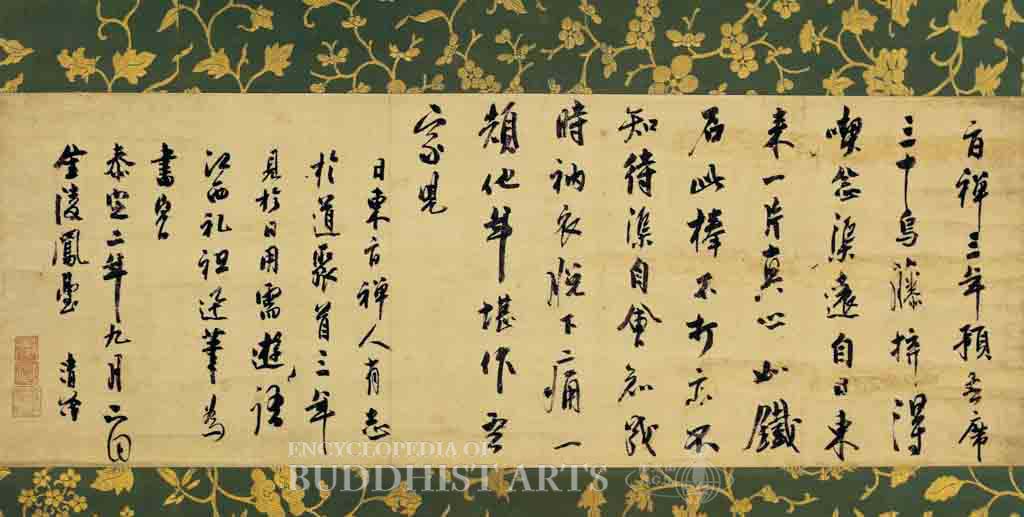
Farewell Verses for Betsugen Enshi
Ink on paper
Farewell Verses for Betsugen Enshi
CHINA; Yuan dynasty
These verses were written by Master Gulin Qingmao, a Chan monk of the Yuan dynasty (1271–1368). According to the colophon, the scroll is dated to the year 1325. Betsugen Enshi came to China from Japan to study Buddhism, and was a disciple under Gulin for three years. Before Betsugen’s departure for Jiangxi, Gulin scripted these verses as a gift to him, in which he praised him for his determination in learning and trusted that he will be successful in his future endeavors. The work was listed as a National Treasure of Japan in 1952.
The characters of this calligraphy are distinct and separate, and the composition is clear and thorough. A strong stylistic influence from Mi Fu is seen in the swift and meandering brushstrokes, which resulted in a cursive script particularly articulate in terms of movement and energy.
Gulin Qingmao’s lay surname was Lin and he was also known as Mao Gulin. He was a monk of the Yuan dynasty from present day Yueqing, Zhejiang who was praised for his virtuous conduct and acclaimed for his calligraphic skills.
For more details, go to the Encyclopedia of Buddhist Arts: Calligraphy, page 74.
Cite this article:
author = Hsingyun and Youheng and Youlu and Pokorski, Stefanie and Mankuang and Edson, Gary,
booktitle = {Encyclopedia of Buddhist Arts: Calligraphy },
pages = 74,
title = {{Farewell Verses for Betsugen Enshi}},
volume = 17,
year = {2016}}