
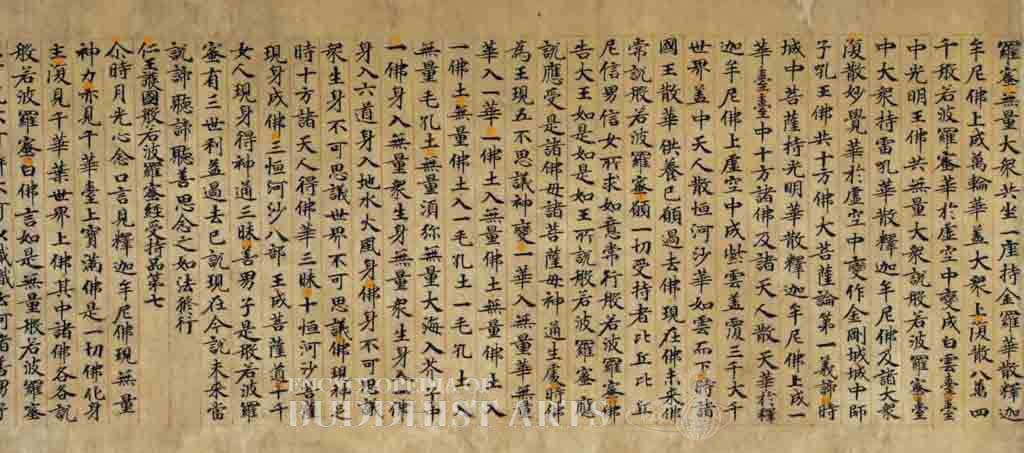
Dongda Temple Pagodas: Benevolent King Sutra (detail)
Ink on paper
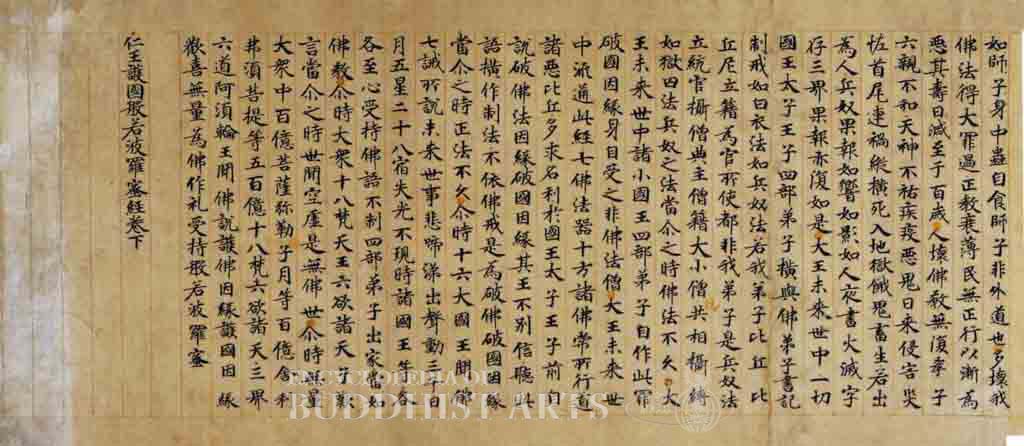
Dongda Temple Pagodas: Benevolent King Sutra (left end section)
Dongda Temple Pagodas: Benevolent King Sutra
CHINA, Zhejiang, Wenzhou; Northern Song dynasty
This manuscript was excavated in 1956 from the east and west pagodas of Dongda Temple in Wenzhou, Zhejiang. The Benevolent King Sutra originated when several kings approached the Buddha for advice on good governance. The Buddha replied by emphasizing that one should persevere on the path to Buddhahood, and further elaborated on the causes, conditions, and merits of ruling and protecting a country. The Buddha also stated how one may benefit from practicing the teachings of the sutra by averting disasters and accruing merit. This sutra is often regarded as the one of the three important scriptures of protecting a nation, the other two being the Lotus Sutra and the Golden Light Sutra.
The calligraphic style of this piece resembles Tang dynasty (618–907) sutra manuscripts. The dense form of the characters is executed using a pointed brush tip and is wielded as well-rounded strokes with subtle articulations. Immense effort was invested in this work, as can be observed by the substantial and coordinated intermediary strokes. The character structure is concentrated, firm, and robust. Overall, this manuscript can be considered a commendable work of art.
For more details, go to the Encyclopedia of Buddhist Arts: Calligraphy, page 64.
Cite this article:
author = Hsingyun and Youheng and Youlu and Pokorski, Stefanie and Mankuang and Edson, Gary,
booktitle = {Encyclopedia of Buddhist Arts: Calligraphy },
pages = 64,
title = {{Dongda Temple Pagodas: Benevolent King Sutra}},
volume = 17,
year = {2016}}