
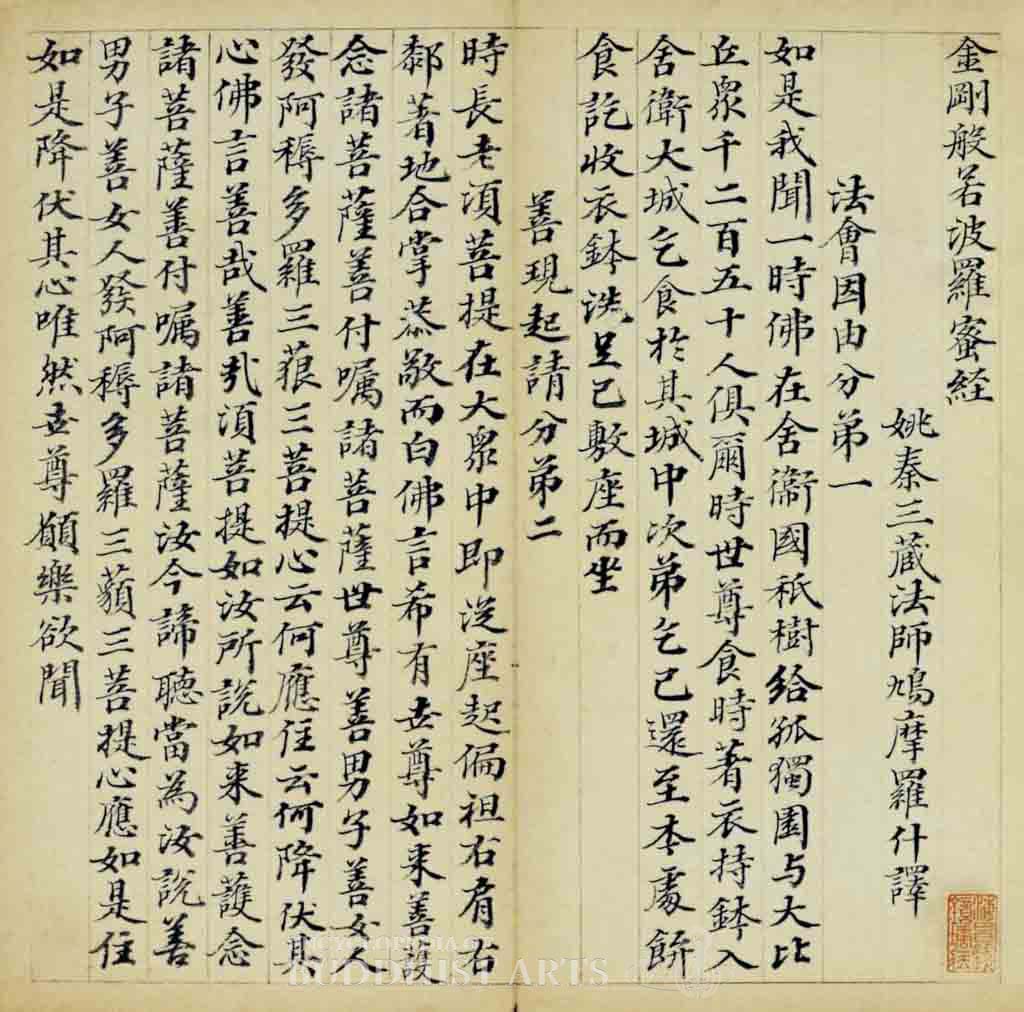
Diamond Sutra (right end section)
Ink on paper
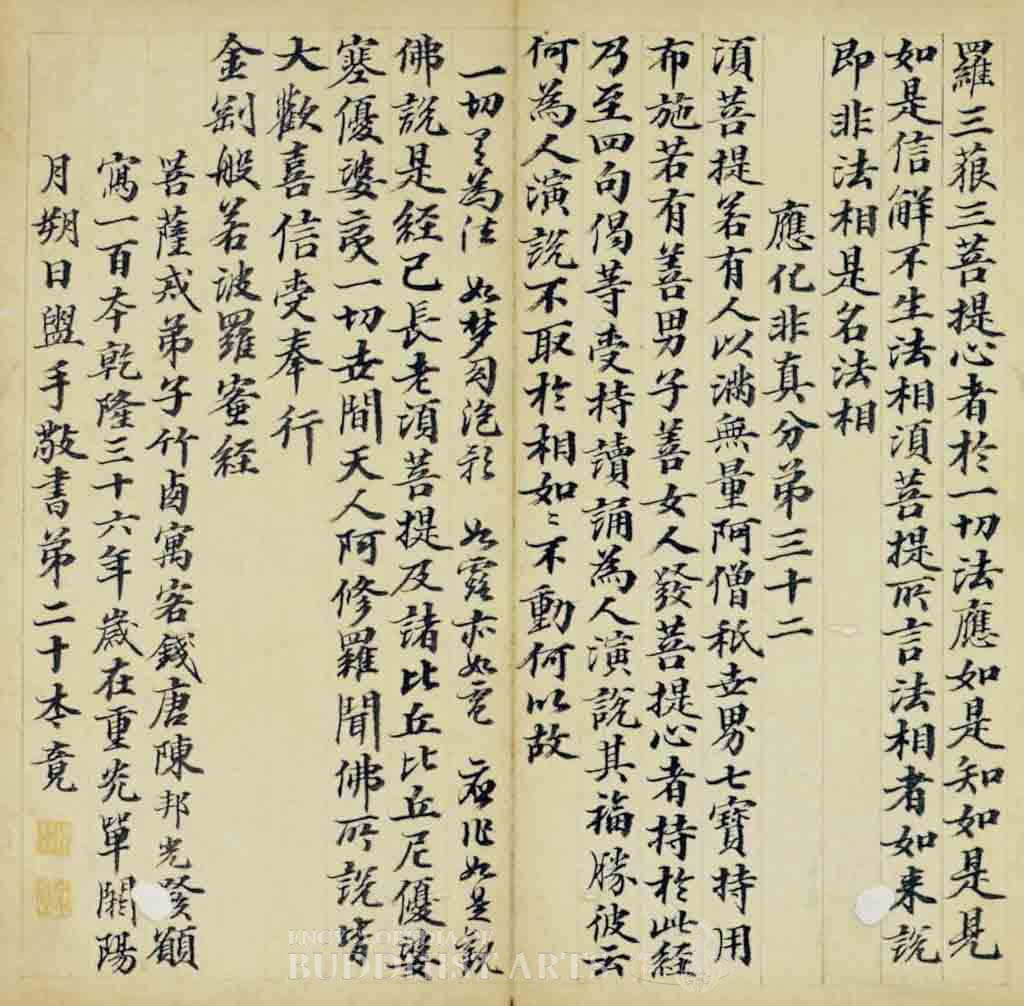
Diamond Sutra (left end section)
Diamond Sutra
CHINA; Qing dynasty
It can be gathered from the colophon that the copyist, Chen Bangguang, was a Buddhist disciple who had undertaken the Bodhisattva vows. Chen made a resolution to copy the Diamond Sutra a hundred times, and this work was his 20th copy, completed in 1771. The Diamond Sutra emphasizes non-abiding and the illusory concept of self in its teachings. Historically, it has been a preferred sutra text for transcription.
Beginning with running and regular scripts, strokes tend to hasten towards full cursive at times, which results in a slightly unkempt look compared to the neat regular scripts that typify most sutra copies. Nevertheless, the brushwork is precise and energetically delivered. This vibrant and spirited touch provides a rare break from the usually restrained style of sutra scrolls.
For more details, go to the Encyclopedia of Buddhist Arts: Calligraphy, page 59.
Cite this article:
author = Hsingyun and Youheng and Youlu and Pokorski, Stefanie and Mankuang and Edson, Gary,
booktitle = {Encyclopedia of Buddhist Arts: Calligraphy },
pages = 59,
title = {{Diamond Sutra}},
volume = 17,
year = {2016}}