
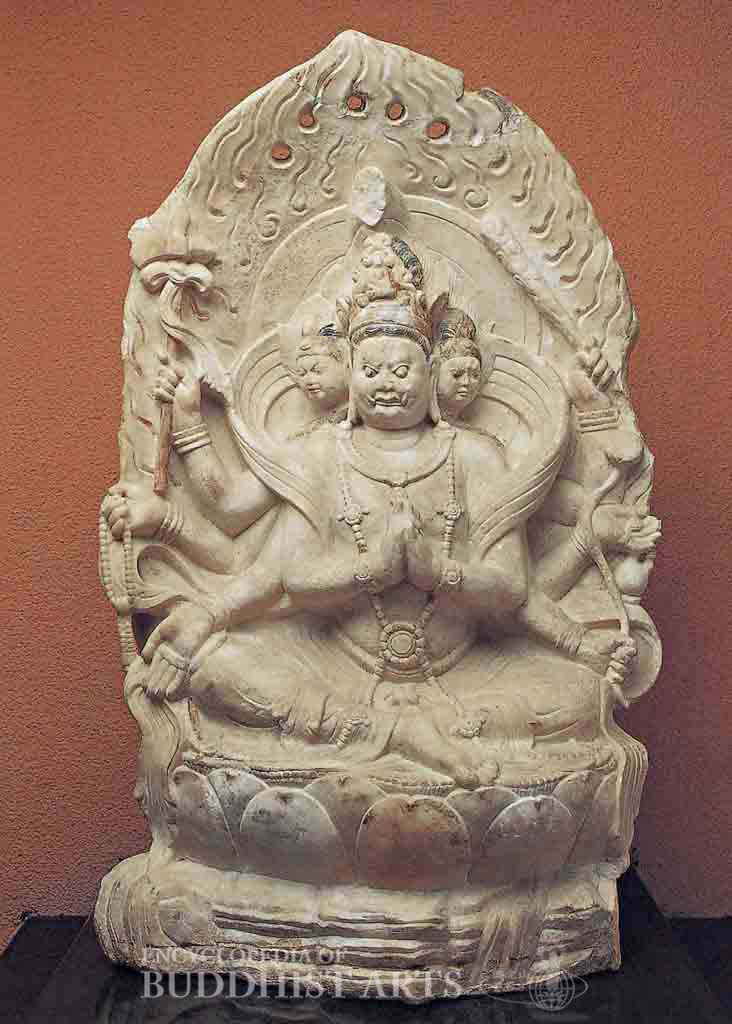
Anguo Temple: Hayagriva
Marble
Anguo Temple: Hayagriva
CHINA, Shaanxi, Xi’an; Tang dynasty
The sculpture was unearthed from Anguo Temple in 1959 and depicts a three-headed Hayagriva with eight arms. The head in the center wears a tall headdress that has a Buddha image in front. Unlike the other two heads, it has a wrathful visage with bulging eyes and protruding fangs. A floating stole sweeps from behind the head to wind about the foremost arms, which are held in the anjali (reverence) mudra. A variety of objects are held in the other hands, including a long-stalked lotus bud, a vase, and a club on the right hands; a whisk, prayer beads, and varada (wish-granting) mudra in the left hands. The deity wears elaborate jewelry and sits cross-legged on a lotus blossom. The broken feature on the nimbus may have been Hayagriva’s main attribute, a horse’s head. Surrounding him is a flaming mandorla.
For more details, go to the Encyclopedia of Buddhist Arts: Sculpture A-F, page 49.
Cite this article:
author = Hsingyun and Youheng and Lovelock, Yann and Chou, Yuan and Huntington, Susan and Edson, Gary and Neather, Robert,
booktitle = {Encyclopedia of Buddhist Arts: Sculpture A-F},
pages = 49,
title = {{Anguo Temple: Hayagriva}},
volume = 10,
year = {2016}}