
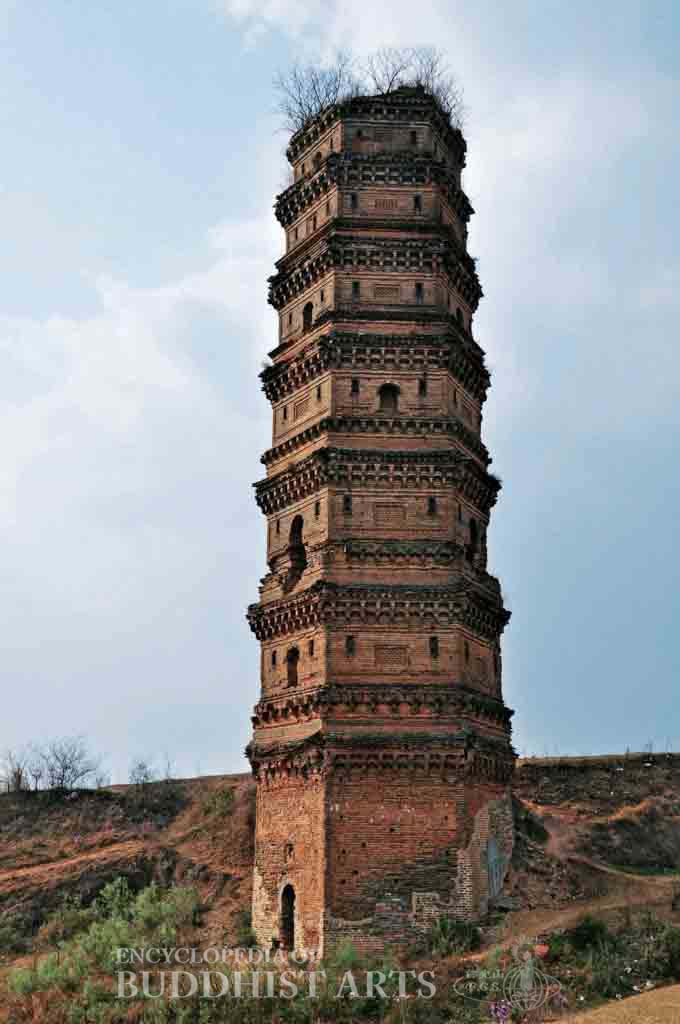
Bozi Pagoda
Bozi Pagoda
CHINA, Hubei, Huanggang
According to the local gazetteer, the construction of the pagoda was overseen by Chan Master Xuying in 783 during the Tang dynasty. The pagoda was nine stories high and had an iron roof shaped like an inverted bowl. The structure has been repaired a number of times. It was listed as a National Cultural Heritage Site in 2006.
The seven-story, hexagonal, brick pagoda is 34.7 m high. The platform base is 2 m high and stands on a slope. An arched doorway is located on the south side of the first story. From the second story upwards, the doors and windows are unevenly distributed. The pagoda displays many styles of windows, such as vertical bars, lattice patterns, and cell patterns. Small niches with Buddha images are located on either side of the doors and windows. The eaves are supported by imitation wooden bracket sets. The bases of the second, third, and fourth stories are underpinned by bracket sets, while lotus petals are found beneath the fifth and sixth stories. Inside there are staircases leading to the top of the pagoda.
The vertical bar windows and the carved lotus petals supporting the bases of the stories were styles made popular during the Tang dynasty (618–907). On the other hand, the cell-pattern windows were mostly popular during the Five Dynasties period (907–960).
For more details, go to the Encyclopedia of Buddhist Arts: Architecture A-F, page 97.
Cite this article:
author = Hsingyun and Youheng and Johnson, Peter and Mankuang and Lancaster, Lewis,
booktitle = {Encyclopedia of Buddhist Arts: Architecture A-F},
pages = 97,
title = {{Bozi Pagoda}},
volume = 1,
year = {2016}}