
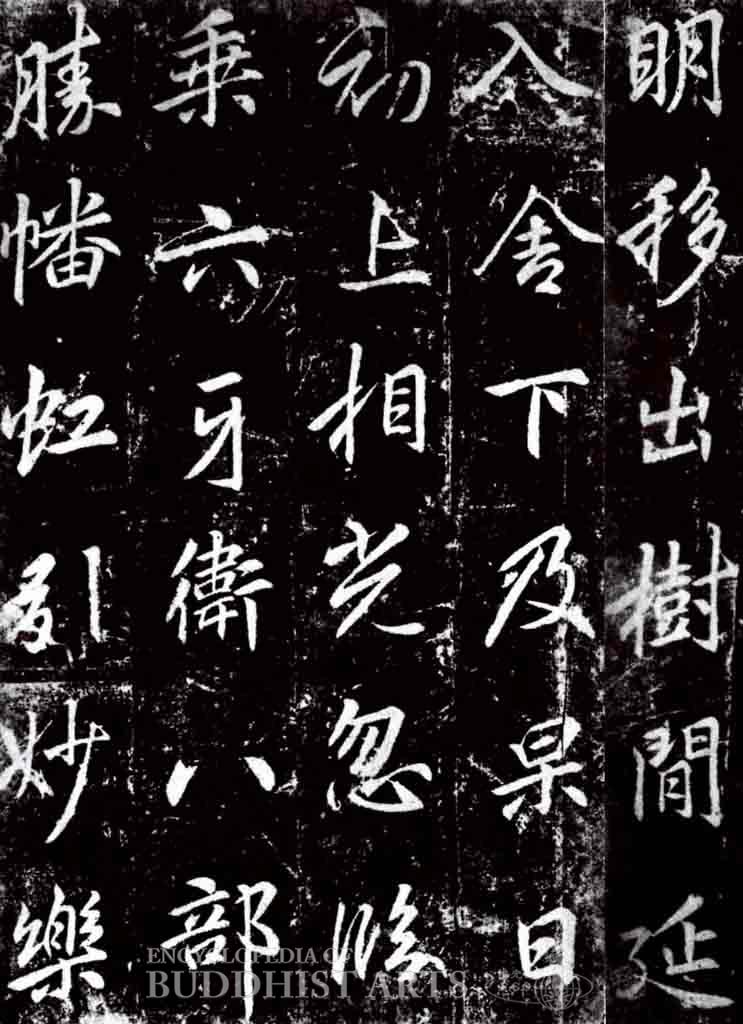
Fahua Temple: Stele
Rubbing
Fahua Temple: Stele
CHINA, Zhejiang, Shaoxing; Tang dynasty
This stele was originally located at Fahua Temple in Shaoxing, Zhejiang. The inscription was both composed and scripted by Tang dynasty (618–907) calligrapher Li Yong. The original stele no longer exists, and only one rubbing remains from the Song dynasty (960–1279). He Shaoji of the Qing dynasty (1644–1911) collected this rubbing. The stele describes how the Eastern Jin (317–420) monk Tanyi was inspired by the manifestation of Samantabhadra Bodhisattva while reciting the Lotus Sutra. It also details the history of building Fahua Temple.
The stele employed broad brushstrokes with a strong structure in smooth, flowing forms. Characters appearing wide and expanding are canted to the left. This work, though having similarities with the Stele of Lushan Temple, lacks the same characteristic stiffness. Li Yong advocated against copy work as it impedes learning and creativity. He said, “He who follows me fails, he who mimics me is plebeian.”
Li Yong, also known as Tai He, was a calligrapher from Jiangdu (present day Yangzhou). Skilled in essay writing and calligraphy, he was famous for his clerical, running, and cursive scripts.
For more details, go to the Encyclopedia of Buddhist Arts: Calligraphy, page 73.
Cite this article:
author = Hsingyun and Youheng and Youlu and Pokorski, Stefanie and Mankuang and Edson, Gary,
booktitle = {Encyclopedia of Buddhist Arts: Calligraphy },
pages = 73,
title = {{Fahua Temple: Stele}},
volume = 17,
year = {2016}}