
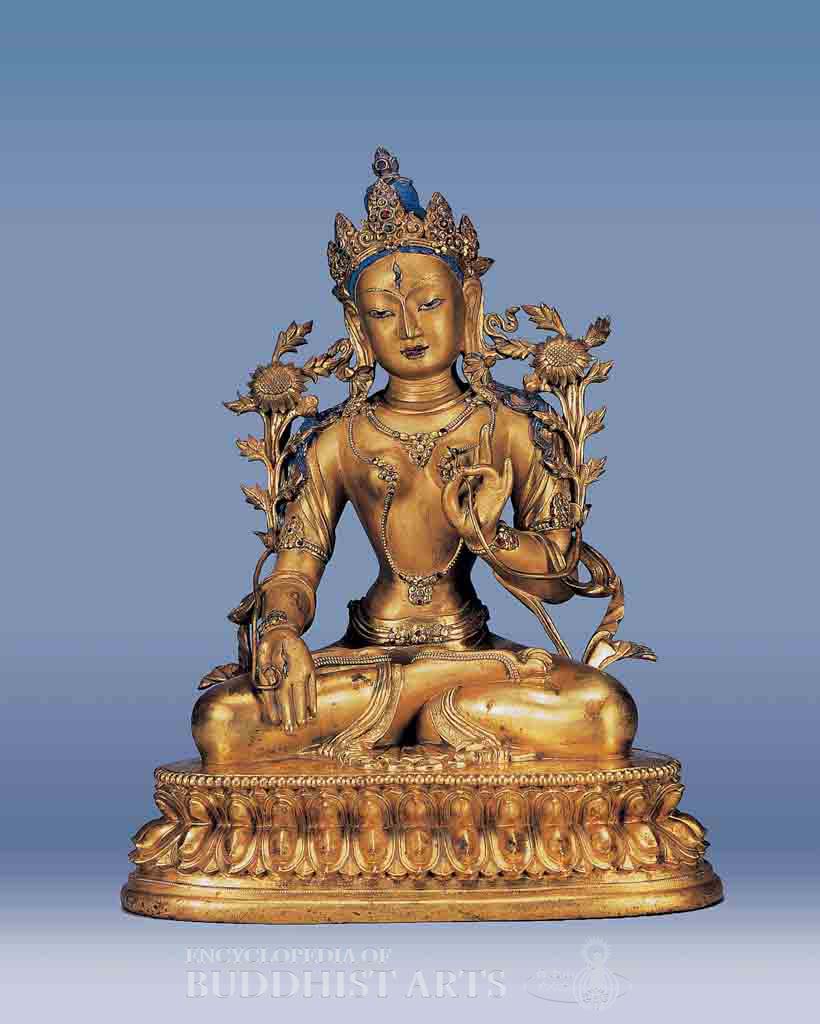
Chengde Eight Outlying Temples: White Tara
Gilt copper alloy
Chengde Eight Outlying Temples: White Tara
CHINA, Hebei, Chengde; Qing dynasty
The White Tara is seated in full lotus position on a double lotus base in this 17th to 18th century depiction. The head is inclined to one side and a five-leaf crown surrounds the usnisa that is tipped with a jewel. The figure is in her seven-eyed form with vertical compassionate eyes on the brow, palms and feet. The right hand is in varada (wish-granting) mudra while the left hand lifts to hold a lotus stalk that flowers at shoulder height, balanced by another on the other shoulder. The figure’s body is adorned with jeweled ornaments. The sculpture was created in the Khalkha Mongolian style of Zanabanar.
For more details, go to the Encyclopedia of Buddhist Arts: Sculpture A-F, page 241.
Cite this article:
Hsingyun, et al. "Chengde Eight Outlying Temples: White Tara." Encyclopedia of Buddhist Arts: Sculpture A-F, vol. 10, 2016, pp. 241.
Hsingyun, Youheng, Yann Lovelock, Yuan Chou, Susan Huntington, Gary Edson, and Robert Neather. 2016. "Chengde Eight Outlying Temples: White Tara" In Encyclopedia of Buddhist Arts: Sculpture A-F, 10:241.
Hsingyun, Youheng, Lovelock, Y., Chou, Y., Huntington, S., Edson, G., & Neather, R.. (2016). Chengde Eight Outlying Temples: White Tara. In Encyclopedia of Buddhist Arts: Sculpture A-F (Vol. 10, pp. 241).
@misc{Hsingyun2016,
author = Hsingyun and Youheng and Lovelock, Yann and Chou, Yuan and Huntington, Susan and Edson, Gary and Neather, Robert,
booktitle = {Encyclopedia of Buddhist Arts: Sculpture A-F},
pages = 241,
title = {{Chengde Eight Outlying Temples: White Tara}},
volume = 10,
year = {2016}}
author = Hsingyun and Youheng and Lovelock, Yann and Chou, Yuan and Huntington, Susan and Edson, Gary and Neather, Robert,
booktitle = {Encyclopedia of Buddhist Arts: Sculpture A-F},
pages = 241,
title = {{Chengde Eight Outlying Temples: White Tara}},
volume = 10,
year = {2016}}