
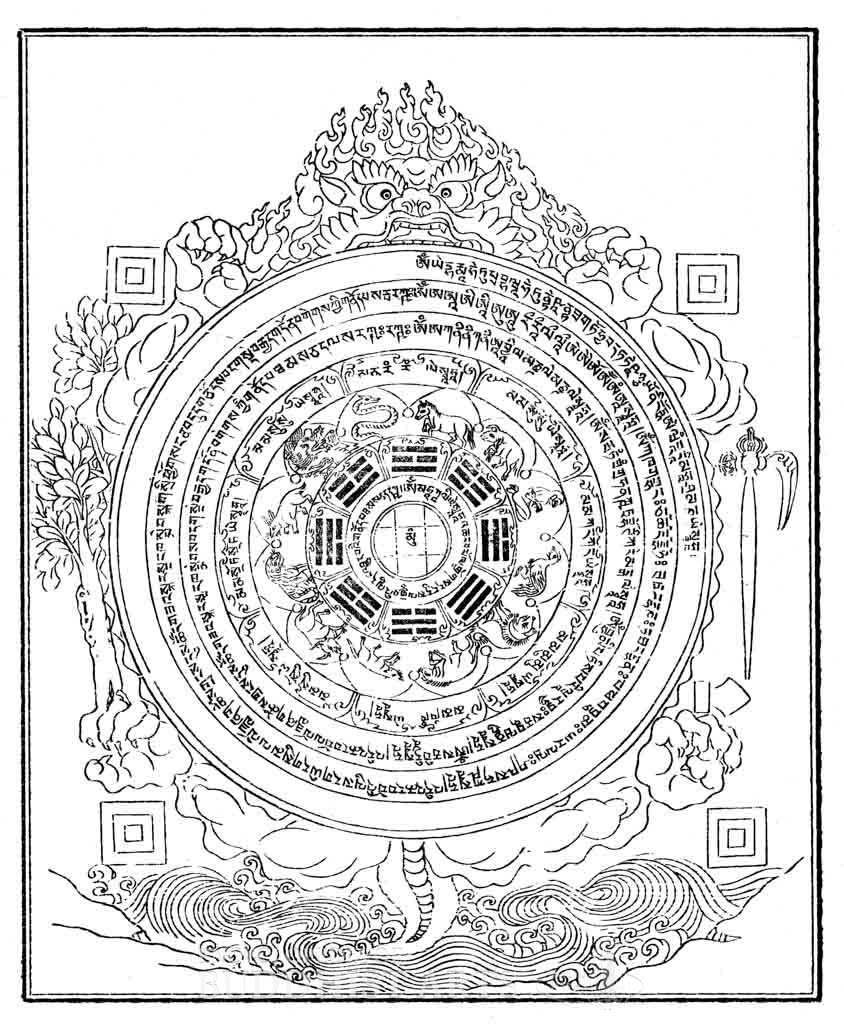
Yonghe Temple: Wheel of Rebirth
Print on paper
Yonghe Temple: Wheel of Rebirth
CHINA, Beijing; Qing dynasty
This diagram of cyclic existence, known in Tibetan as “sipe khorlo” (depiction of the world), dates from the 19th century. Yama, lord of death, grips the wheel between his clawed hands and feet. The nine palaces are symbolically depicted in the center. Moving outwards, there is a small ring of Tibetan script. The thick lines in the next ring are the Bagua (Daoist eight diagrams), symbols for the fundamental elements of reality. Next, there are depictions of the Twelve Chinese Zodiac Animals. The rest of the wheel is filled with a mantra written in Tibetan that is said to protect against disasters. Differing from typical illustrations of the wheel of rebirth, the print is a unique integration of various cosmological concepts from different belief systems.
For more details, go to the Encyclopedia of Buddhist Arts: Painting P-Z, page 1050.
Cite this article:
author = Hsingyun and Youheng and Youlu and Wilson, Graham and Manho and Mankuang and Huntington, Susan,
booktitle = {Encyclopedia of Buddhist Arts: Painting P-Z},
pages = 1050,
title = {{Yonghe Temple: Wheel of Rebirth}},
volume = 16,
year = {2016}}