
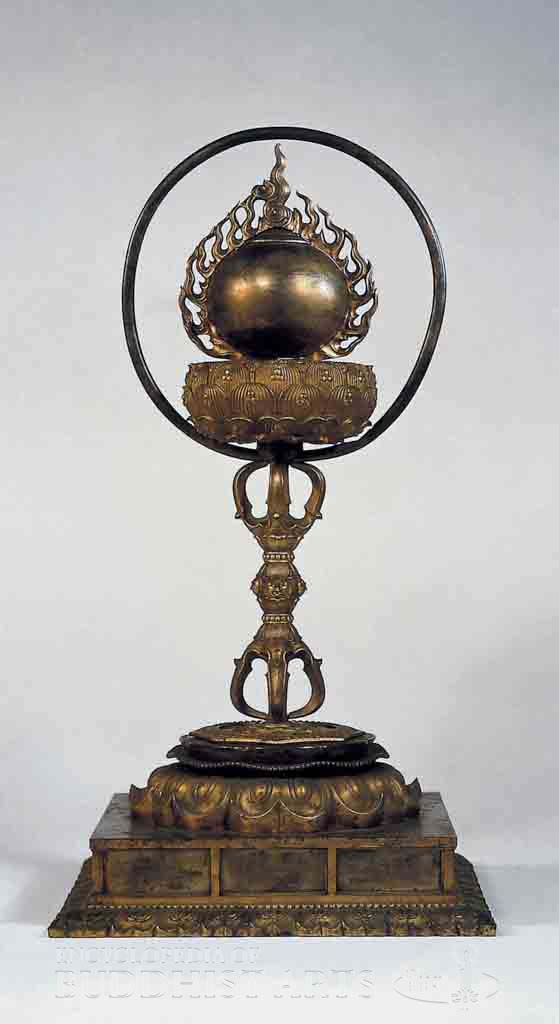
Reliquary
Gilt copper alloy and wood
金銅舍利具
日本
日本十三世紀之作。飛鳥(538~645)至白鳳(645~710)時代,舍利多置入容器內,再埋藏於地下作為堂塔礎石。奈良時代(710~794)以後則將舍利安奉於佛殿上,因而產生形式多樣的舍利容器。平安時代(794~1185)晚期出現莊嚴華麗的舍利具,其主流形式有五輪塔形、蓮花形及火焰寶珠形等,此作屬後者。一九八○年指定為日本重要文化財。
舍利具由基座、蓮台、法輪、五股金剛杵、蓮座及火焰形寶珠組成,銅鑄鎏金。底部為木質基座和蓮台,覆瓣蓮台上平置法輪及直立的五股金剛杵,如花莖般支撐蓮座。金剛杵握柄中央隆起,四面刻劃鬼目。杵頂上托一環,環內置多層仰蓮座,座上安放火焰紋寶珠形舍利具。造型簡潔,鑄工精細,顯現出鎌倉時代(1185~1333)卓越的金工技術。
For more details, go to the Encyclopedia of Buddhist Arts: Artifacts, page 275.
Cite this article:
Hsingyun, et al. "Reliquary." Encyclopedia of Buddhist Arts: Artifacts , vol. 18, 2016, pp. 275.
Hsingyun, Youheng, Youji, Stefanie Pokorski, Mankuang, and Wen Fan. 2016. "Reliquary" In Encyclopedia of Buddhist Arts: Artifacts , 18:275.
Hsingyun, Youheng, Youji, Pokorski, S., Mankuang, & Fan, W.. (2016). Reliquary. In Encyclopedia of Buddhist Arts: Artifacts (Vol. 18, pp. 275).
@misc{Hsingyun2016,
author = Hsingyun and Youheng and Youji and Pokorski, Stefanie and Mankuang and Fan, Wen,
booktitle = {Encyclopedia of Buddhist Arts: Artifacts },
pages = 275,
title = {{Reliquary}},
volume = 18,
year = {2016}}
author = Hsingyun and Youheng and Youji and Pokorski, Stefanie and Mankuang and Fan, Wen,
booktitle = {Encyclopedia of Buddhist Arts: Artifacts },
pages = 275,
title = {{Reliquary}},
volume = 18,
year = {2016}}