
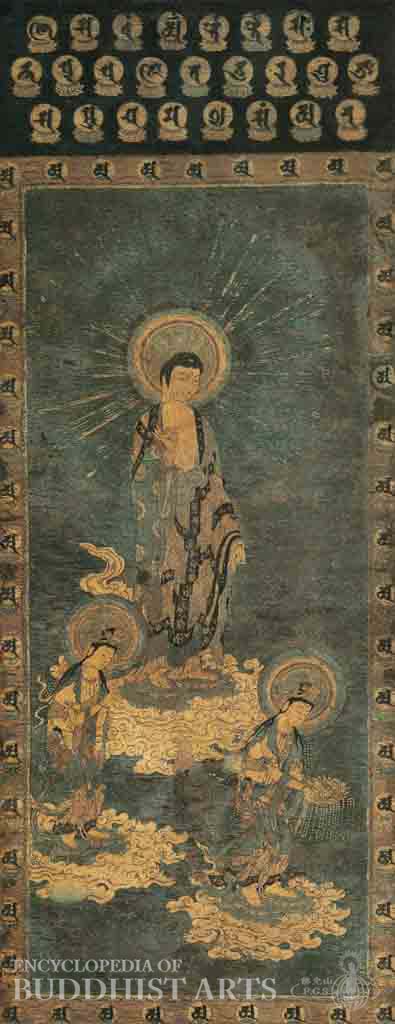
Hogonji Temple: Embroidery of Amitabha Buddha
Silk
刺繡阿彌陀佛來迎圖
日本
刺繡佛菩薩的圖像,又稱繡佛、繡像、繡帳。印度、西域等地自古即有刺繡佛像,約於苻秦時代(351~394)傳入中國,至南朝齊(479~502)以後,繡像之風盛行,並傳至日本。圖以平織絹帛為地,採多種彩線繡成,表現佛菩薩來迎的場面。一九○○年指定為日本重要文化財。
主尊阿彌陀佛及二脇侍菩薩皆立於祥雲上。阿彌陀佛略微側身作來迎狀,頭部放出毫光。畫面右前方菩薩手捧蓮花,後者合掌作禮,呈迎接往生者之姿。上方三排橫列圓相分別繡入二十五位菩薩之梵字,四周邊框圓相中則是阿彌陀佛四十八願之梵字。針法簡練,色調柔和,繡面細緻,纖毫畢現,富有質感。
For more details, go to the Encyclopedia of Buddhist Arts: Artifacts, page 123.
Cite this article:
Hsingyun, et al. "Hogonji Temple: Embroidery of Amitabha Buddha." Encyclopedia of Buddhist Arts: Artifacts , vol. 18, 2016, pp. 123.
Hsingyun, Youheng, Youji, Stefanie Pokorski, Mankuang, and Wen Fan. 2016. "Hogonji Temple: Embroidery of Amitabha Buddha" In Encyclopedia of Buddhist Arts: Artifacts , 18:123.
Hsingyun, Youheng, Youji, Pokorski, S., Mankuang, & Fan, W.. (2016). Hogonji Temple: Embroidery of Amitabha Buddha. In Encyclopedia of Buddhist Arts: Artifacts (Vol. 18, pp. 123).
@misc{Hsingyun2016,
author = Hsingyun and Youheng and Youji and Pokorski, Stefanie and Mankuang and Fan, Wen,
booktitle = {Encyclopedia of Buddhist Arts: Artifacts },
pages = 123,
title = {{Hogonji Temple: Embroidery of Amitabha Buddha}},
volume = 18,
year = {2016}}
author = Hsingyun and Youheng and Youji and Pokorski, Stefanie and Mankuang and Fan, Wen,
booktitle = {Encyclopedia of Buddhist Arts: Artifacts },
pages = 123,
title = {{Hogonji Temple: Embroidery of Amitabha Buddha}},
volume = 18,
year = {2016}}