
Detachment from Appearances
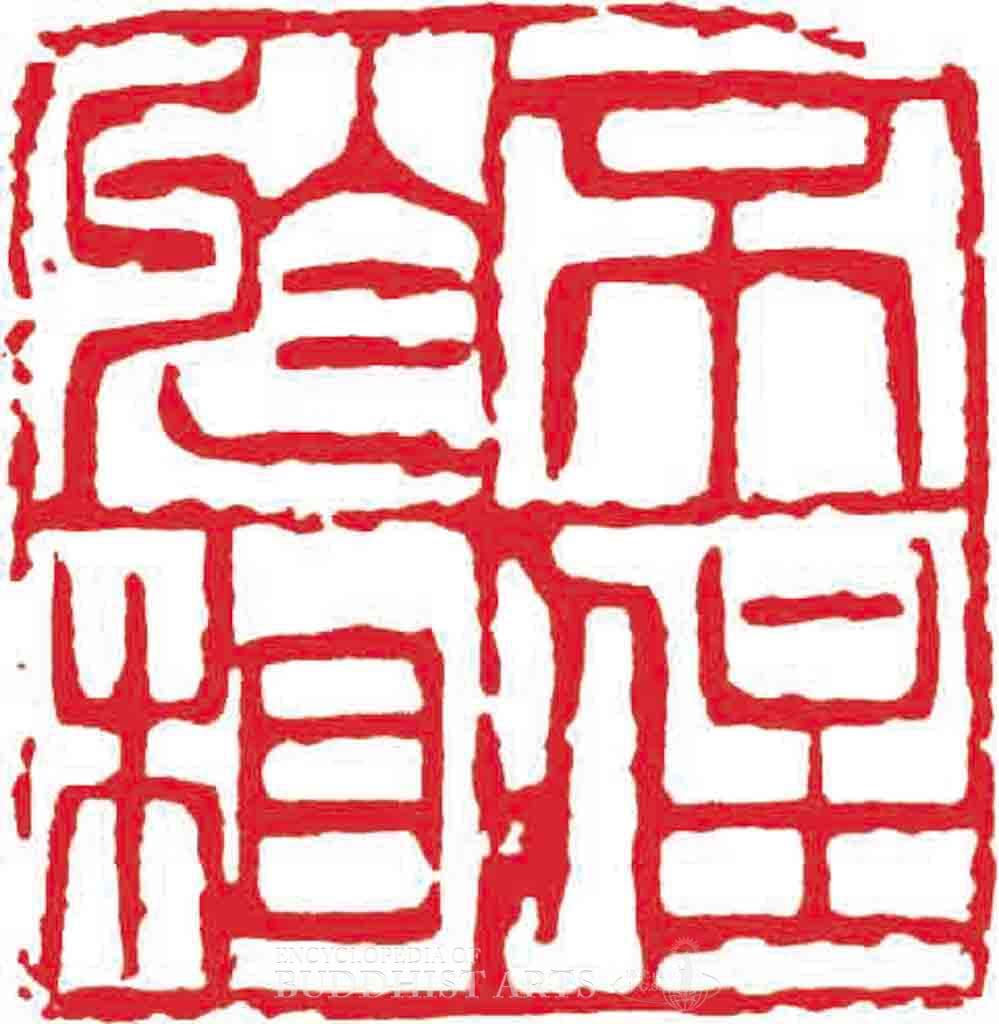
Red-character square seal
不住於相 李大木
台灣
「不住於相」出自《金剛經》:「菩薩應如是布施,不住於相。」說明菩薩布施應無所住,不可執著於相上的布施。
此印生動活潑,田字框之界格似乎是信手拈來,斑駁自然的線條與恰到好處的破邊,有漢封泥之古趣;所用體勢方圓自適,筆畫輕重有度,勁挺有力。刀勢內蘊,清雅恬靜,脈絡牽連,意趣高邈,全印呈和諧勻稱之貌。
李大木名獨,字大木,別署獨翁。山東煙台牟平人。擅長水墨繪畫與書法、篆刻,治印心折於吳昌碩、齊白石的創作風貌,尤其欽佩齊白石的豪邁氣勢,遂以為師範,並融會秦漢金石文字,終能自成一格。一九六一年與王壯為、王北岳、曾紹杰等人,籌組「海嶠印集」,對臺灣篆刻藝術的發展具有推動作用。
For more details, go to the Encyclopedia of Buddhist Arts: Calligraphy, page 294.
Cite this article:
Hsingyun, et al. "Detachment from Appearances." Encyclopedia of Buddhist Arts: Calligraphy , vol. 17, 2016, pp. 294.
Hsingyun, Youheng, Youlu, Stefanie Pokorski, Mankuang, and Gary Edson. 2016. "Detachment from Appearances" In Encyclopedia of Buddhist Arts: Calligraphy , 17:294.
Hsingyun, Youheng, Youlu, Pokorski, S., Mankuang, & Edson, G.. (2016). Detachment from Appearances. In Encyclopedia of Buddhist Arts: Calligraphy (Vol. 17, pp. 294).
@misc{Hsingyun2016,
author = Hsingyun and Youheng and Youlu and Pokorski, Stefanie and Mankuang and Edson, Gary,
booktitle = {Encyclopedia of Buddhist Arts: Calligraphy },
pages = 294,
title = {{Detachment from Appearances}},
volume = 17,
year = {2016}}
author = Hsingyun and Youheng and Youlu and Pokorski, Stefanie and Mankuang and Edson, Gary,
booktitle = {Encyclopedia of Buddhist Arts: Calligraphy },
pages = 294,
title = {{Detachment from Appearances}},
volume = 17,
year = {2016}}