
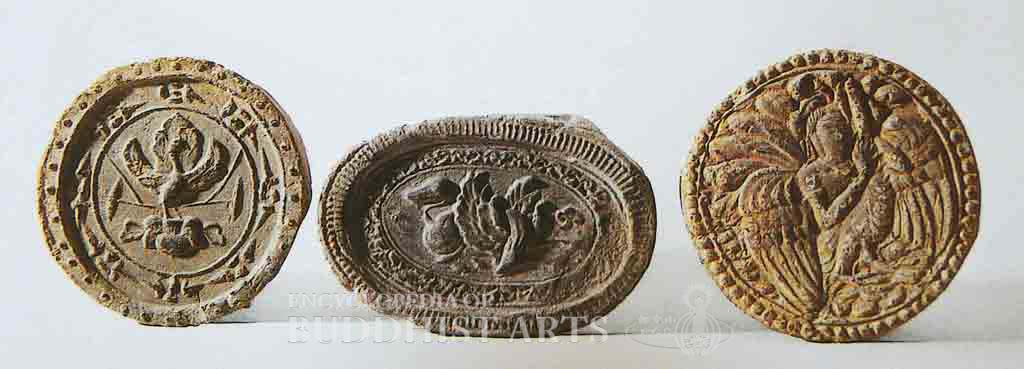
Hwangnyongsa Temple: Tile Caps
Earthenware
陶瓦當
韓國慶尚北道慶州市皇龍寺遺址出土
韓國慶尚北道慶州市九黃洞皇龍寺遺址出土。三件瓦當紋飾各異,均具特色。圖右依次為迦陵頻伽、異獸及朱雀紋,瓦當外圍以聯珠紋及直線為邊飾,徑高分別為14.5公分、9.7公分、14.5公分。
韓國建築使用瓦當約始於二、三世紀。統一新羅時期(668~935)八世紀國力增強,以海陸進行東西方文化交流,中國文化乃至希臘系統文化由此快速傳入朝鮮半島,對韓國藝術和文化留下深厚的影響。此三件瓦當的圖像,即是當時文化交流的實例佐證。
皇龍寺為統一新羅時期規模最大的寺院,其建築使用的瓦當,在品質和紋飾上非常考究,與眾不同由此可見。
For more details, go to the Encyclopedia of Buddhist Arts: Artifacts, page 133.
Cite this article:
Hsingyun, et al. "Hwangnyongsa Temple: Tile Caps." Encyclopedia of Buddhist Arts: Artifacts , vol. 18, 2016, pp. 133.
Hsingyun, Youheng, Youji, Stefanie Pokorski, Mankuang, and Wen Fan. 2016. "Hwangnyongsa Temple: Tile Caps" In Encyclopedia of Buddhist Arts: Artifacts , 18:133.
Hsingyun, Youheng, Youji, Pokorski, S., Mankuang, & Fan, W.. (2016). Hwangnyongsa Temple: Tile Caps. In Encyclopedia of Buddhist Arts: Artifacts (Vol. 18, pp. 133).
@misc{Hsingyun2016,
author = Hsingyun and Youheng and Youji and Pokorski, Stefanie and Mankuang and Fan, Wen,
booktitle = {Encyclopedia of Buddhist Arts: Artifacts },
pages = 133,
title = {{Hwangnyongsa Temple: Tile Caps}},
volume = 18,
year = {2016}}
author = Hsingyun and Youheng and Youji and Pokorski, Stefanie and Mankuang and Fan, Wen,
booktitle = {Encyclopedia of Buddhist Arts: Artifacts },
pages = 133,
title = {{Hwangnyongsa Temple: Tile Caps}},
volume = 18,
year = {2016}}