
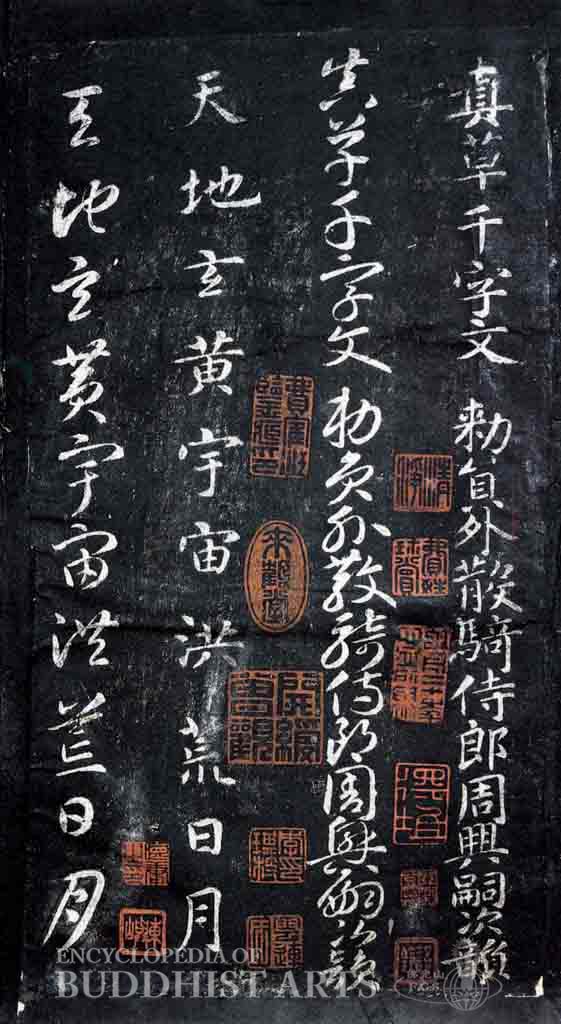
Stele of Thousand Character Classic in Regular and Cursive Scripts (detail)
Rubbing
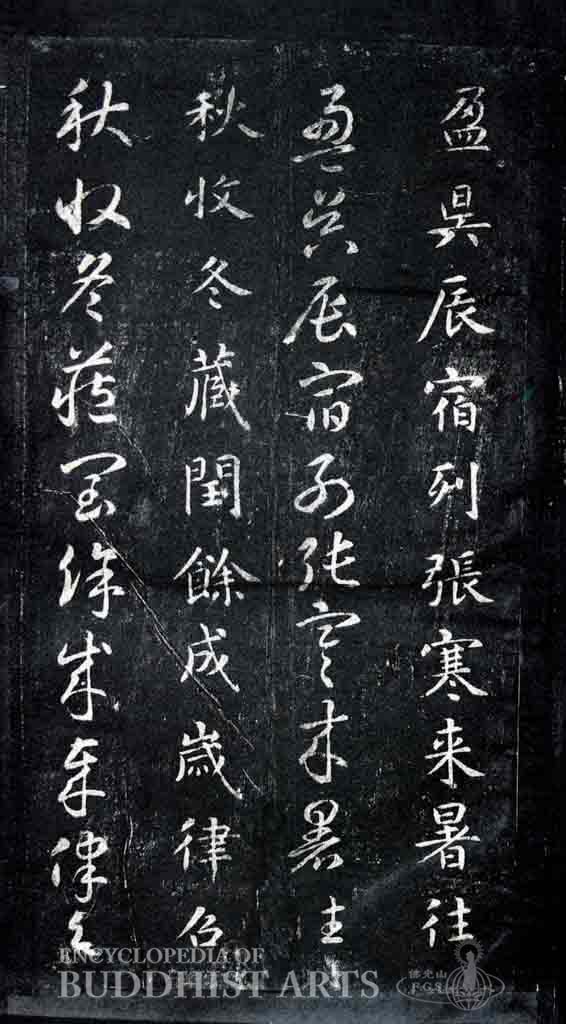
Stele of Thousand Character Classic in Regular and Cursive Scripts (right end section)
Rubbing
真草千字文碑 釋智永
日本
此帖乃智永禪師抄錄南朝梁(502~557)周興嗣所撰的《千字文》。每行十字,計二百零二行,以真書、草書隔行並列寫成,故名《真草千字文》。
此帖是《千字文》存世作品中最具影響者,開後代書家以《千字文》創作之風。現傳世者有墨跡、刻本兩種。墨跡為日本所藏,一九五三年指定為日本國寶;刻本是薛嗣昌據長安崔氏所藏真跡,於北宋大觀三年(1109)摹刻上石,今碑立於陝西西安碑林博物館,拓本則藏北京故宮博物院。
此帖得筆意於先祖王羲之,法度謹嚴,筆力精到。真書圓勁古雅,草書氣韻生動,含蓄而有意趣。宋(960~1279)蘇軾評為:「骨氣深穩,體兼眾妙,精能之至,返造疏淡」。
智永禪師俗姓王,名法極,法名智永。生卒年不詳。南朝陳(557~589)末至隋代(581~618)書法家,王羲之七世孫。工書法,尤以草書最負盛名。因求書者眾,門限(門檻)幾被踏破,遂裹以鐵片,故時人稱「鐵門限」。
參考釋文:真草千字文敕員外散騎侍郎周興嗣次韻/天地玄黃宇宙洪荒日月
盈昃辰宿列張寒來暑往/秋收冬藏閏餘成歲律呂
For more details, go to the Encyclopedia of Buddhist Arts: Calligraphy, page 241.
Cite this article:
Hsingyun, et al. "Stele of Thousand Character Classic in Regular and Cursive Scripts." Encyclopedia of Buddhist Arts: Calligraphy , vol. 17, 2016, pp. 241.
Hsingyun, Youheng, Youlu, Stefanie Pokorski, Mankuang, and Gary Edson. 2016. "Stele of Thousand Character Classic in Regular and Cursive Scripts" In Encyclopedia of Buddhist Arts: Calligraphy , 17:241.
Hsingyun, Youheng, Youlu, Pokorski, S., Mankuang, & Edson, G.. (2016). Stele of Thousand Character Classic in Regular and Cursive Scripts. In Encyclopedia of Buddhist Arts: Calligraphy (Vol. 17, pp. 241).
@misc{Hsingyun2016,
author = Hsingyun and Youheng and Youlu and Pokorski, Stefanie and Mankuang and Edson, Gary,
booktitle = {Encyclopedia of Buddhist Arts: Calligraphy },
pages = 241,
title = {{Stele of Thousand Character Classic in Regular and Cursive Scripts}},
volume = 17,
year = {2016}}
author = Hsingyun and Youheng and Youlu and Pokorski, Stefanie and Mankuang and Edson, Gary,
booktitle = {Encyclopedia of Buddhist Arts: Calligraphy },
pages = 241,
title = {{Stele of Thousand Character Classic in Regular and Cursive Scripts}},
volume = 17,
year = {2016}}