
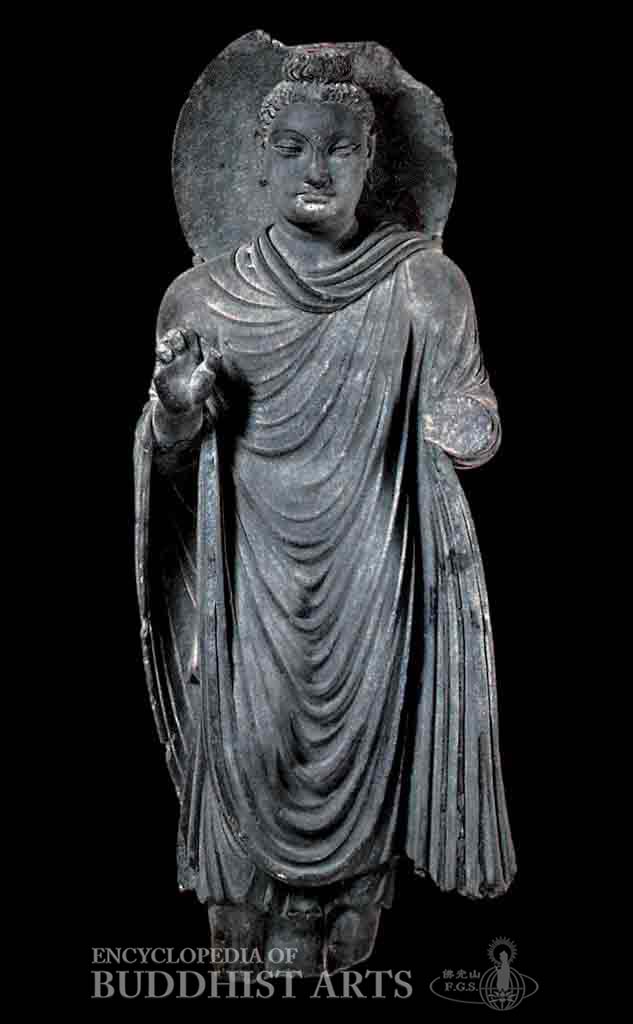
Standing Buddha
Schist
佛立像
巴基斯坦
與秣菟羅(Mathura)同期發展的犍陀羅佛教美術,產生了大量優秀的作品。犍陀羅地區曾為亞歷山大大帝(336~323 BCE在位)所占領,因此造像藝術融合了希臘、羅馬的風格,在佛教造像上得到鮮明的體現。此像即為典型作品之一。
該像站姿端正,帶素面頭光,波狀卷髮,高肉髻,大耳,眉間有白毫,雙目低垂,神情堅毅;兩臂屈起,左前臂斷損,右手抬起較高,掌心向前,手指殘。其卷髮、深目高鼻等雅利安人(Aryans)容貌特徵、厚重的袈裟襞褶以及身材比例,都異於秣菟羅,而具有希臘、羅馬藝術的特質。通肩袈裟紋路勻整,宛如穿著羅馬人的寬大長袍。
For more details, go to the Encyclopedia of Buddhist Arts: Sculpture St-Z, page 1150.
Cite this article:
Hsingyun, et al. "Standing Buddha." Encyclopedia of Buddhist Arts: Sculpture St-Z, vol. 13, 2016, pp. 1150.
Hsingyun, Youheng, Yann Lovelock, Yuan Chou, Susan Huntington, Gary Edson, and Robert Neather. 2016. "Standing Buddha" In Encyclopedia of Buddhist Arts: Sculpture St-Z, 13:1150.
Hsingyun, Youheng, Lovelock, Y., Chou, Y., Huntington, S., Edson, G., & Neather, R.. (2016). Standing Buddha. In Encyclopedia of Buddhist Arts: Sculpture St-Z (Vol. 13, pp. 1150).
@misc{Hsingyun2016,
author = Hsingyun and Youheng and Lovelock, Yann and Chou, Yuan and Huntington, Susan and Edson, Gary and Neather, Robert,
booktitle = {Encyclopedia of Buddhist Arts: Sculpture St-Z},
pages = 1150,
title = {{Standing Buddha}},
volume = 13,
year = {2016}}
author = Hsingyun and Youheng and Lovelock, Yann and Chou, Yuan and Huntington, Susan and Edson, Gary and Neather, Robert,
booktitle = {Encyclopedia of Buddhist Arts: Sculpture St-Z},
pages = 1150,
title = {{Standing Buddha}},
volume = 13,
year = {2016}}