
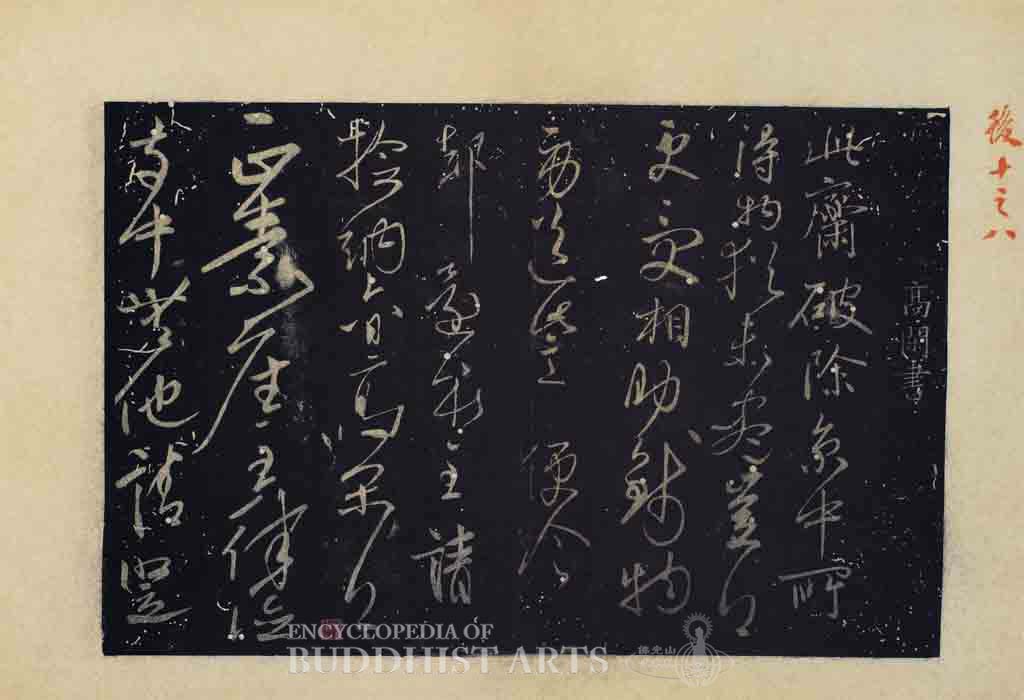
Ci Zhai Letter (detail)
Rubbing
此齋帖 釋高閑
中國
此作為高閑所寫的一封短札,見收於《絳帖》之中。所謂《絳帖》,乃是承續、增損《淳化閣帖》的製作,所以才有機會收入、保留所謂名人名臣的作品。
以草書論之,或守法謹慎如王羲之,或揮灑性情如懷素,便有今草與狂草之別。高閑承懷素遺緒,故用筆翻騰多變,自第一行以下速度漸快,首二字猶見楷行,後即以草書為之。然較之懷素,仍顯得較受單字的拘限,上下字呼應不強,大抵性情功力皆有所差距,才呈現這樣的面貌。
高閑為唐代(618~907)僧、草書名家,於當時即負有盛名。其名下尚有墨跡《千字文》殘卷存世,堪稱中唐時期(756~846)草書的代表。
參考釋文:此齋破除京中所/得物猶未盡豈得/更受相助錢物/勞送此意便令/卻還本至請/檢納六日高閑上
For more details, go to the Encyclopedia of Buddhist Arts: Calligraphy, page 33.
Cite this article:
Hsingyun, et al. "Ci Zhai Letter." Encyclopedia of Buddhist Arts: Calligraphy , vol. 17, 2016, pp. 33.
Hsingyun, Youheng, Youlu, Stefanie Pokorski, Mankuang, and Gary Edson. 2016. "Ci Zhai Letter" In Encyclopedia of Buddhist Arts: Calligraphy , 17:33.
Hsingyun, Youheng, Youlu, Pokorski, S., Mankuang, & Edson, G.. (2016). Ci Zhai Letter. In Encyclopedia of Buddhist Arts: Calligraphy (Vol. 17, pp. 33).
@misc{Hsingyun2016,
author = Hsingyun and Youheng and Youlu and Pokorski, Stefanie and Mankuang and Edson, Gary,
booktitle = {Encyclopedia of Buddhist Arts: Calligraphy },
pages = 33,
title = {{Ci Zhai Letter}},
volume = 17,
year = {2016}}
author = Hsingyun and Youheng and Youlu and Pokorski, Stefanie and Mankuang and Edson, Gary,
booktitle = {Encyclopedia of Buddhist Arts: Calligraphy },
pages = 33,
title = {{Ci Zhai Letter}},
volume = 17,
year = {2016}}