
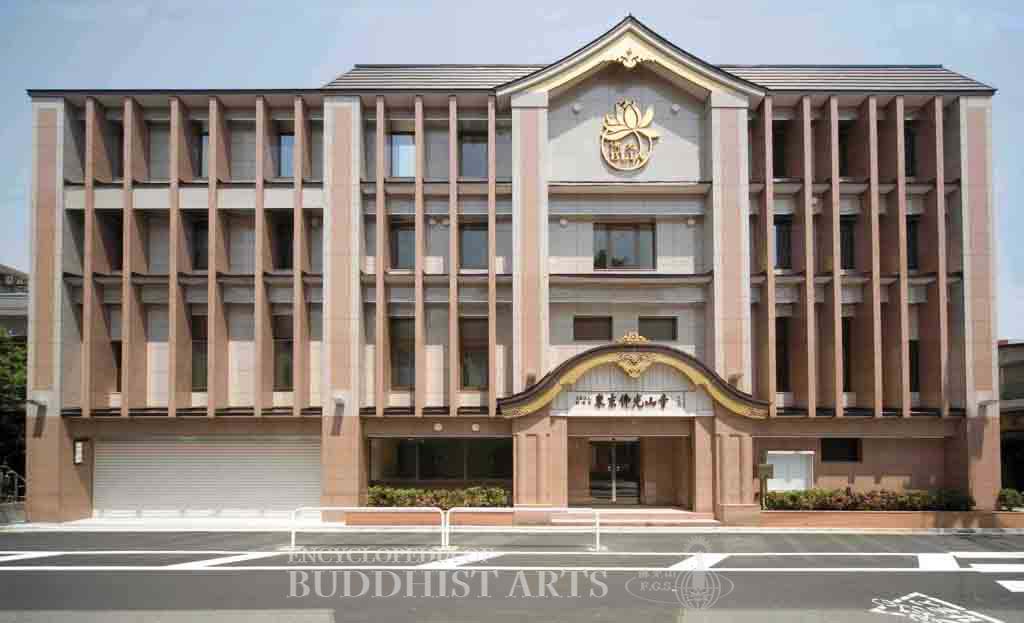
Fo Guang Shan Tokyo Temple
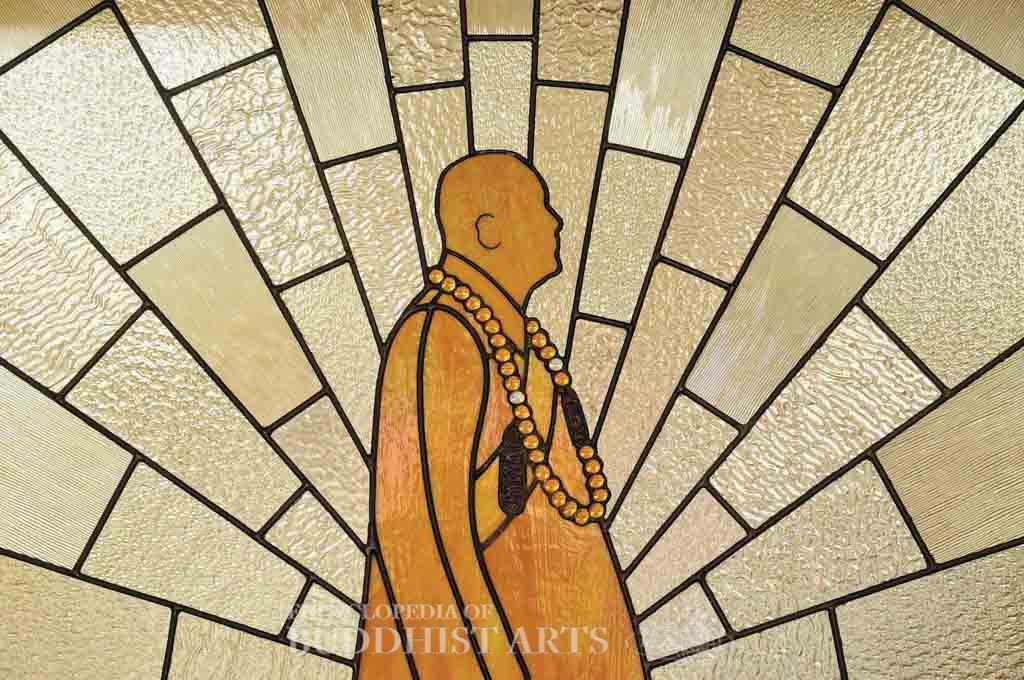
Fo Guang Shan Tokyo Temple: Glass Portrait of Master Hsing Yun
Fo Guang Shan Tokyo Temple
JAPAN, Tokyo
Also known as Tokyo Bukkozanji, the temple is one of the branch temples of Fo Guang Shan. The temple was established in 1993 and rebuilt between 2005 and 2007 following deterioration of the building.
The temple occupies an area of 389.5 sq m. The 10 m high temple building has four stories above ground and two basement levels. The main entrance is designed in traditional Japanese style with an undulating bargeboard. The first story consists of the reception hall and tea house, while the main hall is on the second story. The third and fourth stories house the monastic quarters. The two basement levels contain classrooms, meeting rooms, dining hall, and kitchen.
There is a stained glass portrait of Master Hsing Yun, founder of Fo Guang Shan, at the entrance. The main hall, also called the Tathagata Hall, contains a seated statue of Sakyamuni Buddha by the sculptor Weng Songshan. The statue is clothed in a golden robe and has a colorful flaming mandorla. The hands form the dhyana (meditation) mudra. The hall also contains a wall inscribed with the Heart Sutra, as well as a sculpture of the Buddha’s hand in glass, created by the artist Yang Huishan.
For more details, go to the Encyclopedia of Buddhist Arts: Architecture A-F, page 337.
Cite this article:
author = Hsingyun and Youheng and Johnson, Peter and Mankuang and Lancaster, Lewis,
booktitle = {Encyclopedia of Buddhist Arts: Architecture A-F},
pages = 337,
title = {{Fo Guang Shan Tokyo Temple}},
volume = 1,
year = {2016}}