
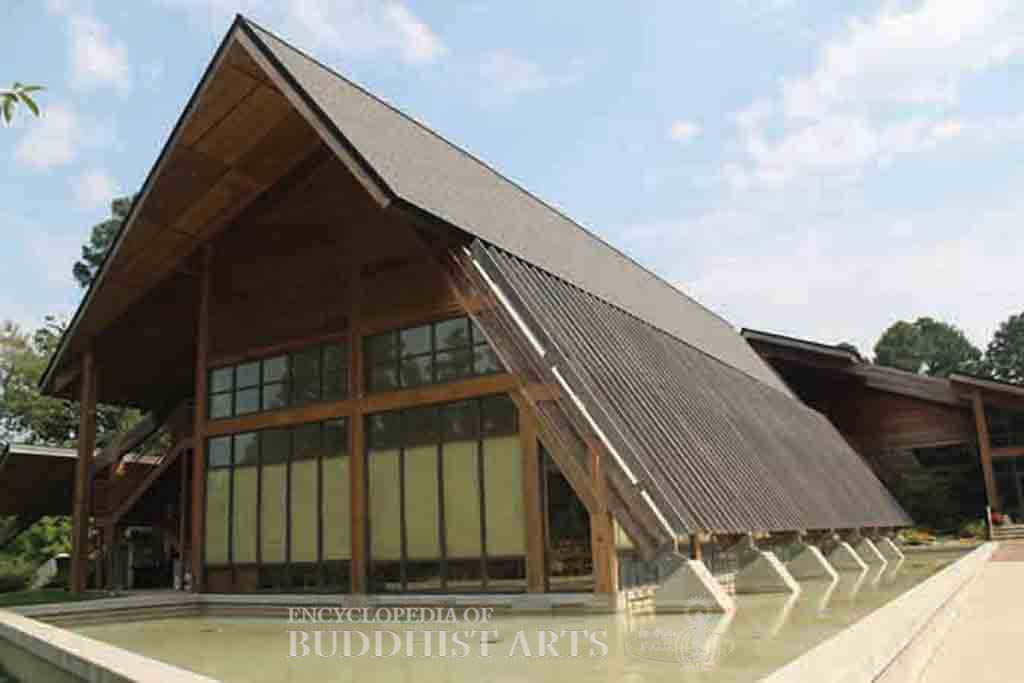
Fo Guang Shan North Carolina
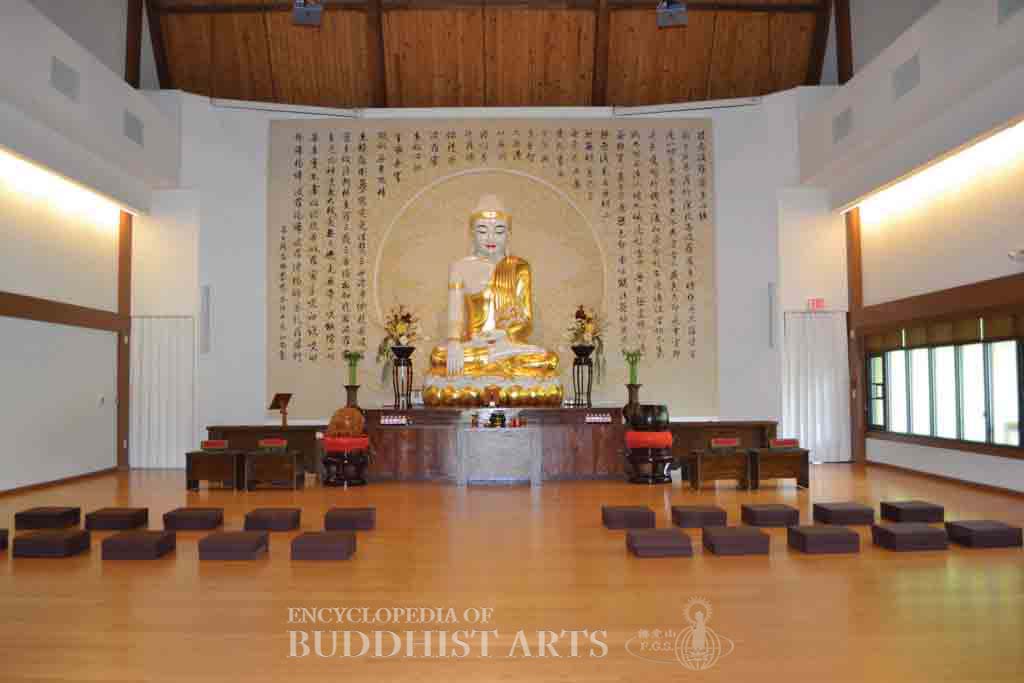
Fo Guang Shan North Carolina: Jade Buddha Hall (interior)
Fo Guang Shan North Carolina
USA, North Carolina, Raleigh
The temple was founded in 2000 by Fo Guang Shan International Buddhist Order following requests from the Buddha’s Light International Association in North Carolina. Construction took place between 2005 and 2010. It was designed by the architect Kris Yao, who made use of environmentally sustainable materials to build a modern temple that blends in with the locality.
The temple is almost 10 m high and sits on a 1.2 ha site. It consists of 1,645 sq m of usable floor area. It has an austere architectural form with the intention of expressing the spirit of Buddhism. There are two buildings connected by a corridor. The main building material is laminated timber, where the ends of the frame members are tied to a reinforced concrete foundation. The buildings are cladded with wood panels and asphalt tiles. The structures stand out as there is minimal finishing.
The temple contains the Jade Buddha Hall, meditation hall, multimedia library, dining hall, and classrooms. Over the entrance to the Jade Buddha Hall there is a horizontal inscribed board with the calligraphy of founder, Master Hsing Yun. Inside the hall, there is a jade statue of Sakyamuni Buddha seated in the lotus position with the Heart Sutra as a backdrop.
Apart from being a multi-functional Buddhist learning center for the nearby community, the temple is also a center for the local university’s interfaith curriculum, with the aim of localizing Buddhism.
For more details, go to the Encyclopedia of Buddhist Arts: Architecture A-F, page 331.
Cite this article:
author = Hsingyun and Youheng and Johnson, Peter and Mankuang and Lancaster, Lewis,
booktitle = {Encyclopedia of Buddhist Arts: Architecture A-F},
pages = 331,
title = {{Fo Guang Shan North Carolina}},
volume = 1,
year = {2016}}