

Kuda Caves: Cave 6
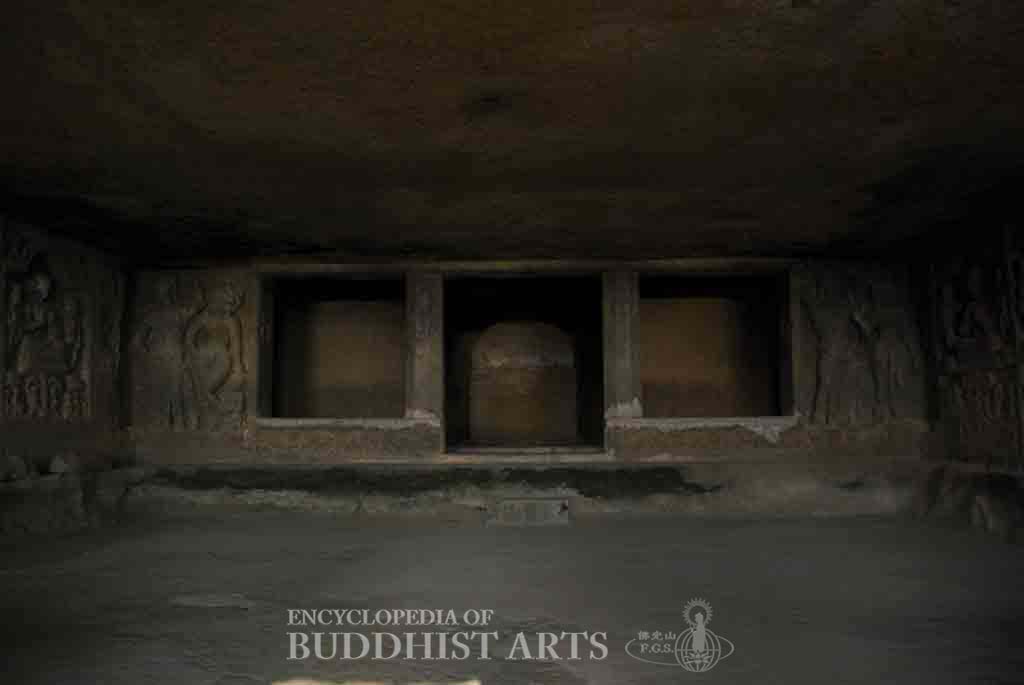
Kuda Caves: Cave 6

Kuda Caves: Cave 6 - Reliefs
Kuda Caves
INDIA, Maharashtra
These caves are located on the Konkan costal region, about 28 km east of Murud in Maharashtra. They were excavated on a southwest-facing slope located about 45 m to 60 m above sea level. The 26 caves are divided into 2 tiers, with Caves 1 to 15 on the lower tier and Caves 16 to 26 on the upper tier, which is 12 m higher. Dating from the 1st century BCE to the 3rd century CE, some of the caves were renovated around the 6th century with additions of Buddhist sculptures.
Most of the caves have a portico in front, each of which is lined with columns and a doorway that opens into the cave. Some of the caves contain windows to each side of the doorway. The exteriors of some of the caves also display carved remnants of artificial wooden architectural features. Five of the caves are caitya caves, and the rest are vihara caves, which were used by monks as living quarters. Most of the vihara caves are small and of a simple design. Cave 5 is the largest vihara cave with a square main hall measuring 10.5 m on each side. There are no cells in this cave but it contains platforms along the three inner walls.
Caves 1, 6, 9, 15, 21 are caitya caves. Each caitya cave enshrines a stupa with the exception of the unfinished Cave 21. The stupas are housed within the inner shrines at the rear and have cylindrical bases with few adornments. The upper section of each stupa is shaped like an inverted bowl, above which is a harmika that is attached to the ceiling.
Cave 6 is the main caitya cave. It has a portico at the front measuring 7.5 m by 2.3 m. The ceiling of the portico projects another 2.4 m out and is supported by an elephant sculpture on each side. The portico contains plain octagonal columns near the center and balustrades carved with geometric patterns on the sides. The left pilaster at the very end is decorated with Buddha niches on both the frontal and inner sides. The doorway into the cave is flanked by two large windows. The main hall inside the cave measures 8.8 m wide by 8.9 m deep. Similar to the design of the portico, the back wall of the main hall contains two plain octagonal columns with a balustrade on each side. Instead of geometric patterns, the balustrades are decorated with lively reliefs of animals and other figures. The doorway at the center of the back wall leads to the 7.1 m by 2.1 m antechamber. The antechamber has a small cell on its left end, and at the center of the back wall is another opening which leads to the inner shrine. The shrine is 4.7 m wide, 6.2 m deep, and 3.2 m high, and houses a plain stupa measuring 2.2 m in diameter.
The main hall of Cave 6 houses some of the most elaborate reliefs. On the left and right sides of the back wall are large reliefs of mithuna couples. Reliefs of Buddha niches cover the side walls. These Buddhas are seated on lotus thrones, some with legs crossed while others with legs pendent, and they form either the Dharmacakra (Dharma wheel) mudra or the dhyana (meditation) mudra. Many of the Buddhas are flanked by standing attendant Bodhisattvas, with apsaras flying above the niches. Below the lotus thrones of the large niches there are images of two nagas holding the stems of the lotus thrones, with kneeling figures to the sides. Most of these reliefs were carved in the late 6th century. Remnants of plaster and paint remain on the walls.
Most of the caves have inscriptions bearing the names of its donors and their positions. According to these inscriptions, the caves and their artworks were commissioned by monks, merchants, gardeners, writers, and other lay people.
For more details, go to the Encyclopedia of Buddhist Arts: Caves R-L, page 603.
Cite this article:
author = Hsingyun and Youheng and Johnson, Peter and Mankuang and Huntington, Susan and Edson, Gary and Neather, Robert,
booktitle = {Encyclopedia of Buddhist Arts: Caves R-L},
pages = 603,
title = {{Kuda Caves}},
volume = 6,
year = {2016}}