
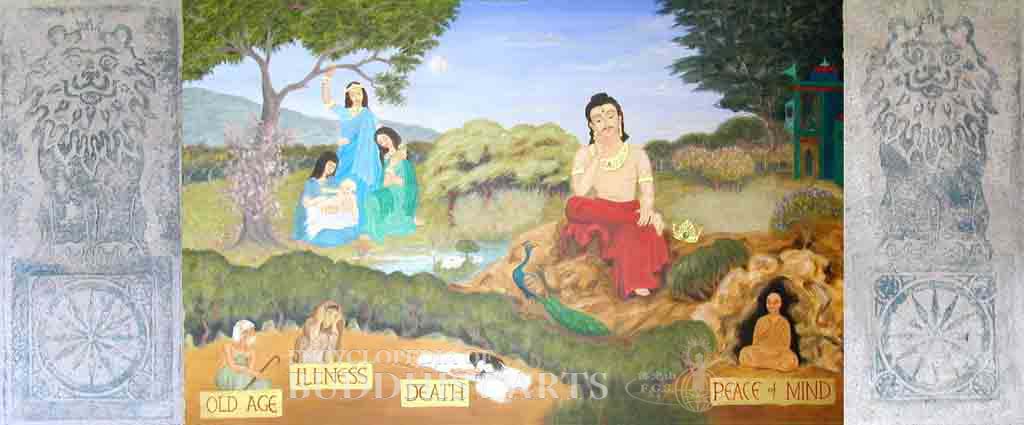
Thames Buddhist Vihara: Life of the Buddha - Four Encounters
Oil painting
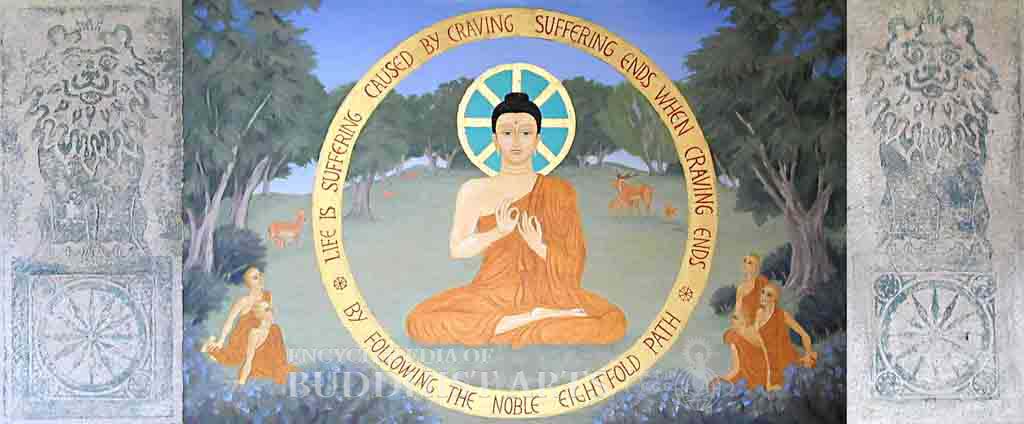
Thames Buddhist Vihara: Life of the Buddha - First Turning of the Dharma Wheel

Thames Buddhist Vihara: Life of the Buddha - Parinirvana

Thames Buddhist Vihara: Life of the Buddha - Dharma Teaching
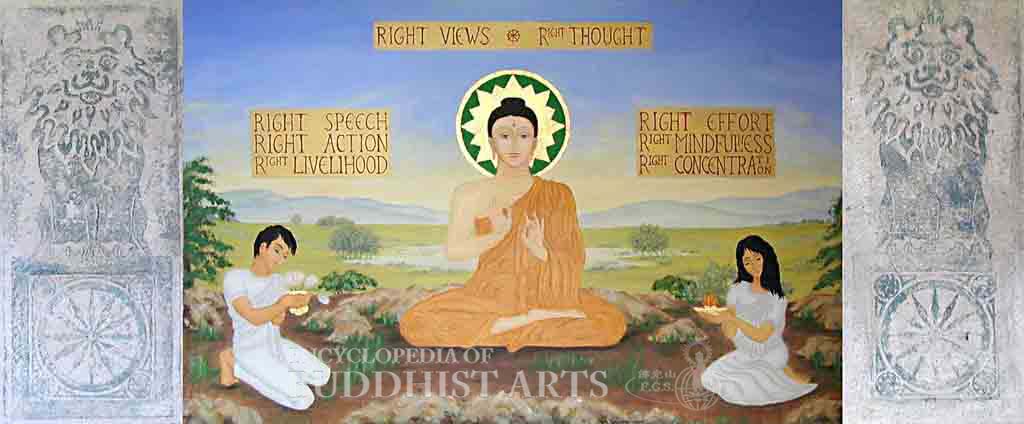
Thames Buddhist Vihara: Life of the Buddha - Eightfold Path

Thames Buddhist Vihara: Life of the Buddha - Path to Enlightenment
Thames Buddhist Vihara: Life of the Buddha
UNITED KINGDOM, London
These six scenes from the Life of the Buddha were painted in oils on wood panels and are each flanked by guardian lions printed in relief on handmade paper. The artist Martha Aitchison took two and a half years to complete them; they were installed in the vihara on Vesak Day in May 1997.
The first painting in the series depicts Prince Siddhartha contemplating on his encounters with old age, sickness, death, and an ascetic. In the center of the second painting, the Buddha is shown at the moment of enlightenment, sitting beneath the Bodhi tree and forming the bhumisparsa (earth-touching) mudra. Smaller scenes of the events leading up to his enlightenment, including the prince leaving the palace, ascetic practice, and Sujata offering milk porridge, are painted around the central figure. In the third painting, the First Turning of the Dharma Wheel, the Buddha is shown in Deer Park, sitting in lotus position and forming the vitarka (teaching) mudra. He is flanked by his five fellow ascetics, who become his first disciples after he teaches them the Dharma. The key points of the first teaching are written within a wheel surrounding the Buddha.
The painting of Dharma Teaching portrays the Buddha sitting in full lotus position with a patterned nimbus behind his head. The Buddha forms the abhaya (fearlessness) mudra with his right hand. On the left, there is a rose bush with a bud, an open flower, a withering flower, and falling petals; they represent impermanence, no-self, and suffering. In the next painting, two figures in white robes kneel beside the Buddha, holding up offerings. The aspects of the Noble Eightfold Path are written within cartouches in the upper register. The final painting shows the Buddha passing into parinirvana under two sala trees. An inscription in the lower register reads “Decay is inherent in all compounded things. Work out your salvation with diligence.”
The pictures are painted with delicate lines and vibrant colors. Lush natural scenes fill the backgrounds. The lion prints on the sides were designed with reference to the Asoka pillars in India.
For more details, go to the Encyclopedia of Buddhist Arts: Painting P-Z, page 899.
Cite this article:
author = Hsingyun and Youheng and Youlu and Wilson, Graham and Manho and Mankuang and Huntington, Susan,
booktitle = {Encyclopedia of Buddhist Arts: Painting P-Z},
pages = 899,
title = {{Thames Buddhist Vihara: Life of the Buddha}},
volume = 16,
year = {2016}}