
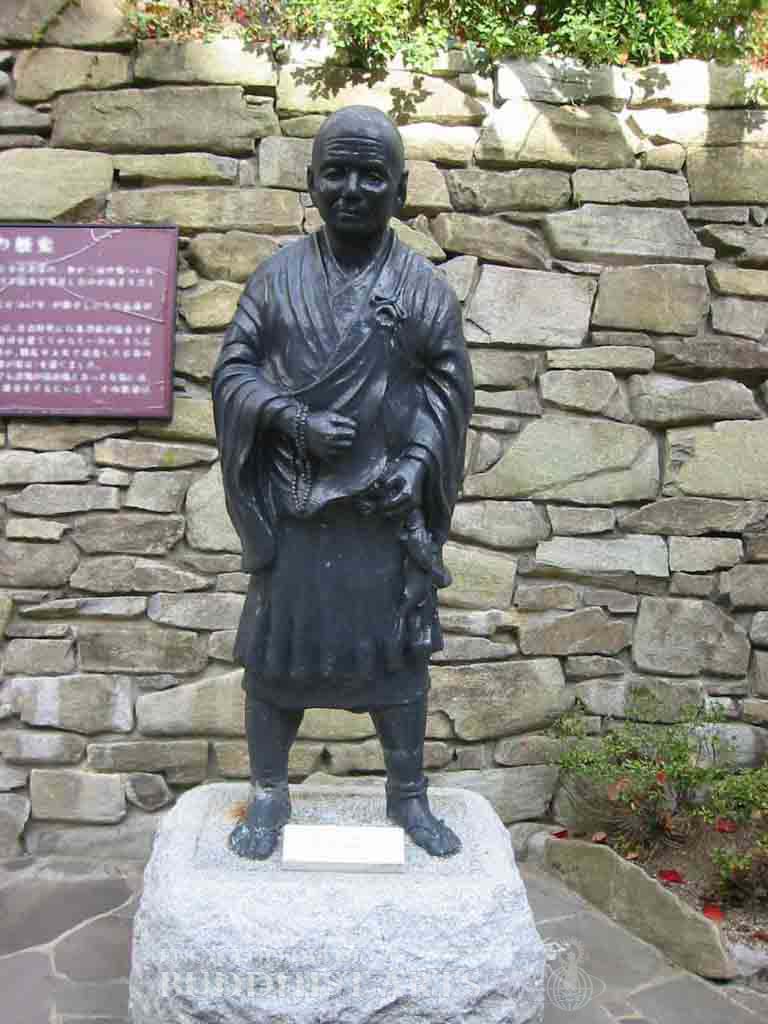
Gyoki
Gyoki
JAPAN, Osaka, Sakai; Nara period
Gyoki, also known as Gyoki Shonin or Gyoki Hoshi, was a monk born in Otori, Kawachi (present day Sakai, Osaka). Renounced at the age of 15 at Asukadera Temple in Nara, he studied under Master Dosho as one of his first pupils. Gyoki later studied Yogacara, a core doctrine of the Hosso school of Japanese Buddhism, at Yakushiji Temple. He returned to his birthplace in 704, where he converted his former home into a temple. Gyoki also founded and constructed numerous temples and halls including Burakuji Temple in Kochi, Chokyuji Temple in Nara, and the main halls of Kongorinji Temple and Chojuji Temple in Shiga.
Despite strict regulations prohibiting monks from venturing outside the monastic compounds, Gyoki traveled around Japan to give teachings to the common people. He and his followers were persecuted by the government, although Gyoki’s popularity and administrative skills earned him a pardon from the government. He was later recognized in 745 as the first monk given the rank of Daisojo, which is the highest honor for a Buddhist monk in Japan.
Gyoki is widely recognized as the founder of Japanese cartography. During his travels, he constructed roads, bridges, and canals. According to a 14th century Tendai source, Gyoki discovered that Japan was shaped like a vajra, a symbol comprised of both a thunderbolt and a diamond. He is also often considered Japan’s first civil engineer, as he quite literally paved the way for infrastructure and the construction of temples.
During the erection of Todaiji Temple in Nara, Emperor Shomu (reigned 724–749) of the Nara period recruited Gyoki and his disciples to organize labor and resources from the countryside. He raised sufficient funds to enable the casting of the bronze statue of Vairocana Buddha. Unfortunately, Gyoki passed away in 749, three years before the consecration of the statue. He is affectionately known throughout Japan today by his posthumous title of Bodhisattva.
For more details, go to the Encyclopedia of Buddhist Arts: People, page 87.
Cite this article:
author = Hsingyun and Youheng and Youlu and Pokorski, Stefanie and Yichao and Mankuang and Miaohsi,
booktitle = {Encyclopedia of Buddhist Arts: People },
pages = 87,
title = {{Gyoki}},
volume = 19,
year = {2016}}