
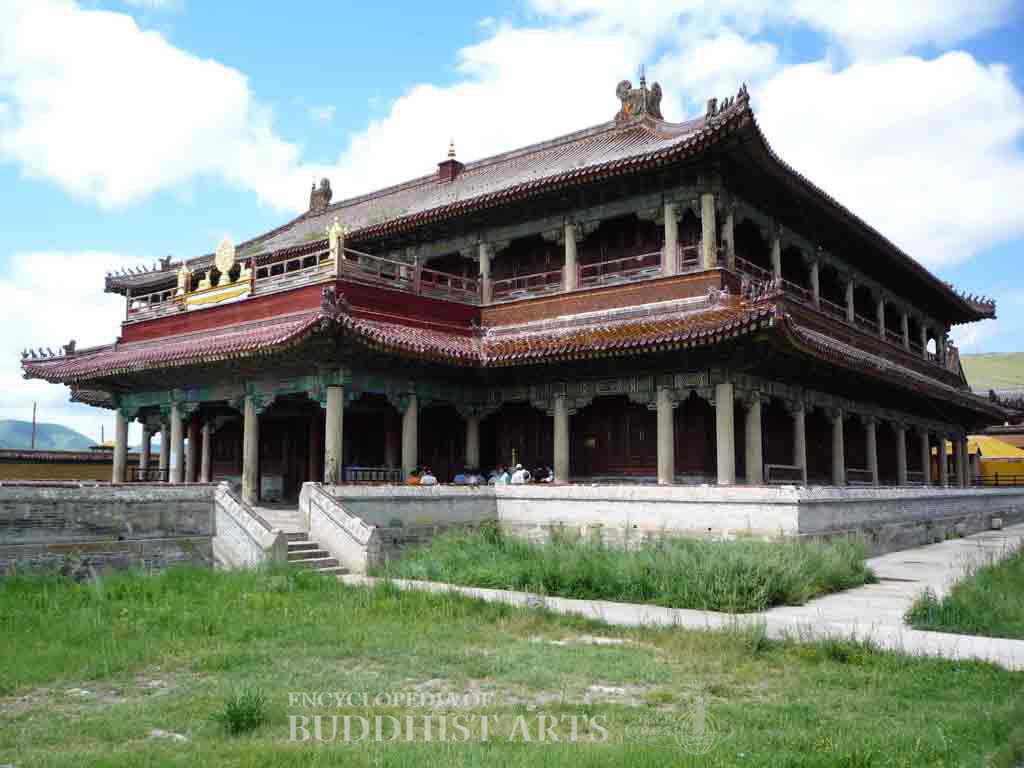
Amarbayasgalant Monastery
Amarbayasgalant Monastery
MONGOLIA, Selenge, Baruunburen
The monastery was constructed between 1727 and 1737 by Emperor Yongzheng (reigned 1722–1735) of the Qing dynasty in honor of Zanabazar, whose mummified body was moved there in 1779. The anti-Buddhist campaign of the 1930s resulted in the destruction of 10 of the 37 halls in the monastery. It was restored from 1975 to 1990 with the support of UNESCO.
The monastery is built on a south-north axis and is surrounded by a wall measuring 207 m by 175 m. The principal structures are the screen wall, main temple gate, Heavenly King Hall, the main hall, Sakyamuni Buddha Hall, and the Summer Palace or the living quarters of the Bogd Gegen. On the sides there are the bell and drum towers, pavilions, Amitayus Hall, halls for the Fourth Bogd Gegen and Zanabazar, Narkhajid Hall, and Maitreya Hall.
The two-story main hall is square with each side measuring 32 m. It has a front portico and a hip roof with a flat, square top. A miniature stupa is located in the center of each ridge and there are dragons with fishtails at the ridge ends. The hall is surrounded by a veranda on the first story and a balcony on the second. The veranda and balcony are supported by plain round columns with colored bracket sets, which support the intricately decorated architraves. The roofs are covered in brown cylindrical tiles and the upturned corners are decorated with Chinese-style figurines. A Dharma wheel flanked by two deer is set as part of the balustrade of the second story above the portico. The architecture is a fusion of Chinese, Tibetan, and Mongolian styles.
For more details, go to the Encyclopedia of Buddhist Arts: Architecture A-F, page 11.
Cite this article:
author = Hsingyun and Youheng and Johnson, Peter and Mankuang and Lancaster, Lewis,
booktitle = {Encyclopedia of Buddhist Arts: Architecture A-F},
pages = 11,
title = {{Amarbayasgalant Monastery}},
volume = 1,
year = {2016}}