
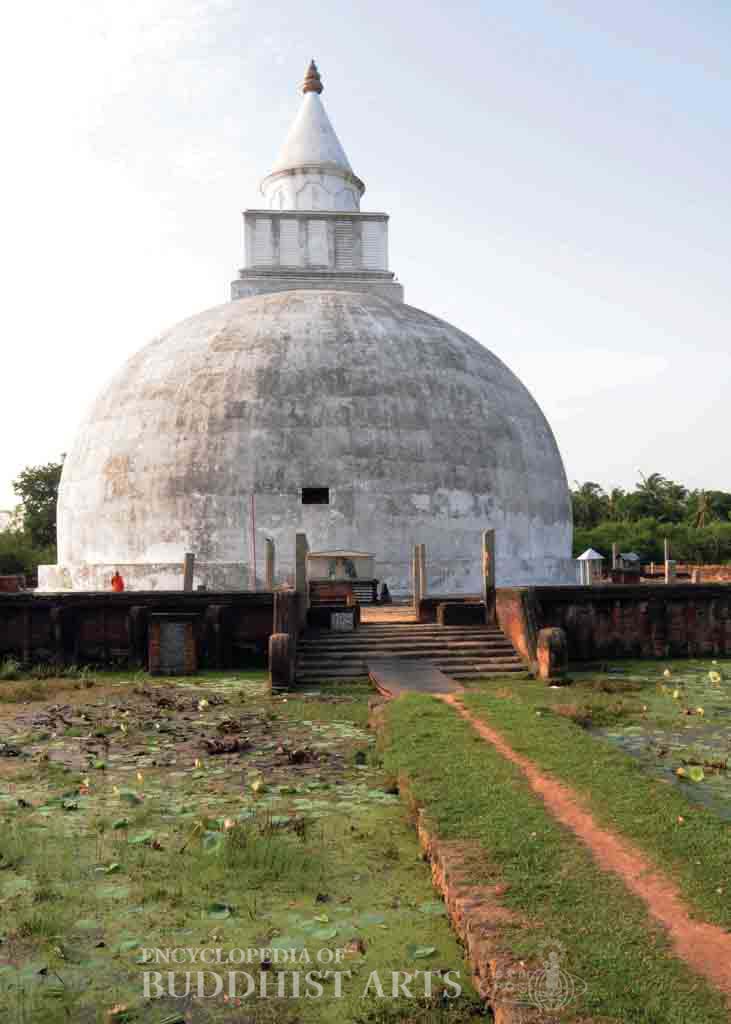
Tissamaharama Raja Maha Vihara
Tissamaharama Raja Maha Vihara
SRI LANKA, Southern Province, Tissamaharama
The temple was built in the 2nd century BCE by King Kavan Tissa (reigned 205–161 BCE) of Ruhuna. According to the chronicles, the site was chosen by King Kavan Tissa as it had been consecrated by the Buddha himself, who spent some time in meditation here with the Five Hundred Arhats. Today it is one of the 16 sacred Buddhist sites in Sri Lanka.
There are four main structures in the temple complex: Tissamaharama Stupa, which is the most prominent; Yatala Stupa; Sandagiri Stupa; and Menik Stupa. The Tissamaharama Stupa is located in the southeast of the site, while the Menik Stupa and the Yatala Stupa are near the lake by the Western Tank.
The Tissamaharama Stupa is built in the shape of an inverted bowl. It is one of the largest and oldest stupas in Sri Lanka, measuring 47.5 in height and 168 m in circumference. According to the chronicles, around 12,000 monastics lived in the area during the time of King Kavan Tissa, who deposited the forehead relic and four tooth relics of Sakyamuni Buddha in the stupa.
The Sandagiri Stupa lies to the east of the Tissamaharama Stupa. It was initially built on a square platform, measuring approximately 60 m on each side, but only half of the stupa remains today. The floor is covered with bricks and there are flower altars at the four cardinal points.
The Yatala Stupa is located 1.5 km from the Tissamaharama Stupa. A large number of relic caskets have been discovered in the stupa. The restoration of the stupa started in 1883 and took over a century to complete. A small opening has been left to observe the different phases of construction. The stupa is surrounded by an Elephant Wall, which is probably the oldest in the country.
The Menik Stupa is near Yatala Stupa. Its shape is similar to that of Tissamaharama Stupa but smaller in size. Restoration of the stupa began in 1882 by monk Tangalle Sri Jinaratana and it was completed in 1894.
For more details, go to the Encyclopedia of Buddhist Arts: Architecture T-Z, page 1132.
Cite this article:
author = Hsingyun and Youheng and Johnson, Peter and Mankuang and Lancaster, Lewis,
booktitle = {Encyclopedia of Buddhist Arts: Architecture T-Z},
pages = 1132,
title = {{Tissamaharama Raja Maha Vihara}},
volume = 4,
year = {2016}}