
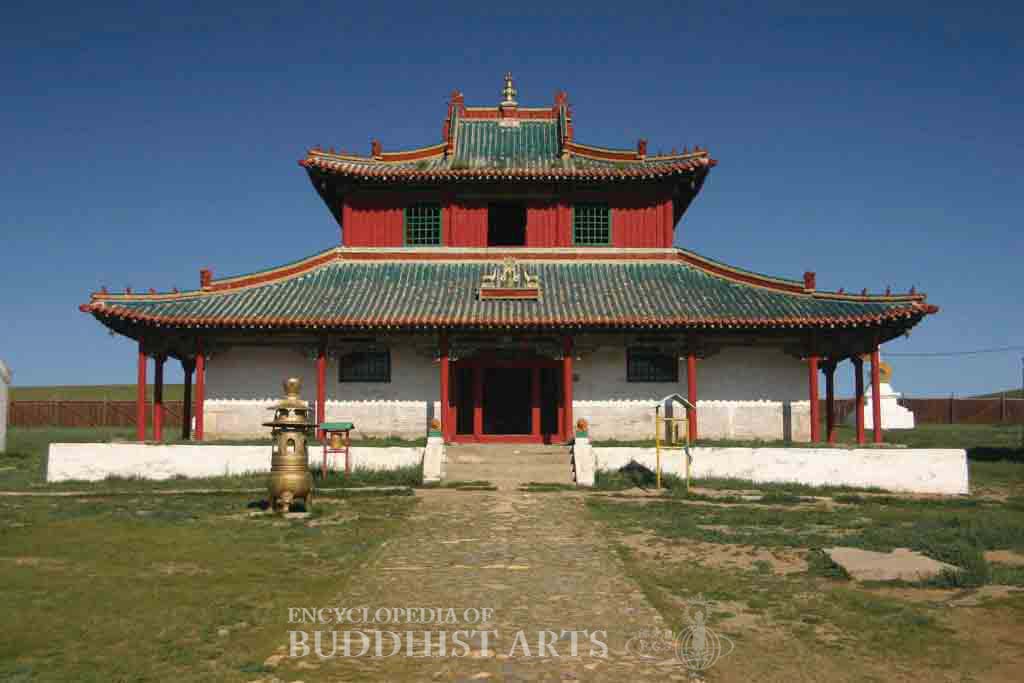
Shankh Monastery
Shankh Monastery
MONGOLIA, Ovorkhangai
The monastery was founded by Zanabazar, the First Jebtsundamba Khutuktu and famous sculptor, in 1647 when he was just 12 years old. It was originally a ger monastery which moved around until it was established in its present location in 1787. By the 1920s it consisted of 20 buildings and there were over 1,500 monks in residence. It contained several Vajrayana schools and was a center for the study of Buddhist philosophy. The monastery was closed down in 1937 during the persecution of Buddhism and most buildings were destroyed except the main hall. The monastery belongs to the Gelug school of Tibetan Buddhism. As part of the Orkhon Valley Cultural Landscape, it was listed as a UNESCO World Heritage Site in 2004.
Only the main hall has been restored. It is a two-story building with a hip-and-gable roof. The eaves on the lower story are extensive and cover a veranda which surrounds the building. The eaves are supported by undecorated red columns surmounted by bracket sets which underpin highly decorated architraves. The roofs are covered in green tiles with red edges. The main ridge is short and has a miniature stupa in the center. On the roof above the doorway there is a Dharma wheel flanked by two deer. The walls of the first story are rendered in plaster, while the upper story is made of wood. Stupas have been erected behind the hall. This is a good example of the Mongolian style of Buddhist monastery architecture.
For more details, go to the Encyclopedia of Buddhist Arts: Architecture M-S, page 970.
Cite this article:
author = Hsingyun and Youheng and Johnson, Peter and Mankuang and Lancaster, Lewis,
booktitle = {Encyclopedia of Buddhist Arts: Architecture M-S},
pages = 970,
title = {{Shankh Monastery}},
volume = 3,
year = {2016}}