
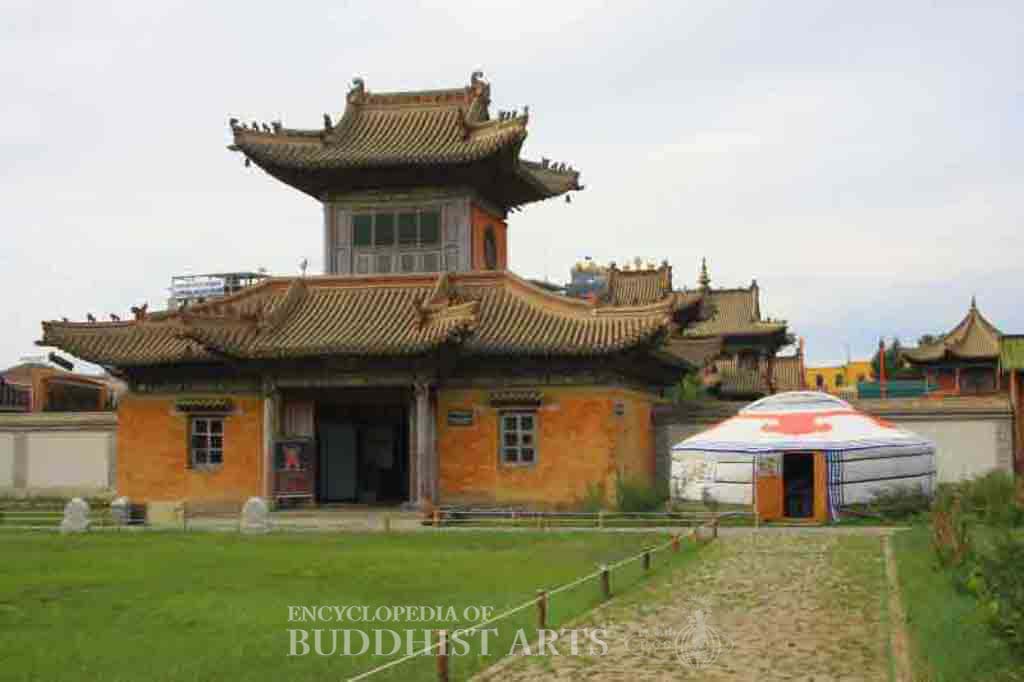
Choijin Lama Monastery
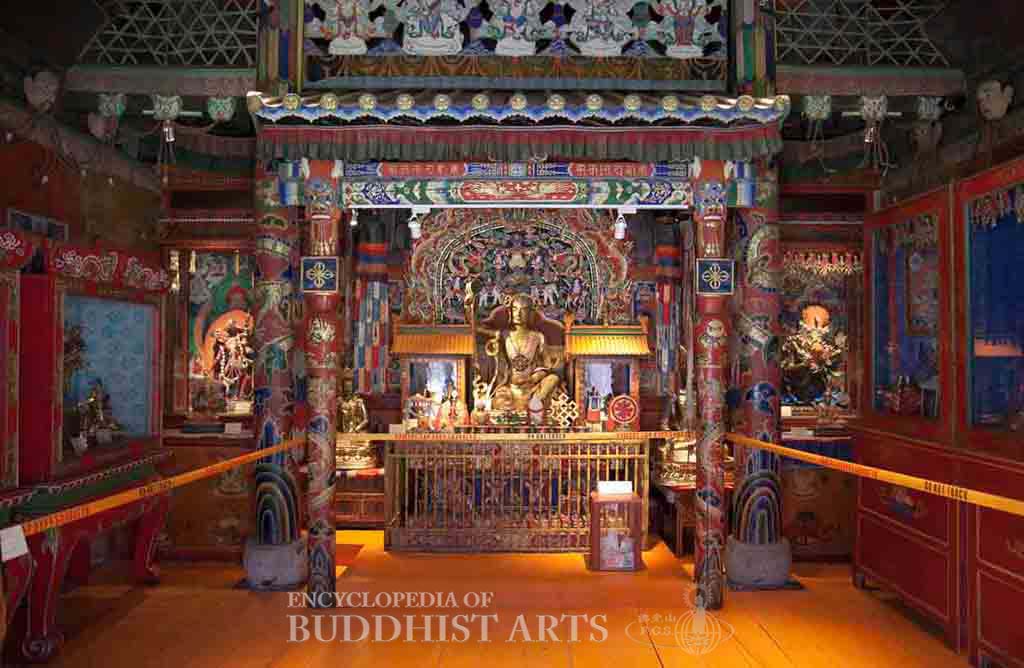
Choijin Lama Monastery (interior)
Choijin Lama Monastery
MONGOLIA, Ulaanbaatar
Choijin means Dharmapala or Dharma Protector and it is also the title of Luvsankhaidav, the state oracle and brother of the Mongolian ruler Bogd Khan (reigned 1911–1924). Construction of the monastery complex started in 1904 and was completed in 1908. It was originally occupied by Choijin Lama Luvsankhaidav. In 1937 it was closed during the persecution of Buddhism and became a disorganized repository for many Buddhist statues, thangkas, and artifacts removed from other monasteries. This new role probably saved it from destruction. It was converted to the Museum of Religious History in 1942. The monastery has been renovated on a number of occasions.
The monastery is divided into three compounds, in which there are five halls. On the central axis there are the screen wall, main gateway, which is also the Heavenly King Hall, the Gate of Honor, the main hall, and Yadam Hall. On opposite sides there are the Zuu Hall and the Amugulang Hall, together with two auxiliary gateways. The buildings were constructed in blue brick and wood, and have roofs decorated with green tiles and animals along the hips.
The Heavenly King Hall has a double-eave hip-and-gable roof. The distance between the eaves is quite noticeable, which is typical of Mongolian style Buddhist architecture. The three-by-three bay wide main hall has a double-eave hip-and-gable roof and again the upper level is quite high. The hall is square with a portico at the front and the Protector Shrine at the back. The roof of the portico is undulating and it has multiple eaves. Inside the hall there is an 18th century gilded statue of Sakyamuni Buddha flanked by his disciples. To the right there is a statue of Choijin Lama Luvsankhaidav, while to the left there is the embalmed body of Baldanchoimbolon, his teacher. The hall houses a number of religious instruments and a rich collection of cham masks.
The Zuu Hall houses papier-mache images of the Buddhas of the Past, Present and Future. The walls are decorated with images of the Sixteen Arhats. On either side of the entrance the Four Heavenly Kings are depicted as hermits sitting in caves in meditation. The Amugulang Hall, or Hall of Peace, is dedicated to Zanabazar. His portrait is on the north wall and some of his sculptures are on display. The Yadam Hall is enclosed in its own compound. It was the place where Choijin Lama Luvsankhaidav performed private ceremonies.
The monastery houses an extensive collection of Buddhist statues, thangkas, masks, ritual implements and a set of the Mongolian Canon.
For more details, go to the Encyclopedia of Buddhist Arts: Architecture A-F, page 152.
Cite this article:
author = Hsingyun and Youheng and Johnson, Peter and Mankuang and Lancaster, Lewis,
booktitle = {Encyclopedia of Buddhist Arts: Architecture A-F},
pages = 152,
title = {{Choijin Lama Monastery}},
volume = 1,
year = {2016}}