
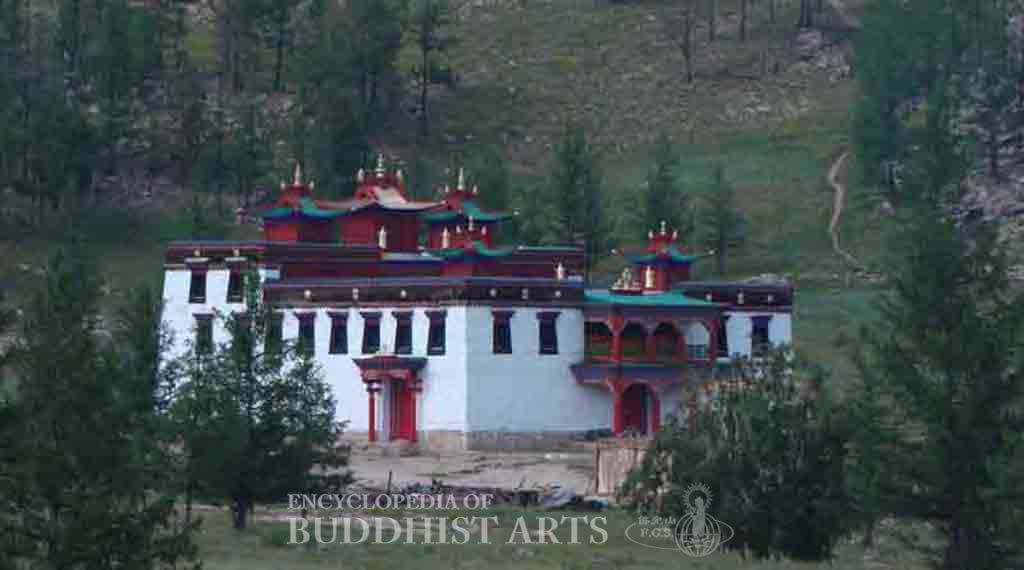
Baldan Bereeven Monastery
Baldan Bereeven Monastery
MONGOLIA, Khentii, Umnudelger
The monastery is surrounded by four mountains said to resemble different animals. It belongs to the Gelug school of Tibetan Buddhism. It was founded in 1654 by the monk Tsevendorj, a student of Zanabazar. Initially, there was a community of about 1,500 monks. It was rebuilt in 1850 as an important teaching monastery with four separate colleges, over 20 halls and almost 8,000 monks. The monastery was completely destroyed during the persecution of Buddhism in 1937. Three halls have now been restored and the ruins of nearly 50 halls, stupas, and auxiliary buildings can still be seen in the monastery grounds.
The reconstructed assembly hall is square with an elevated section at the rear. The walls incline slightly inwards and there is a row of small rectangular windows at the top. Along the top of the walls there is a red ocher band with golden medallions at intervals. At the front there is a portico with four red pillars and ornate capitals connected by architraves. On top of the portico there is a balcony with a roof decorated with a Dharma wheel flanked by deer.
At the top of the entire hall there are square towers with hip-and-gable roofs. The roof of the central tower at the rear is golden in contrast to the green roofs of the other towers. In the center of the ridges there are miniature pagodas, and the ridge ends are decorated with golden ornaments. The hall is built in typical Tibetan style.
For more details, go to the Encyclopedia of Buddhist Arts: Architecture A-F, page 44.
Cite this article:
author = Hsingyun and Youheng and Johnson, Peter and Mankuang and Lancaster, Lewis,
booktitle = {Encyclopedia of Buddhist Arts: Architecture A-F},
pages = 44,
title = {{Baldan Bereeven Monastery}},
volume = 1,
year = {2016}}