
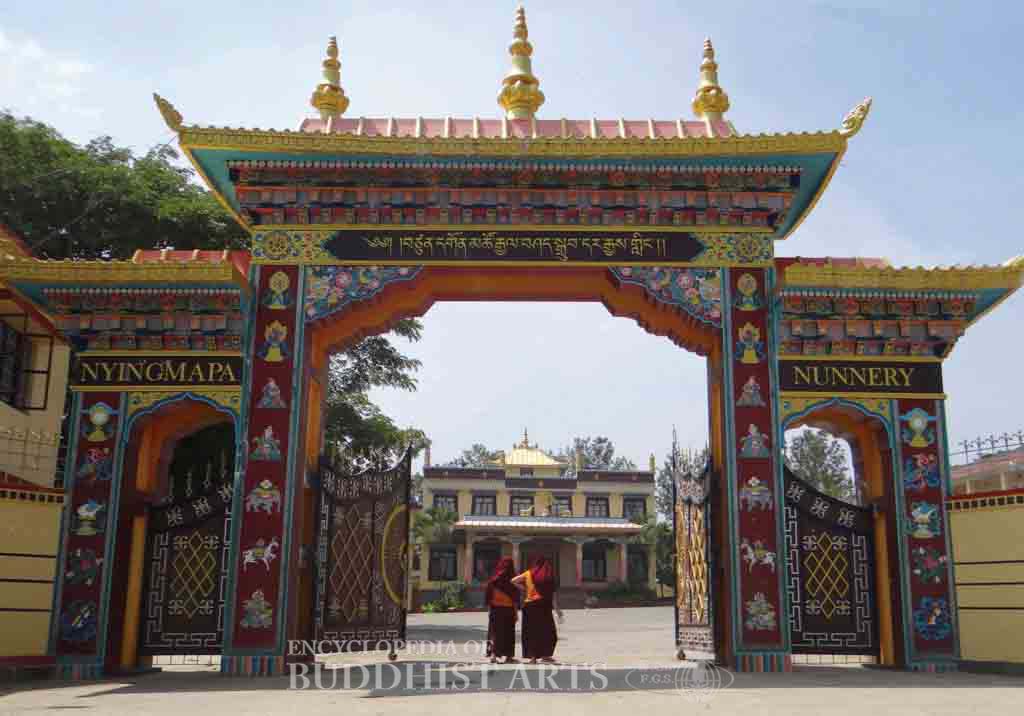
Namdroling Monastery: Nunnery
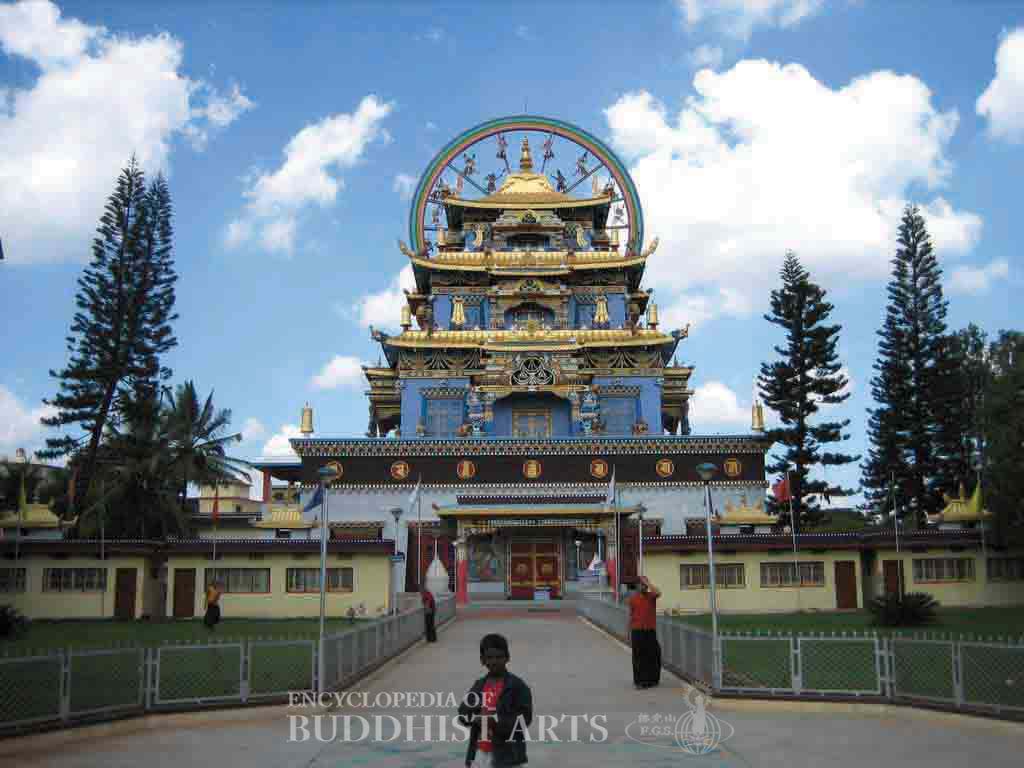
Namdroling Monastery
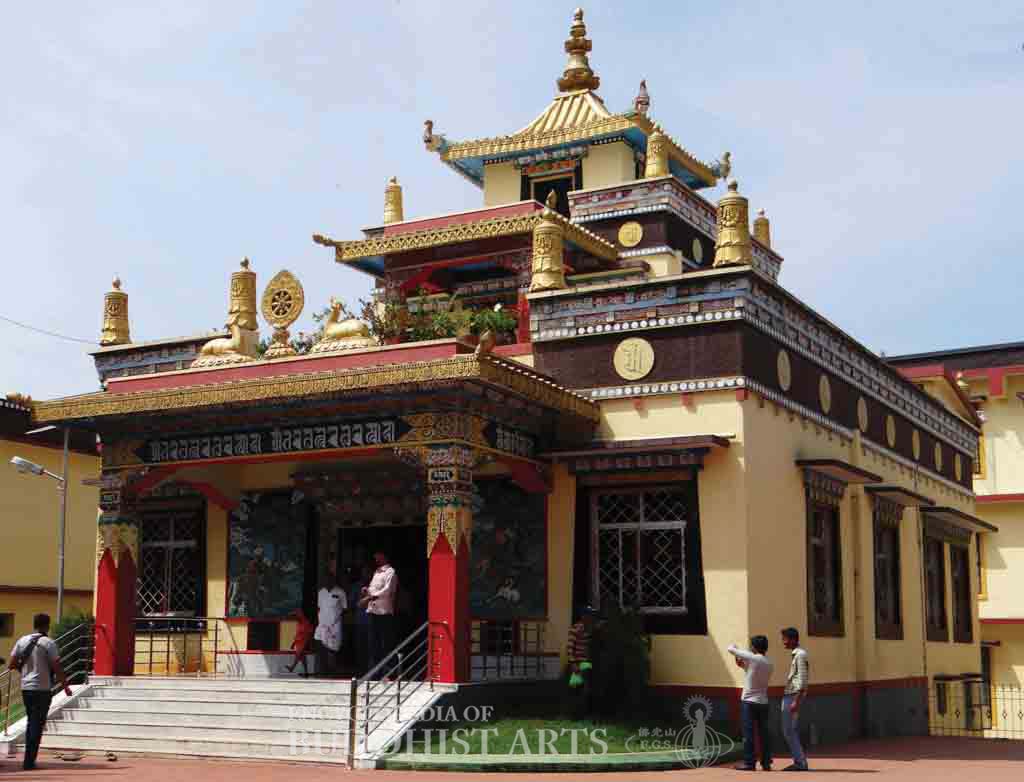
Namdroling Monastery
Namdroling Monastery
INDIA, Karnataka, Bylakuppe
The monastery was established by Pema Norbu Rinpoche in 1963, shortly after he arrived in India from Tibet. Initially the monastery was just a bamboo structure, but it is now one of the largest teaching centers of the Nyingma school of Tibetan Buddhism, housing 5,000 monks and nuns.
The monastery complex consists of a school, nunnery, retreat center, Padmasambhava Buddhist Vihara, nursing home, libraries, Stupas of the Eight Buddhas, Terton Migyur Dorje’s Sarira Stupa, Vajrakilaya Hall, Zangdog Palri Hall, Kagyed, and various Tara Halls.
The Padmasambhava Buddhist Vihara houses three large statues: Sakyamuni Buddha in the center, and Amitabha Buddha and Padmasambhava on the right and left respectively. There are altogether 67 scenes depicted around the vihara, including the Twelve Deeds of the Buddha, the Twelve Great Teachers of Dzogchen, and 25 major disciples of Guru Padmasambhava. The columns and beams in the hall are elaborately carved. To the left of the Padmasambhava Buddhist Vihara is the Vajrakilaya Hall.
The Zangdog Palri Hall is in Chinese-Tibetan style. The lower section of the building is painted in white, as is any traditional Tibetan monastery, and on the top of the building there are three stories with gilded eaves and elaborate decorations. Starting from the east gate of the monastery, there is a circumambulation path with over 1,000 prayer wheels.
The Ngagyur Nyingma Institute, also known as the Higher Buddhist Studies and Research Center, was officially opened in 1978. It was expanded and there are now three buildings with over 150 rooms. The Samten Osel Ling Retreat Center has a prayer hall, kitchen, and store room. The Tsogyal Shedrub Dargyeling Nunnery facilitates the study and practice of nearly 400 nuns.
For more details, go to the Encyclopedia of Buddhist Arts: Architecture M-S, page 776.
Cite this article:
author = Hsingyun and Youheng and Johnson, Peter and Mankuang and Lancaster, Lewis,
booktitle = {Encyclopedia of Buddhist Arts: Architecture M-S},
pages = 776,
title = {{Namdroling Monastery}},
volume = 3,
year = {2016}}