
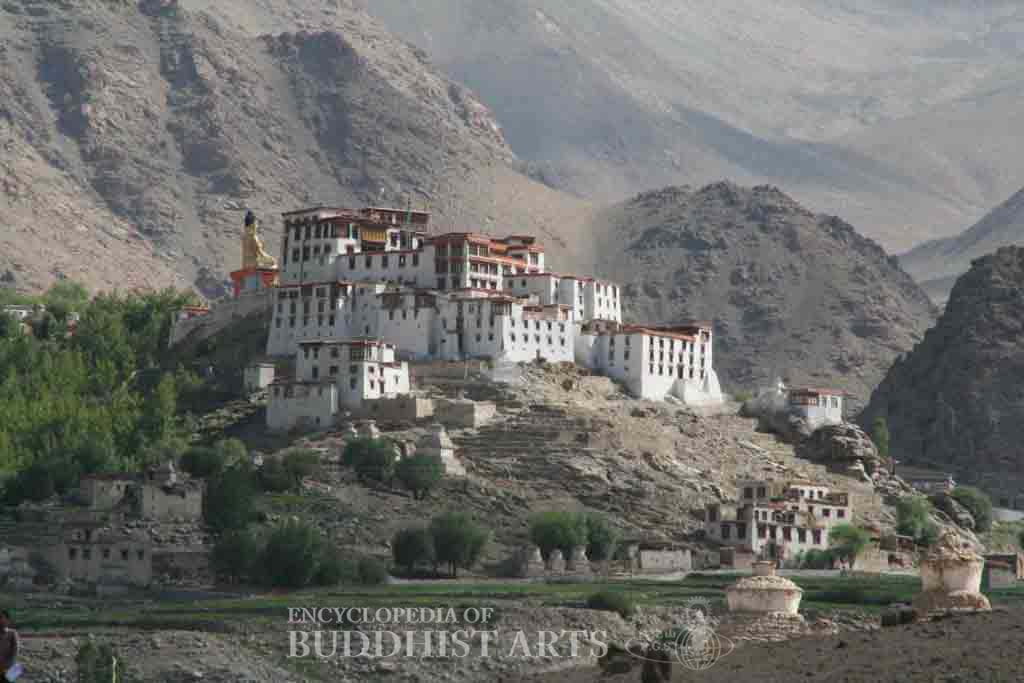
Likir Monastery
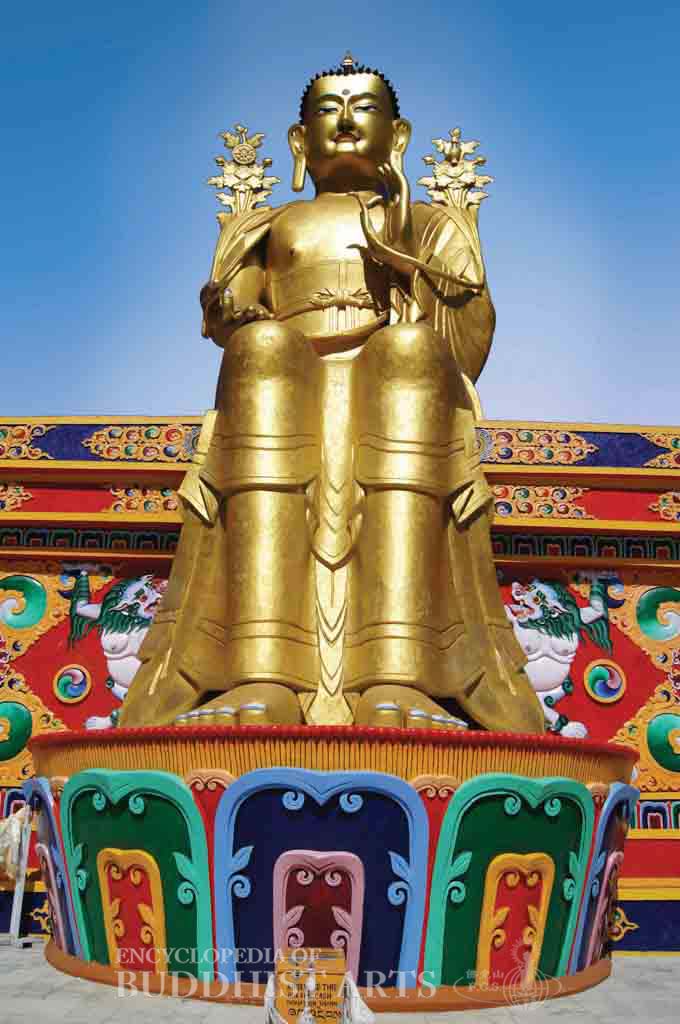
Likir Monastery: Maitreya Buddha
Likir Monastery
INDIA, Jammu and Kashmir, Ladakh
According to an inscription, the construction of Likir Monastery was commissioned by the fifth king of Ladakh, Lhachen Gyalpo, and carried out by Lama Duwang Chosje in 1065. Likir means Encircled Naga and it represents the two great Naga Kings, Nanda and Taksako. During the 15th century, it underwent expansion and was converted to a monastery of the Gelug school.
The monastery consists of a large stupa, two assembly halls, a central courtyard, Dharma Protector Halls, shrines, and the Central Institute of Buddhist Studies. Its architecture is in traditional Tibetan style with ornate windows. The large stupa is located below the monastery and contains frescoes representing Tsongkhapa and other lamas of his time. Among the two assembly halls, the older one is located on the right of the central courtyard. It houses three large statues of the Sakyamuni Buddha, Maitreya Buddha and Tsongkhapa, together with statues of Amitabha Buddha and Avalokitesvara Bodhisattva. Thangkas of the Sakyamuni Buddha and the guardian divinity of Likir are hung from beams close to the entrance. The portico to the assembly hall has thangka paintings of the Guardians of the Four Directions and the Wheel of Rebirth. The newer assembly hall, which is approximately 200 years old, is located diagonally across from the entrance to the courtyard. A statue of an Eleven-Headed Thousand-Armed Avalokitesvara is enshrined in this assembly hall. On the left wall there are paintings of the Thirty-Five Buddhas, while on the right wall there is an image of the Sakyamuni Buddha flanked by two of his disciples. The Zimchung, the head lama’s chamber, is near the courtyard and contains thangkas and images of lamas as well as the 21 manifestations of the White Tara.
On the roof there is a 23 m high gilded statue of the Maitreya Buddha, which was completed in 1999. The Buddha is robed with both shoulders covered and seated on a colorful Sumeru throne with legs pendent. His left hand is in vitarka (teaching) mudra while his right hand forms the varada (wish-granting) mudra over the right knee. Intertwined in both hands is a long-stemmed lotus which extends to the back of his shoulders.
The Central Institute of Buddhist Studies teaches in three languages: Hindi, Sanskrit, and English. It serves as the venue of the annual Dosmochey—an assembly of votive offerings and sacred dances. The monastery houses a repository of old manuscripts, thangkas, old costumes, and earthen pots.
For more details, go to the Encyclopedia of Buddhist Arts: Architecture G-L, page 660.
Cite this article:
author = Hsingyun and Youheng and Johnson, Peter and Mankuang and Lancaster, Lewis,
booktitle = {Encyclopedia of Buddhist Arts: Architecture G-L},
pages = 660,
title = {{Likir Monastery}},
volume = 2,
year = {2016}}