
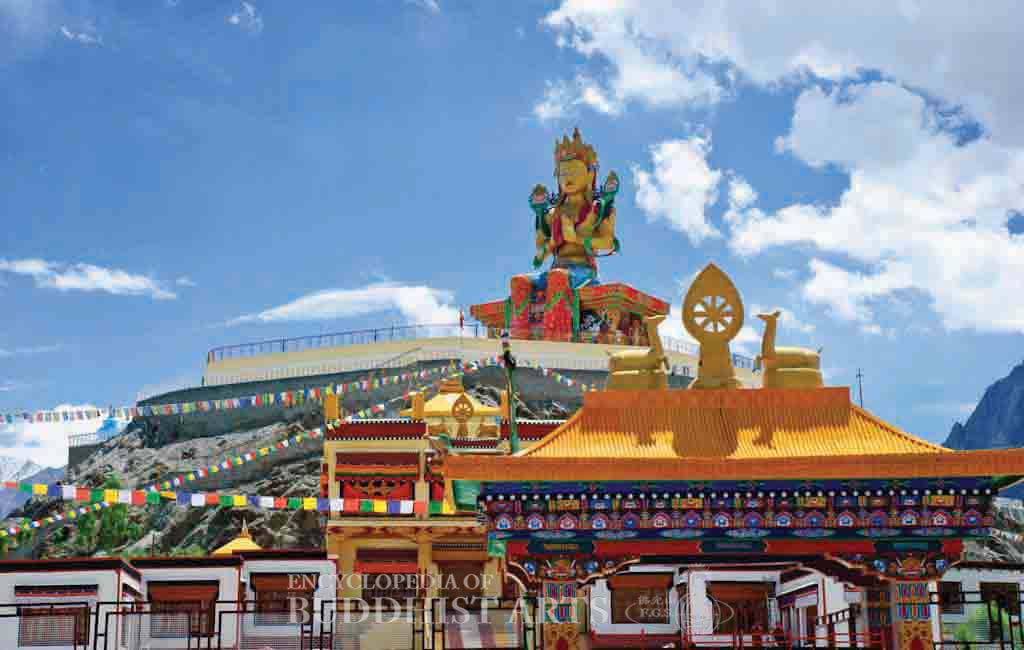
Diskit Monastery
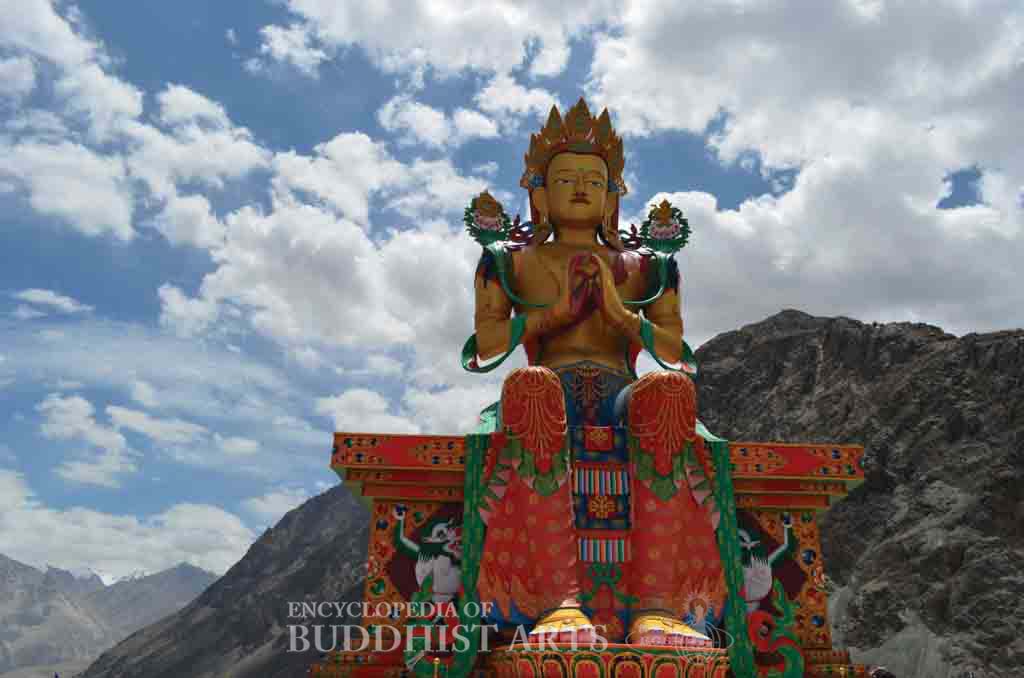
Diskit Monastery: Maitreya Buddha
Diskit Monastery
INDIA, Jammu and Kashmir, Ladakh
Located in the Nubra Valley of northern India, it is the oldest and largest Buddhist monastery in the region. It was founded in the 14th century by Changzem Tserab Zangpo, a disciple of Tsongkhapa. This Gelug school monastery was given to a Rinpoche of Thiksey Monastery in the 18th century, and is thus considered a subsidiary of that monastery.
The monastery comprises a central hall, monastic quarters, and a school. The central hall has a typical Tibetan flat roof with a cupola, which is covered with frescoes depicting the Tashilhunpo Monastery in Tibet. The central hall includes an assembly hall and shrines. A statue of Maitreya is enshrined within the hall. Numerous wrathful deities are painted in the shrine on the second level of the central hall. A lack of maintenance has resulted in noticeable deterioration, although recent extensions to the monastery appear in good condition.
On a hilltop behind the monastery, there is the official residence of the Chief Lama of Nubra and a very large seated Maitreya Buddha statue. Construction of the 32 m high statue started in 2006, followed by consecration by the Fourteenth Dalai Lama in 2010. The statue is decorated with 8 kg of donated gold. It was funded locally and erected for the protection of the Diskit village and for world peace. Adorned with armlets, bracelets, anklets, and ornaments, the crowned Buddha wears a green stole which drapes down to the ground as the ends twirl upward. While holding his hands in a mudra, the Buddha grasps two long-stemmed and blossoming lotuses, which extend above the shoulders. On top of each lotus, there is either a vase or a Dharma wheel. The Buddha sits with legs pendent on a red Sumeru throne resplendently decorated with colorful gems on its gilded surfaces.
For more details, go to the Encyclopedia of Buddhist Arts: Architecture A-F, page 244.
Cite this article:
author = Hsingyun and Youheng and Johnson, Peter and Mankuang and Lancaster, Lewis,
booktitle = {Encyclopedia of Buddhist Arts: Architecture A-F},
pages = 244,
title = {{Diskit Monastery}},
volume = 1,
year = {2016}}