

Muaro Jambi Temple Complex
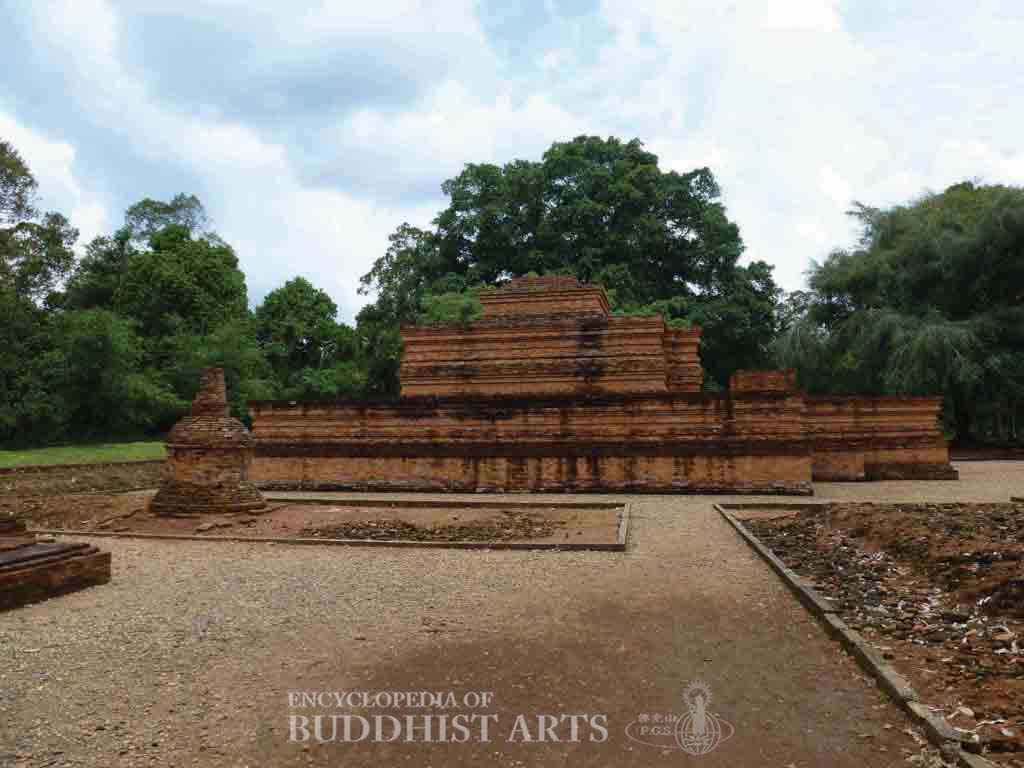
Muaro Jambi Temple Complex
Muaro Jambi Temple Complex
INDONESIA, Jambi, Muara Jambi
This Buddhist temple complex occupies 12 sq km along the north bank of the Batang Hari River. Archaeological research and historical sources suggest this temple complex was a Buddhist center of learning and cultivation during the Melayu Kingdom (7th–14th century). The site comprises 82 brick structures, seven temples, many stupas, and other unidentified smaller structures.
The 3 m high, brick Gumpung Temple measures 18 m on each side, and has no inner space; it is in the form of a platform and was likely used to hold a venerated statue. It is accessible from the east via a narrow brick pathway, followed by a covered staircase leading to the top. At the beginning of this pathway is a carving of a makara, a mythical sea creature. During an excavation, 11 cavities were discovered at the base of the temple containing gold, silver, and bronze cups; small gold plates with and without inscriptions; gold lotus flowers; and semi-precious stones. The inscriptions date these pieces from the early 9th to mid-10th century. In front of the temple there is a large man-made pool measuring 120 m by 100 m.
Tinggi Temple stands to the north of the pool close to Gumpung Temple. It is the most elaborate temple on the site and is fully restored. It was built around an older temple and dates from the 9th century; it is also square with no inner space. A stairway that leads to the upper terraces projects out to the front and is lined on two sides with brick walls. The temple has three tiers with corbeling, which is more accentuated on the second tier. The upper tier represents a Sumeru throne. A low walled niche at the top likely contained a sacred image in the past.
For more details, go to the Encyclopedia of Buddhist Arts: Architecture M-S, page 748.
Cite this article:
author = Hsingyun and Youheng and Johnson, Peter and Mankuang and Lancaster, Lewis,
booktitle = {Encyclopedia of Buddhist Arts: Architecture M-S},
pages = 748,
title = {{Muaro Jambi Temple Complex}},
volume = 3,
year = {2016}}