
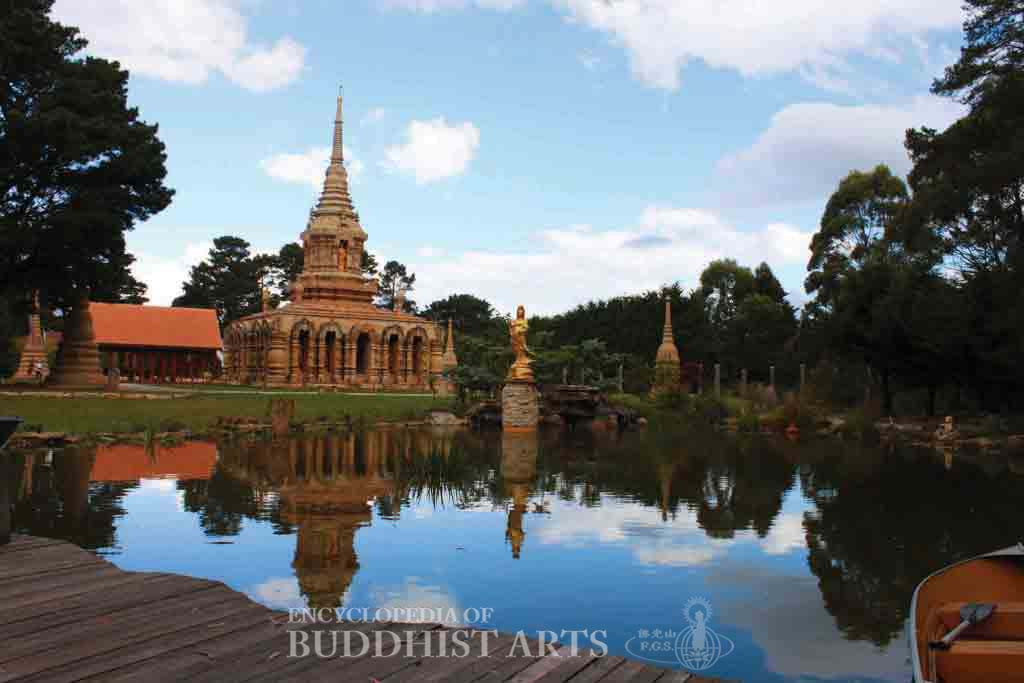
Sunnataram Forest Monastery
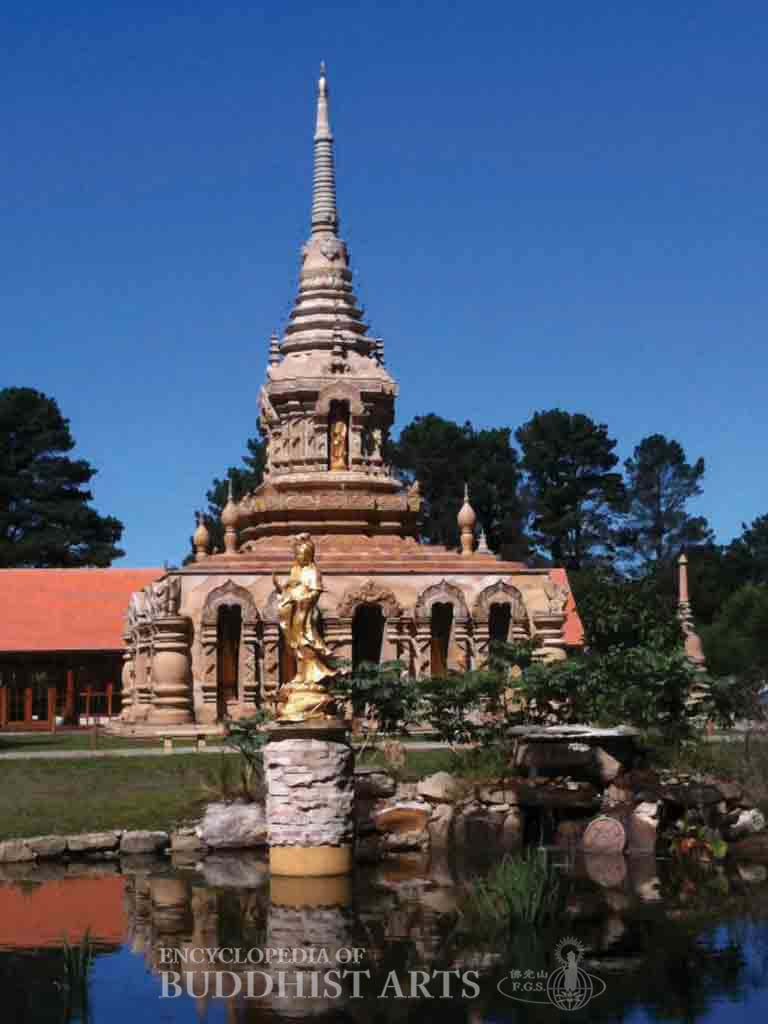
Sunnataram Forest Monastery: Gratitude Pagoda
Sunnataram Forest Monastery
AUSTRALIA, New South Wales, Bundanoon
Established in 1990, the Sunnataram Forest Monastery follows Theravada Buddhism in the Thai Forest tradition. The complex occupies 40 ha of natural bush land adjoining Morton National Park.
The monastery consists of the main shrine, meditation hall, Gratitude Pagoda, two pavilions, monastic quarters, Dhamma Amphitheater, and Avalokitesvara Pond. The main shrine and meditation hall are in one building, constructed in 1990 and is the oldest structure of the monastery. It has a hip-and-gable roof with two porticos at the front and back.
The Gratitude Pagoda, built in 2003, has a prominent square Sumeru base with five standing Buddha niches on each side and a round column surmounted by a winged lion at each corner. The upper section of the pagoda consists of a number of layers: a base platform followed by an ornate multi-cornered body with a standing Buddha facing the four directions, and octagonal tapered tiers supporting an inverted bowl. The spire consists of a hexagonal harmika, stacked rings, lotus, plain column, canopy, and jeweled finial. There is a smaller pagoda at each corner of the path surrounding the Gratitude Pagoda, as well as two pavilions in front of it and the Avalokitesvara Pond behind it.
The Dhamma Amphitheater was constructed in 2008. It contains an outdoor exhibition displaying 60 carved sandstone panels, as well as a three-dimensional world map showing the Silk Road travel routes, which span Egypt, Mesopotamia, Central Asia, China, and India. Its goal is to explain how Buddhism spread westwards. An Asoka Pillar carved in Thailand stands in the center. It rests on a base inlaid with stone panels displaying scenes from the Life of the Buddha.
For more details, go to the Encyclopedia of Buddhist Arts: Architecture M-S, page 1070.
Cite this article:
author = Hsingyun and Youheng and Johnson, Peter and Mankuang and Lancaster, Lewis,
booktitle = {Encyclopedia of Buddhist Arts: Architecture M-S},
pages = 1070,
title = {{Sunnataram Forest Monastery}},
volume = 3,
year = {2016}}