
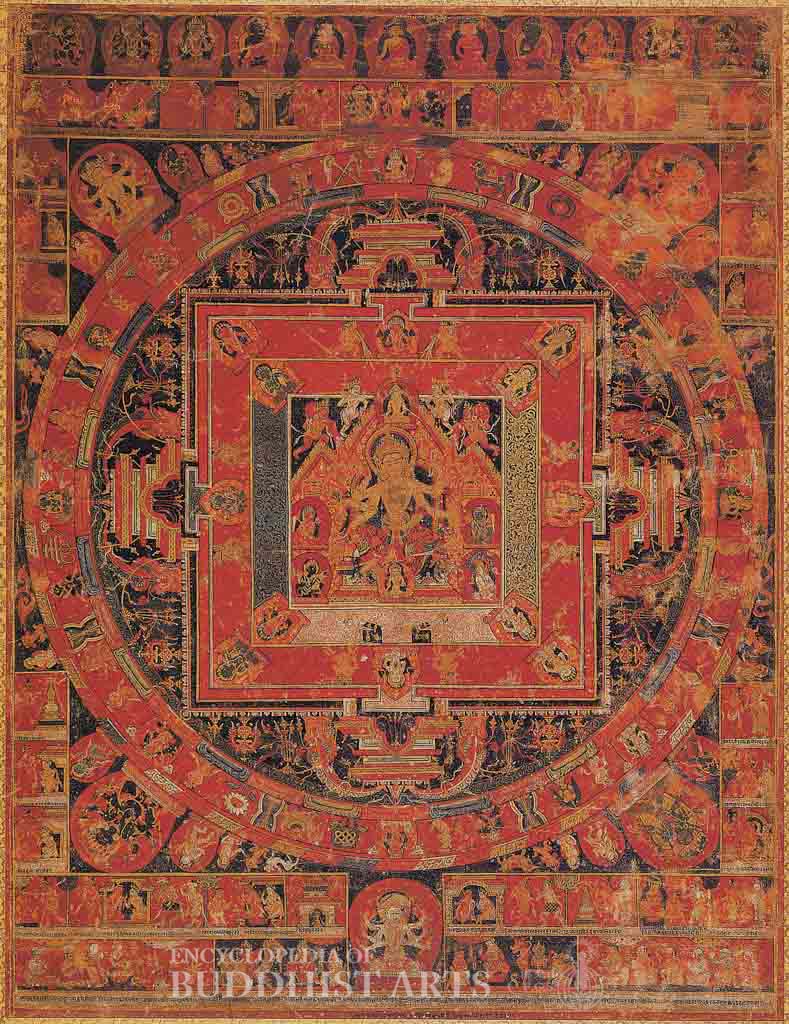
Vasudhara Mandala
Ink and color on cotton

Vasudhara Mandala (detail)
Vasudhara Mandala
NEPAL
This Nepalese mandala was painted during the Malla dynasty (1200–1768). It was commissioned by Jakhasimhana Tamrakara, a metalsmith from Kathmandu. Vasudhara Bodhisattva symbolizes wealth and abundance, and is highly venerated in Nepal. During the annual celebration in honor of Vasudhara, it is a common practice for lay devotees to offer mandalas in prayer for blessings from the Bodhisattva.
The golden Vasudhara sits in a shrine within a square in the center of the mandala. The Bodhisattva has six arms and wears a pointed crown. Beside the central figure, there are small images of Avalokitesvara Bodhisattva on the right and the green Vajrapani on the left, who represent compassion and wisdom respectively. Ratnasambhava Buddha, accompanied by yaksas and deities of wealth, is directly above Vasudhara. Below the Bodhisattva, two figures are shown opening treasure chests. Bodhisattvas occupy the inner corners of the squares painted around the central image. Large towers rise from the sides of the outer square, which represents a palace wall. Makaras are painted on either side of each tower. The red outer ring is decorated with images of the eight auspicious symbols. In each of the inner corners of the outer square, there is a depiction of a Pancaraksa deity flanked by yoginis and other figures. Within small rectangles around the outer square, there are images of beings being rescued from four of the Eight Dangers: lions, thieves, crocodiles, and elephants. There is also a visual depiction of a story in praise of Vasudhara that is usually recited at the culmination of her festival. The scenes are divided by buildings or trees and are accompanied by inscriptions.
In the upper register, the significant Buddhas, Bodhisattvas, and deities in the Newar Buddhist pantheon are shown. From left to right, they are Cakrasamvara, Eight-Armed Manjusri Bodhisattva, Prajnaparamita, the Five Dhyani Buddhas, Four-Armed Avalokitesvara, Manjuvajra, and Vasudhara Bodhisattva. The Vasudhara ceremony and a group of figures offering mandalas like this one are painted in the lower register. On the far right, a Vajracharya priest performs a fire offering. Similar practices can be seen in Newar Vajracharya rituals to this day. The painting is dominated by warm red and yellow hues. The delicate treatment of the figures reflects the aesthetic refinement and technical maturity of the 15th century Newari art.
For more details, go to the Encyclopedia of Buddhist Arts: Painting P-Z, page 961.
Cite this article:
author = Hsingyun and Youheng and Youlu and Wilson, Graham and Manho and Mankuang and Huntington, Susan,
booktitle = {Encyclopedia of Buddhist Arts: Painting P-Z},
pages = 961,
title = {{Vasudhara Mandala}},
volume = 16,
year = {2016}}