
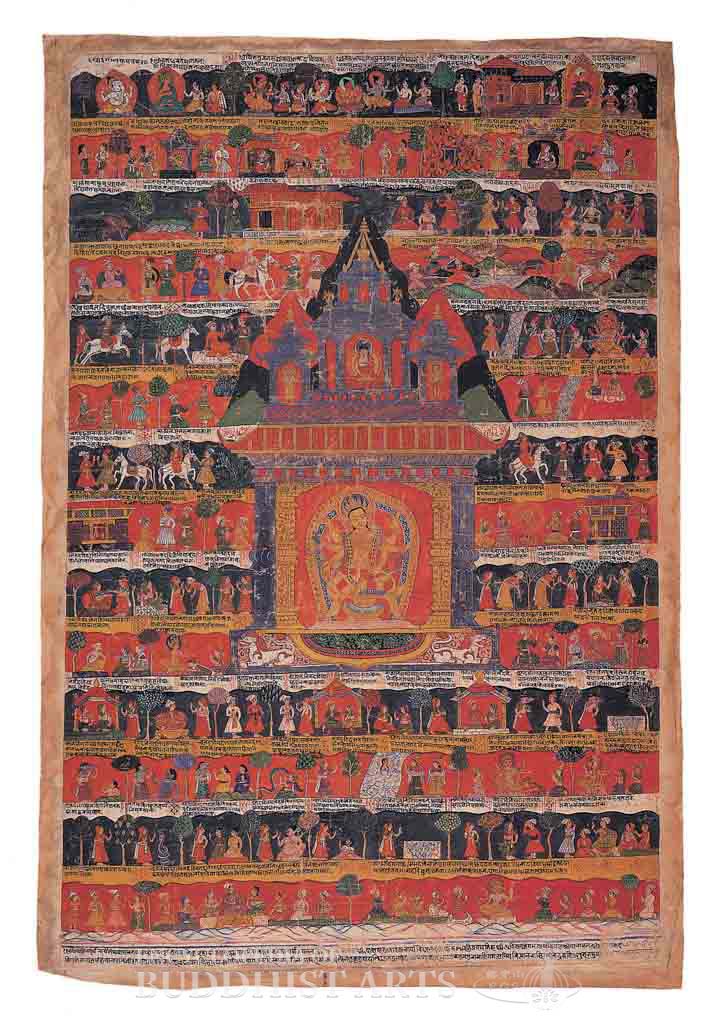
Vasudhara Bodhisattva
Ink and color on cotton
Vasudhara Bodhisattva
NEPAL
Vasudhara Bodhisattva is a popular figure in Nepal and an annual tribute ceremony is held from October to November. This Nepalese painting was commissioned by Jayanana Vajracharya in memory of his mother.
Golden, Six-Armed Vasudhara stands within a shrine in the center of the painting. Above the Bodhisattva, the Buddha, Prajnaparamita, and Avalokitesvara sit in towers with upward turned eaves. A golden stupa tops the central tower. The narrative is depicted in 14 rows with alternating blue and red backgrounds. The individual scenes are separated by trees and are labelled with inscriptions written on bands of white and gold above the rows. Small scenes around the central image relate a story that begins in the upper left corner with an invocation of Ganesa as the traditional remover of obstacles for any undertaking. In the sequence of images that follows, Vasudhara, recognizing the difficulties that have beset the kingdom of King Suryodana, sends two attendants, who first assume the forms of beautiful maidens and then the forms of wild boars, to teach the king a ritual invoking the aid of the Bodhisattva. The king is convinced and attempts to perform the ritual, but his young queen interferes with the ceremony. Vasudhara then transforms into an old woman and comes to the palace. The senior queen immediately recognizes the old woman as Vasudhara and duly worships her. However, the junior queen orders the old woman to leave the palace. Vasudhara blesses the senior queen and transforms the junior queen into a sow-faced figure. The sow-faced queen is forced from the palace and witnesses the terrible sufferings undergone by beings of lower rebirth. She repents her transgressions and is immediately restored to her original self. As the queen journeys back to the palace, she instructs the suffering beings on the merits of worshipping Vasudhara. The sufferers are delivered from their troubles; withered trees begin to grow again, a sick snake becomes healthy, a hungry ghost is satiated, and a dirty pond is filled with clean water. When the queen returns, the royal family performs a great ceremonial prayer to Vasudhara, who then appears before them and blesses the kingdom. The interaction of the vividly colored, animated figures gives a sense of vitality to the painting, a fine example of 18th century Kathmandu Valley art.
For more details, go to the Encyclopedia of Buddhist Arts: Painting P-Z, page 960.
Cite this article:
author = Hsingyun and Youheng and Youlu and Wilson, Graham and Manho and Mankuang and Huntington, Susan,
booktitle = {Encyclopedia of Buddhist Arts: Painting P-Z},
pages = 960,
title = {{Vasudhara Bodhisattva}},
volume = 16,
year = {2016}}