
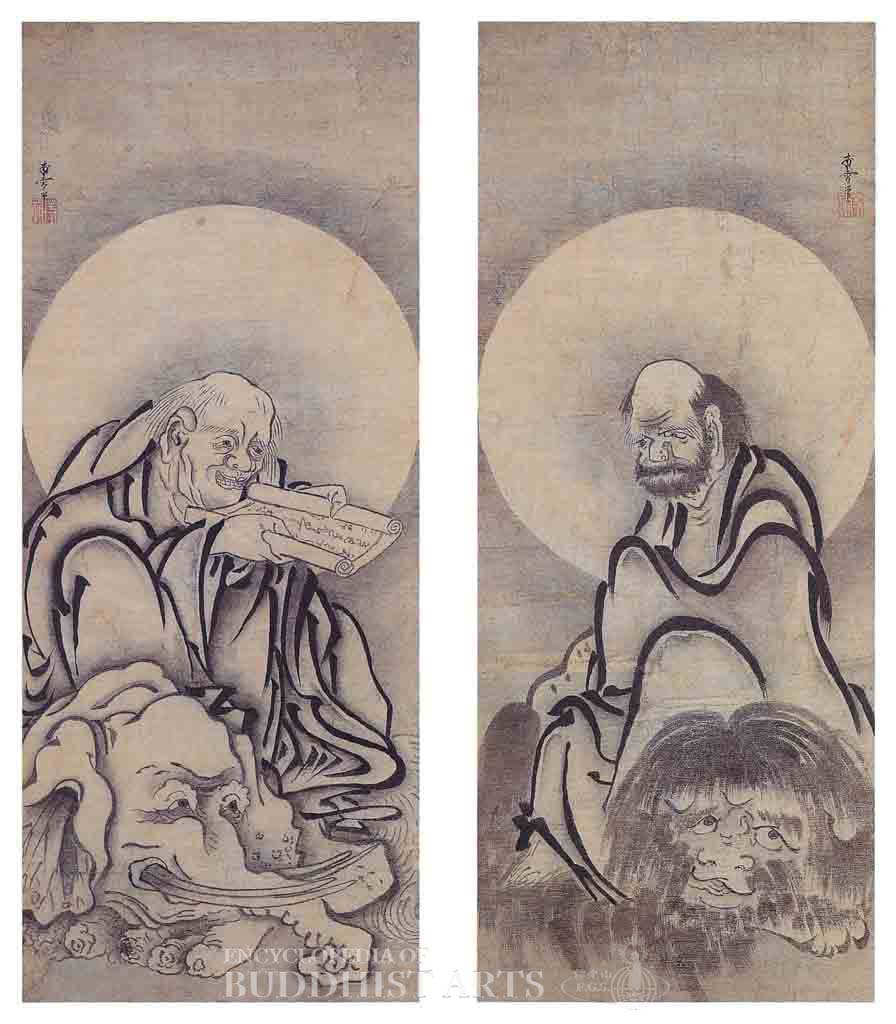
Manjusri and Samantabhadra Bodhisattvas - Samantabhadra
Ink on paper
Manjusri and Samantabhadra Bodhisattvas
JAPAN; Muromachi period
The signature of “Tozen” and the seal imprint “Hosetsu” on these 16th century hanging scrolls indicate that they were painted by Tozen Hosetsu, a Zen monk of Tofukuji Temple in Kyoto who studied painting under the renowned artist Sesshu Toyo. Rather than the typical portrayal of these two Bodhisattvas as majestic figures adorned with jewelry, Tozen chooses to depict them as elderly monks. Samantabhadra has thin hair, a wrinkled face, and a large nose. Sitting on the back of an elephant, the Bodhisattva looks down at a scroll held close to the face with both hands. Manjusri has a hooked nose and a thick beard. He sits on a lion and stares downwards intently with narrowed eyes. The gentle lion has a shaggy mane, and lies on the ground gazing upwards.
The robes of the Bodhisattvas are painted with thick strokes of dark ink, while the facial features are more delicately outlined. The rounded folds of Manjusri’s robe are particularly interesting. Thick strokes of dry ink are used to paint the shaggy mane of the lion. Samantabhadra symbolizes dedicated Dharma practice, and Manjusri is a symbol of wisdom. By depicting the Bodhisattvas as ordinary, aged human figures, Tozen captures a different aspect of these two Buddhist virtues.
For more details, go to the Encyclopedia of Buddhist Arts: Painting I-O, page 510.
Cite this article:
author = Hsingyun and Youheng and Youlu and Wilson, Graham and Manho and Mankuang and Huntington, Susan,
booktitle = {Encyclopedia of Buddhist Arts: Painting I-O},
pages = 510,
title = {{Manjusri and Samantabhadra Bodhisattvas}},
volume = 15,
year = {2016}}