
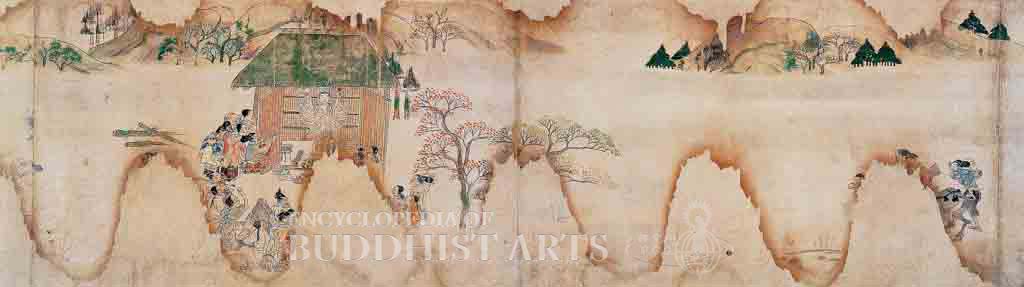
Kokawadera Temple: Legends of Kokawadera Temple (detail)
Ink and color on paper

Kokawadera Temple: Legends of Kokawadera Temple (detail)
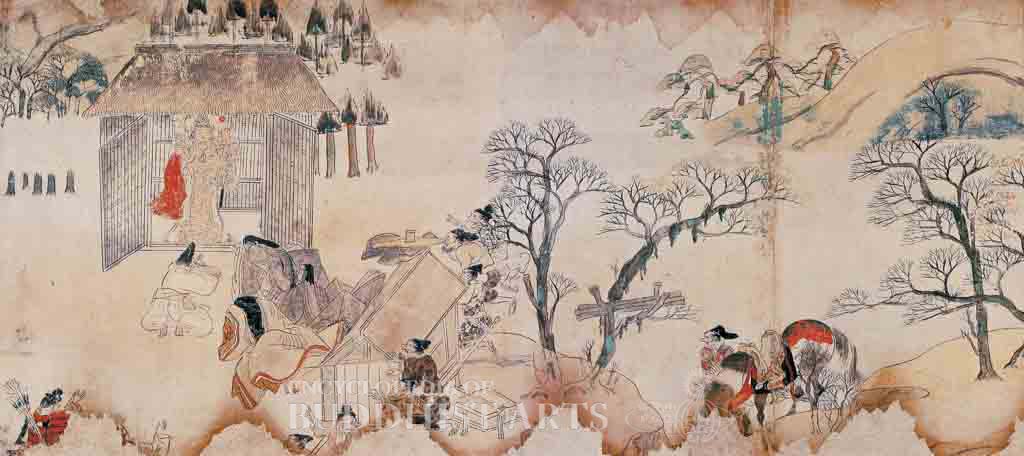
Kokawadera Temple: Legends of Kokawadera Temple - Section 5 (detail)
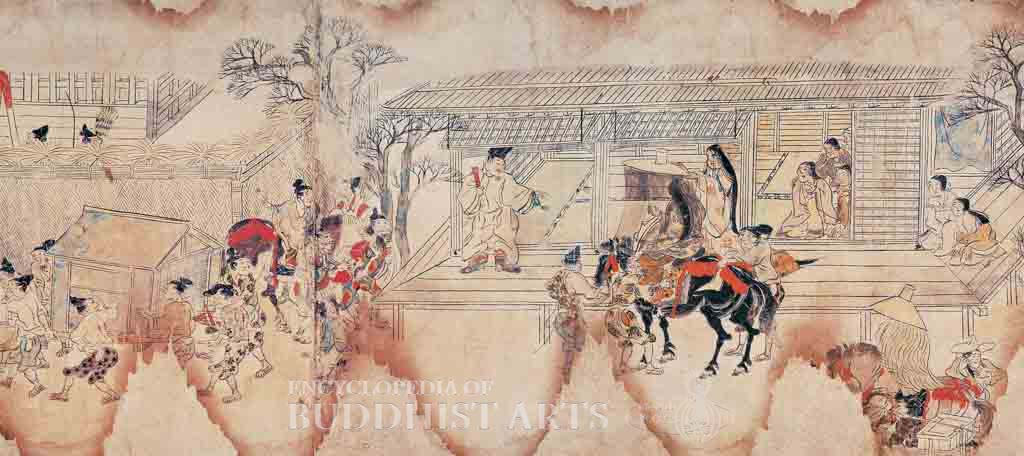
Kokawadera Temple: Legends of Kokawadera Temple - Section 5 (detail)
Kokawadera Temple: Legends of Kokawadera Temple
JAPAN, Wakayama, Kinokawa; Heian period
Painted in the 12th century, this illustrated scroll is composed of five large images and four sections of text. It depicts two stories about a manifestation of Thousand-Armed Avalokitesvara Bodhisattva described in “Origin of Kokawadera Temple” in the Compendium of Temple Legends written in 1054 of the Heian period. Some sections of the scroll have been damaged by fire, but most of the artwork is intact. It was listed as a National Treasure in 1953.
The first two sections illustrate the story of a hunter in Naga (present day Wakayama) who made a vow to erect a temple. He built a hut in his hunting area, and a mysterious boy came and sculpted a statue of the Thousand-Armed Avalokitesvara Bodhisattva in seven days. The statue was venerated by the neighboring people, and Kokawadera Temple was built around the hut. In the painting, a group of devotees are depicted kneeling before the green-roofed hut and looking up at the statue of the Bodhisattva. Offerings are placed within the hut.Trees and mountains are painted in the background.
The next three sections depict the story of a boy who cured the severe illness suffered by the daughter of an elder who lived in Kawachi no kuni (present day Osaka). It was later realized that the boy who built the statue and cured the girl was an incarnation of Thousand-Armed Avalokitesvara. Groups of people are shown gathered around a wooden house attempting to see inside. Workers carry bundles of goods towards the house. The figures are portrayed with plain, lightly colored clothing. Some of the women have their hair in long ponytails. The leaves of the tree on the right side of the image are dotted with red. A sense of rustic elegance characteristic of village life is expressed.
In the fifth section of the scroll, a group of people are shown embarking on a journey in search of the boy. There are figures mounted on horses and others carrying sedan chairs. Ladies watch the bustling scene from within their houses. They come to the hut housing the Thousand-Armed Avalokitesvara statue and recognize the red robe, held in the hands of the statue, which was previously given to the boy. Realizing that the boy was an incarnation of the Bodhisattva, the group bows before the statue.
This artwork is the earliest dated illustrated scroll in Japan. The composition of the scroll, with a group of scenes preceded by a brief written paragraph, is typical of narrative scrolls produced during the late Heian period. The buildings, figures, trees, and mountains are painted with fine, precise strokes. A vivid red color is used sparingly to highlight blossoms on the trees and the robes of some of the figures.
For more details, go to the Encyclopedia of Buddhist Arts: Painting I-O, page 444.
Cite this article:
author = Hsingyun and Youheng and Youlu and Wilson, Graham and Manho and Mankuang and Huntington, Susan,
booktitle = {Encyclopedia of Buddhist Arts: Painting I-O},
pages = 444,
title = {{Kokawadera Temple: Legends of Kokawadera Temple}},
volume = 15,
year = {2016}}