
Arhat
Ink and color on cotton
Arhat
CHINA; Ming dynasty
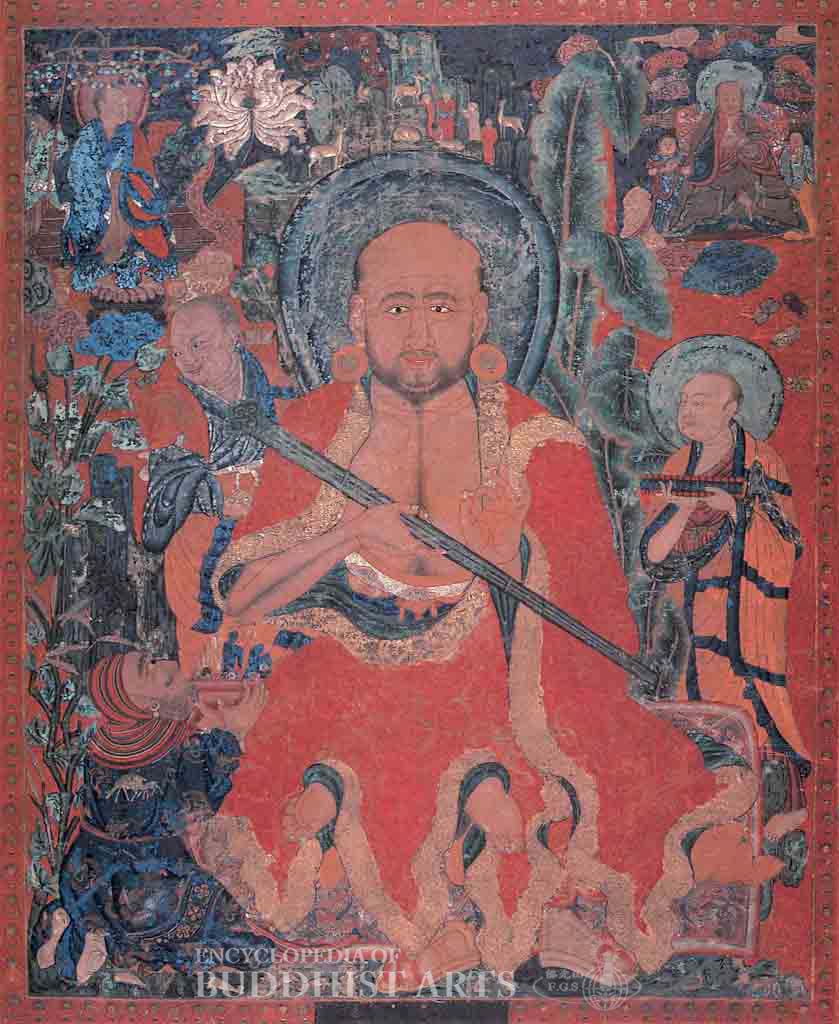
The central figure in this mid-14th century thangka from Gyantse, Tibet is thought to be Vajraputra, one of the Sixteen Arhats. The Arhat has a broad forehead, sharp eyes, and a straight nose. He smiles slightly, revealing his teeth. Dressed in a red robe decorated with gold floral patterns, the Arhat holds a short staff in his right hand and forms the vitarka (teaching) mudra with the left. He is seated with his legs crossed and his monastic shoes placed below him, leaving the feet bare. On the left behind the Arhat’s shoulder, an attendant disciple turns and looks downward. On the right, a standing monk with a nimbus holds a sutra and faces the Arhat. In the bottom left corner, a bearded man kneels and makes an offering. In the upper left corner, another Arhat with a red nimbus stands on a lotus pedestal. Behind him, an attendant holds a jeweled parasol. A seated Arhat with a green nimbus flanked by two disciples is shown in the upper right corner. Colorful clouds are painted above these three figures. The background is filled with images of plantain leaves, flowers, grass, flying butterflies, and animals. The border of the painting is decorated with small seated Buddhas, a rare design.
For more details, go to the Encyclopedia of Buddhist Arts: Painting A-H, page 53.
Cite this article:
author = Hsingyun and Youheng and Youlu and Wilson, Graham and Manho and Mankuang and Huntington, Susan,
booktitle = {Encyclopedia of Buddhist Arts: Painting A-H},
pages = 53,
title = {{Arhat}},
volume = 14,
year = {2016}}