
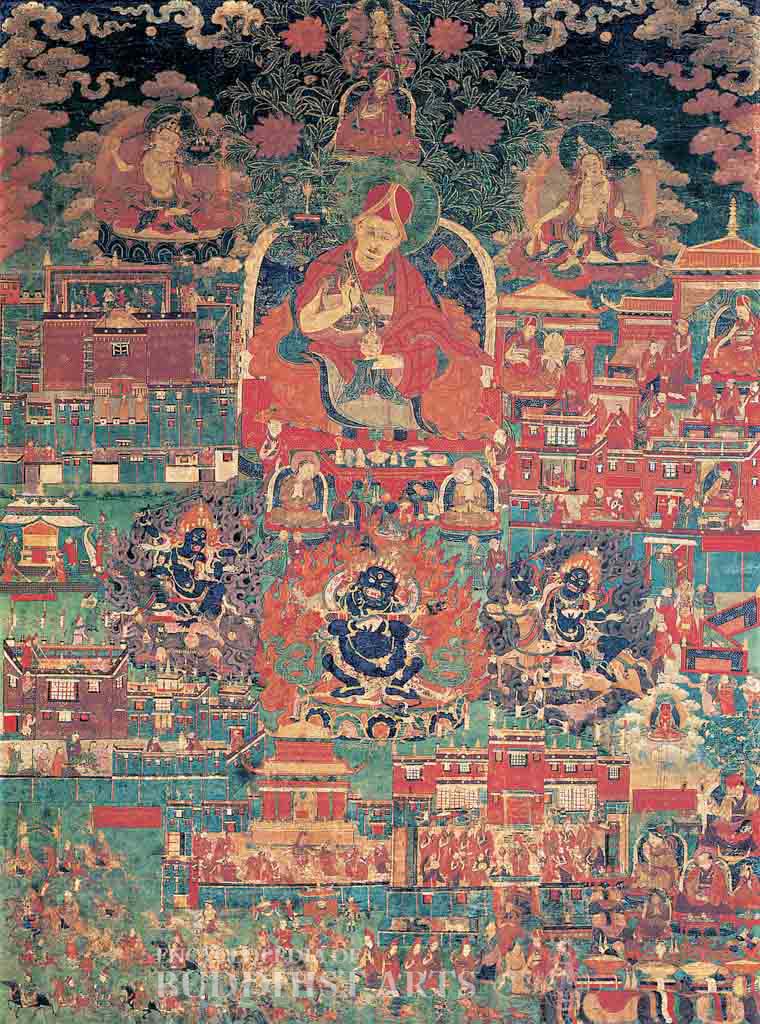
Guru
Color on cotton
Guru
CHINA, Tibet
This innovative thangka of a guru from Central Tibet was painted in the late 17th century. The guru wears a monastic robe and the ritual hat of the Sakya school. His right hand holds a lotus topped with a sutra chest and a flaming sword, while the left hand holds a vase containing the elixir of immortality. A table covered with offerings is placed at the foot of the throne. Two disciples stand beside the table. Below the disciples, the two sponsors of this thangka, wearing brown robes, sit with joined palms.
Above the guru’s nimbus, there is a lama who appears as the lineage holder of the Sakya school, and above the lama is an image of Vajradhara. Both are surrounded by Chinese peonies. Manjusri Bodhisattva is depicted on the left, and White Tara is shown on the right. In the middle of the thangka, there are three blue Dharma protectors. Mahakala, the spiritual protector of the Sakya school, is in the center, flanked by two forms of Mahadevi. The guru is thought to be Kunga Tashi, the 32nd abbot of the Sakya Monastery and the National Master during the Ming dynasty (1368–1644). Scenes from the guru’s life are illustrated at the bottom of the thangka and to the sides of the central figure.
For more details, go to the Encyclopedia of Buddhist Arts: Painting A-H, page 318.
Cite this article:
author = Hsingyun and Youheng and Youlu and Wilson, Graham and Manho and Mankuang and Huntington, Susan,
booktitle = {Encyclopedia of Buddhist Arts: Painting A-H},
pages = 318,
title = {{Guru}},
volume = 14,
year = {2016}}