
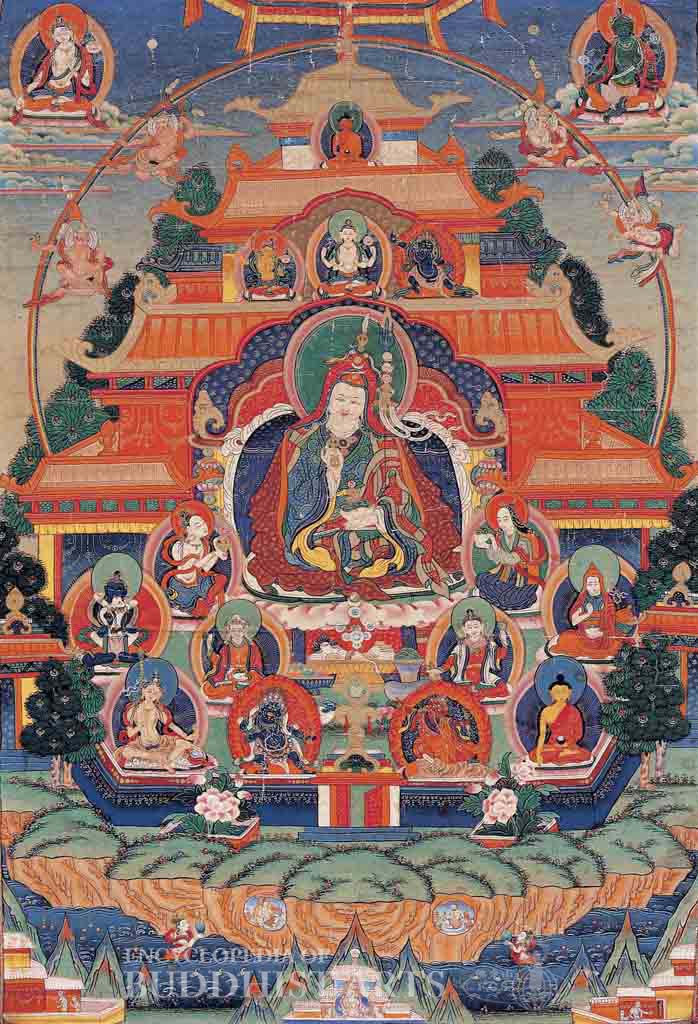
Padmasambhava
Color on linen
Padmasambhava
CHINA, Tibet
In 747, the Vajrayana Master Padmasambhava traveled from India to Tibet. He subdued local deities, taught the Dharma, and founded the Nyingma school of Tibetan Buddhism. His influence was such that he is revered in Tibet as a manifestation of Avalokitesvara. This 18th century thangka illustrates the Copper Mountain Paradise where Padmasambhava is said to reside. The paradise is depicted as a heavenly palace surrounded by a lake. Padmasambhava sits in the center, wearing a headdress topped with a peacock plume symbolizing purity. Beneath the peacock plume is a vajra that represents the completion of the path, and a sun and moon that denote enlightenment. Padmasambhava holds up a vajra with his right hand. A tantric staff rests against his left shoulder. He is flanked by Mandarava and Yeshe Tsogyal. Buddhas, Bodhisattvas, Dharma protectors, and lamas are depicted below. The red Amitabha Buddha sits at the top of the palace.
For more details, go to the Encyclopedia of Buddhist Arts: Painting P-Z, page 727.
Cite this article:
author = Hsingyun and Youheng and Youlu and Wilson, Graham and Manho and Mankuang and Huntington, Susan,
booktitle = {Encyclopedia of Buddhist Arts: Painting P-Z},
pages = 727,
title = {{Padmasambhava}},
volume = 16,
year = {2016}}