
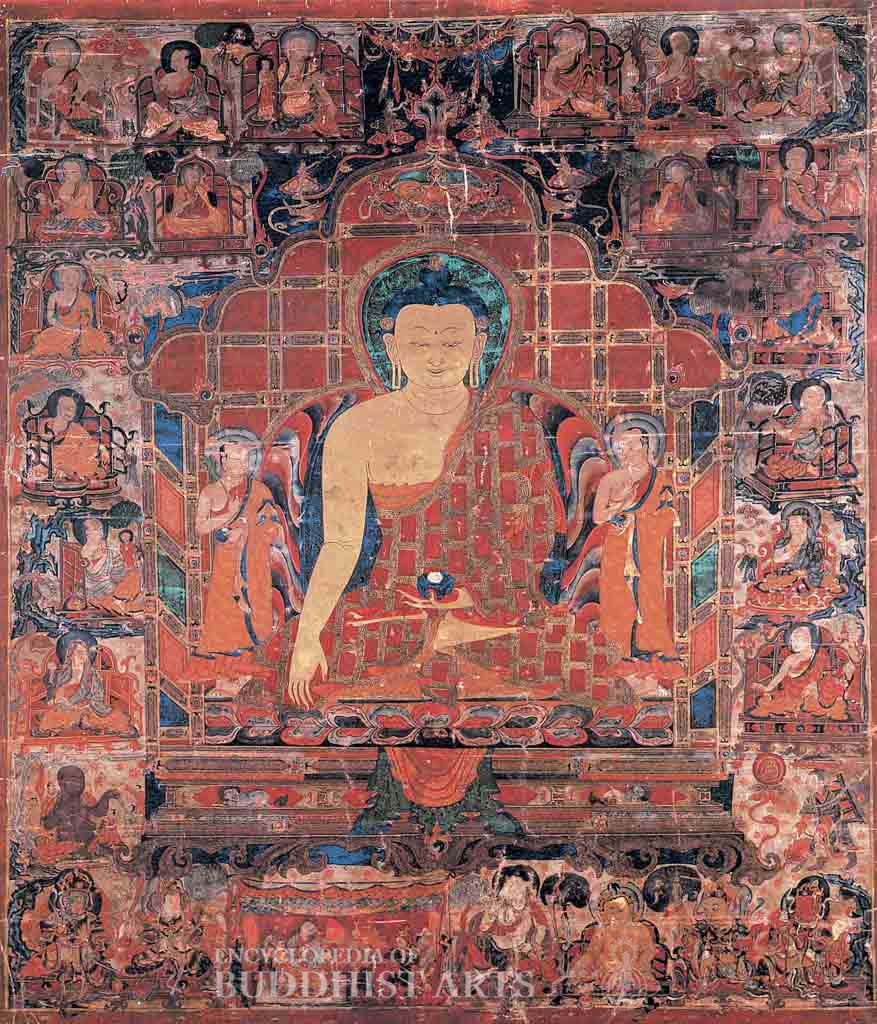
Sakyamuni Buddha and the Eighteen Arhats
Color on cotton
Sakyamuni Buddha and the Eighteen Arhats
CHINA, Tibet
In the center of this mid-15th century central Tibetan thangka, Sakyamuni Buddha sits in full lotus position on a lotus throne, smiling slightly and reaching down with his right hand to form the bhumisparsa (earth-touching) mudra. The Buddha has a robust golden body, blue hair, long ears, and a tall usnisa. A patched monastic robe is draped over the left shoulder. The left hand cradles an alms bowl. Sariputra and Maudgalyayana, both wearing orange monastic robes, stand beside the Buddha. The three figures are contained within a throne structure decorated with geometric patterns that mirror those on the robe of the Buddha. Auspicious creatures, scrolling patterns, and flaming jewels form an arch at the top.
The rest of the thangka is filled with smaller images of the Eighteen Arhats and deities sitting on decorative thrones. Uniquely shaped trees and rocks are painted beside some of the Arhats. At the bottom of the picture, there are depictions of the Four Heavenly Kings, Ganesa, and Kubera, the deity of wealth. Painted in a blend of Chinese, Tibetan, and Nepalese styles from the 13th and 14th centuries, the thangka is a carefully arranged, beautifully detailed artwork.
For more details, go to the Encyclopedia of Buddhist Arts: Painting P-Z, page 785.
Cite this article:
author = Hsingyun and Youheng and Youlu and Wilson, Graham and Manho and Mankuang and Huntington, Susan,
booktitle = {Encyclopedia of Buddhist Arts: Painting P-Z},
pages = 785,
title = {{Sakyamuni Buddha and the Eighteen Arhats}},
volume = 16,
year = {2016}}