
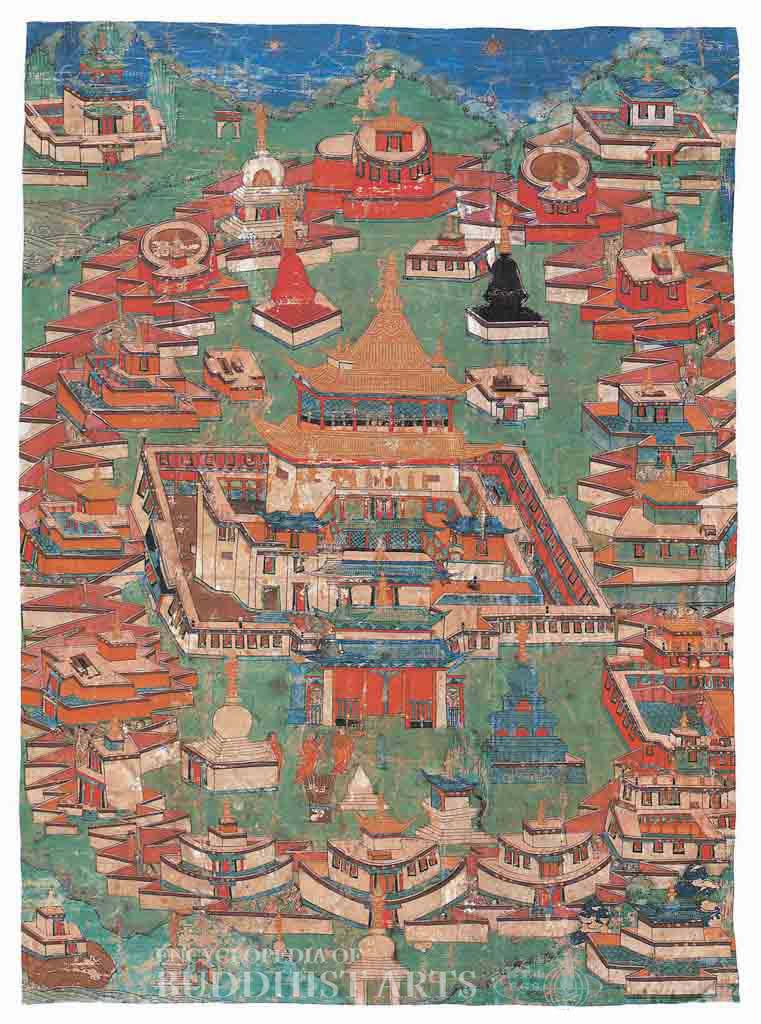
Samye Monastery
Color on cotton
Samye Monastery
CHINA, Tibet
Thought to have been painted in either U-Tsang or eastern Tibet, this rare example of a thangka depicting architecture dates from the late 18th or early 19th century. It is said that Trisong Detsen (reigned 755–797) presided over the foundation-laying ceremony of Samye Monastery, and that the monastery was built with the assistance of Santarakshita and Padmasambhava sometime during the 8th century. It was modeled after the famous Odantapuri Monastery in India.
Samye Monastery, with a gold Chinese-style hip-and-gable roof designed with sharply upturned eaves, is in the center of the painting. The large gateway below the monastery is guarded by two carved snow lions on pedestals. Five stupas colored red, white, black, or blue are arranged on the grounds around the central building. Three monastics in orange robes stand beside the white stupa in the lower register. A jagged wall that contains numerous smaller temples and buildings forms the border of the monastery. The buildings have a three-dimensional appearance and are brightly colored.
For more details, go to the Encyclopedia of Buddhist Arts: Painting P-Z, page 794.
Cite this article:
author = Hsingyun and Youheng and Youlu and Wilson, Graham and Manho and Mankuang and Huntington, Susan,
booktitle = {Encyclopedia of Buddhist Arts: Painting P-Z},
pages = 794,
title = {{Samye Monastery}},
volume = 16,
year = {2016}}