
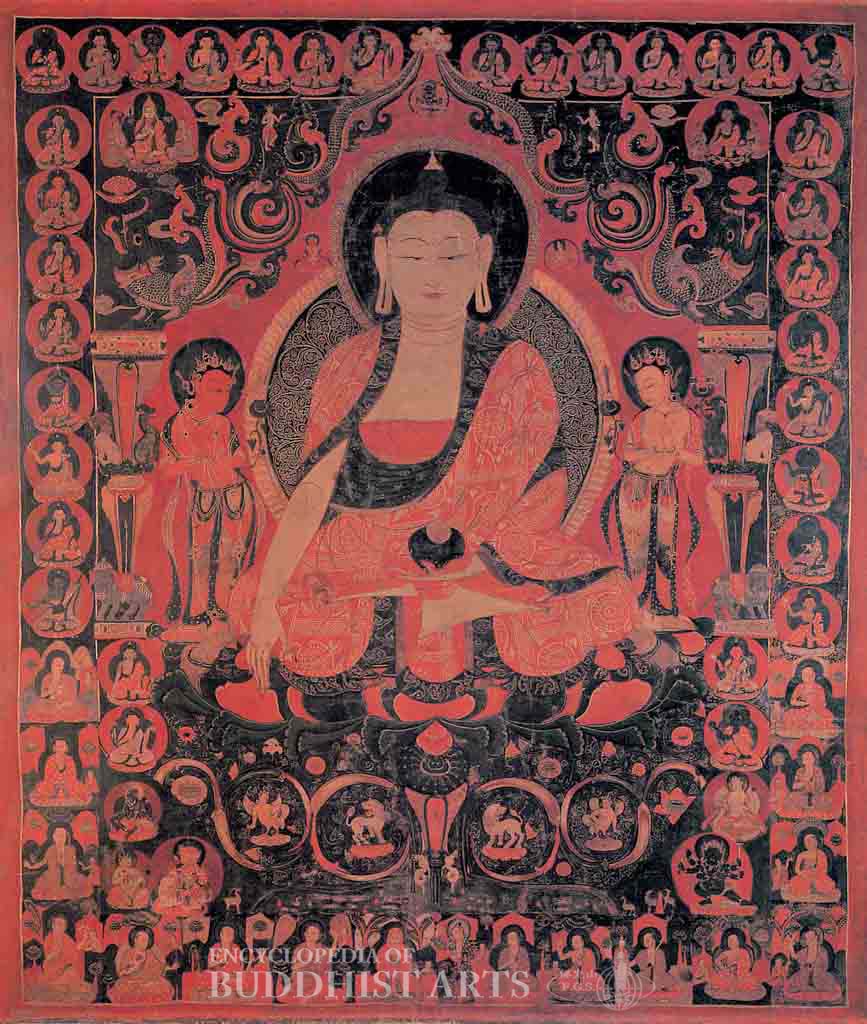
Sakyamuni Buddha Triad
Color on cotton
Sakyamuni Buddha Triad
CHINA, Tibet; Guge Kingdom
This thangka from the second half of the 15th century was made by artists from the Guge Kingdom. The central figure, Sakyamuni Buddha has a usnisa topped with a small tower. The right hand extends to form the bhumisparsa (earth-touching) mudra, and the left hand cradles an alms bowl. Gold patterns cover the Buddha’s red monastic robe and blue aureole. The small figures of Amitabha Buddha, Vajradhara Bodhisattva, and Atisa are arranged within the red backrest, surrounded by an arch decorated with scrolling vines and makaras. Tsongkhapa sits with two disciples outside the arch on the left. Maitreya Bodhisattva, holding a lotus topped with a vase, and Manjusri Bodhisattva, carrying lotuses topped with a sword and a sutra, stand in tribhanga posture beside the Buddha.
The central Buddha together with the smaller Buddha figures along both sides and the top of the thangka make up the Thirty-Five Buddhas of Confession. Lining the lower sides and the bottom are the Sixteen Arhats; Dharmatala, the lay Buddhist, stands in the center of the bottom row of figures. Two naga kings rise from the water in the lower register, flanked by animals, auspicious symbols, and several figures including Green Tara, White Tara, Vaisravana, and Six-Armed Mahakala. Like most Guge Kingdom art, the thangka blends Indian, Nepalese, and Tibetan styles.
For more details, go to the Encyclopedia of Buddhist Arts: Painting P-Z, page 789.
Cite this article:
author = Hsingyun and Youheng and Youlu and Wilson, Graham and Manho and Mankuang and Huntington, Susan,
booktitle = {Encyclopedia of Buddhist Arts: Painting P-Z},
pages = 789,
title = {{Sakyamuni Buddha Triad}},
volume = 16,
year = {2016}}