
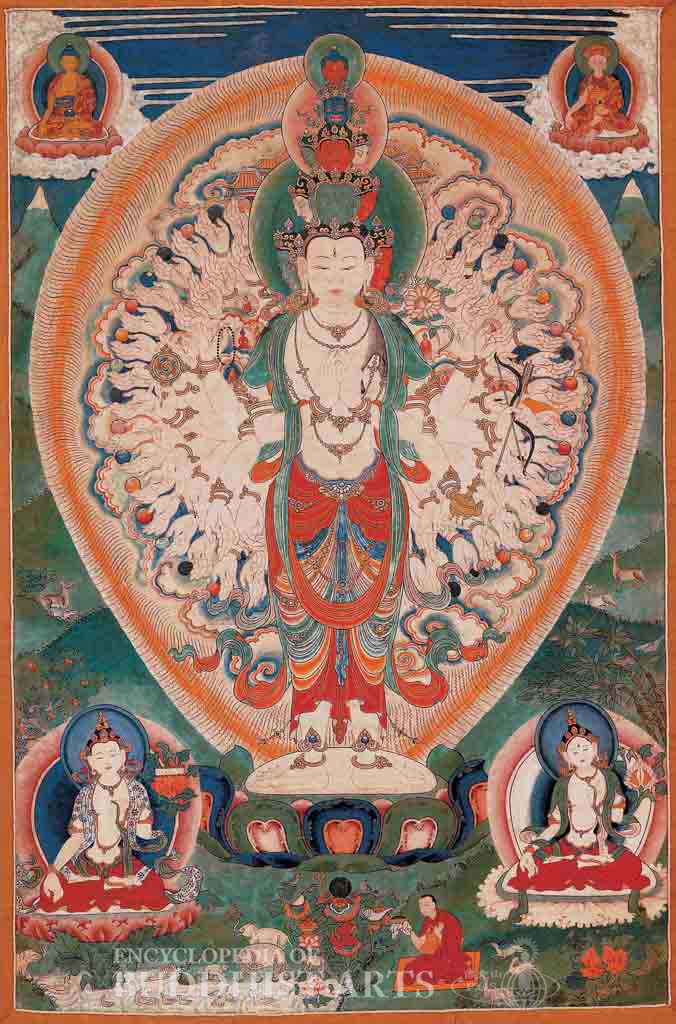
Norbugang Monastery: Thousand-Armed, Thousand-Eyed Avalokitesvara
Ink and color on cotton
Norbugang Monastery: Thousand-Armed, Thousand-Eyed Avalokitesvara
BHUTAN, Punakha
After hearing the Buddha expound the Great Compassion Dharani Sutra, Avalokitesvara Bodhisattva rejoiced and vowed to help all sentient beings. Having made the vow, the Bodhisattva became equipped with a thousand arms and a thousand eyes to perceive suffering and reach out to relieve it. Vajrayana Buddhist art often portrays Avalokitesvara in this form.
In this 19th-century Bhutanese thangka, the Bodhisattva stands facing forwards on a lotus pedestal. The heads are arranged in five tiers, with the red head of Amitabha Buddha at the top above the wrathful blue head of Vajrapani. There are three heads in alternating white, red, and green colors in the remaining three tiers. A heavenly palace is partially visible behind the three nimbuses that surround the heads, and small seated Buddhas are painted beside the shoulders. The body is covered with necklaces, string ornaments, a stole, and a colorful dhoti. Two of the hands gently clasp a wish-fulfilling jewel in front of the chest. The rest of the hands, each with an eye within the palm, fan out around the body, holding Dharma implements including prayer beads, a Dharma wheel, a lotus, a bow, an arrow, and a vase. Behind the bow and arrow, the Buddhas of the Past, Present, and Future are partially visible. The outer ring of hands hold colorful jewels and are bordered by lines of cloud. A mandorla composed of red and black lines backed with orange color surrounds the figure.
In the upper left corner, Sakyamuni Buddha sits on a lotus throne. The figure in the upper right corner wearing a hat and a patched monastic robe is Khenpo Tenzin Chogyal, the founder of Norbugang Monastery. His right hand supports a vase containing the elixir of immortality. Manjusri Bodhisattva and White Tara are depicted in the lower corners. Both have white skin, wear crowns, and sit in full lotus position on lotus thrones. Manjusri holds a long-stemmed lotus topped with a sutra; Tara also holds a lotus.
Symbols representing the five senses are painted in the center of the lower register. There is a mirror for sight, a dramyen (Bhutanese instrument) for sound, a conch shell filled with yogurt for smell, fruit for taste, and a red scarf for touch. The monk painted to the right of these symbols is thought to be the sponsor of the thangka.
For more details, go to the Encyclopedia of Buddhist Arts: Painting I-O, page 714.
Cite this article:
author = Hsingyun and Youheng and Youlu and Wilson, Graham and Manho and Mankuang and Huntington, Susan,
booktitle = {Encyclopedia of Buddhist Arts: Painting I-O},
pages = 714,
title = {{Norbugang Monastery: Thousand-Armed, Thousand-Eyed Avalokitesvara}},
volume = 15,
year = {2016}}