
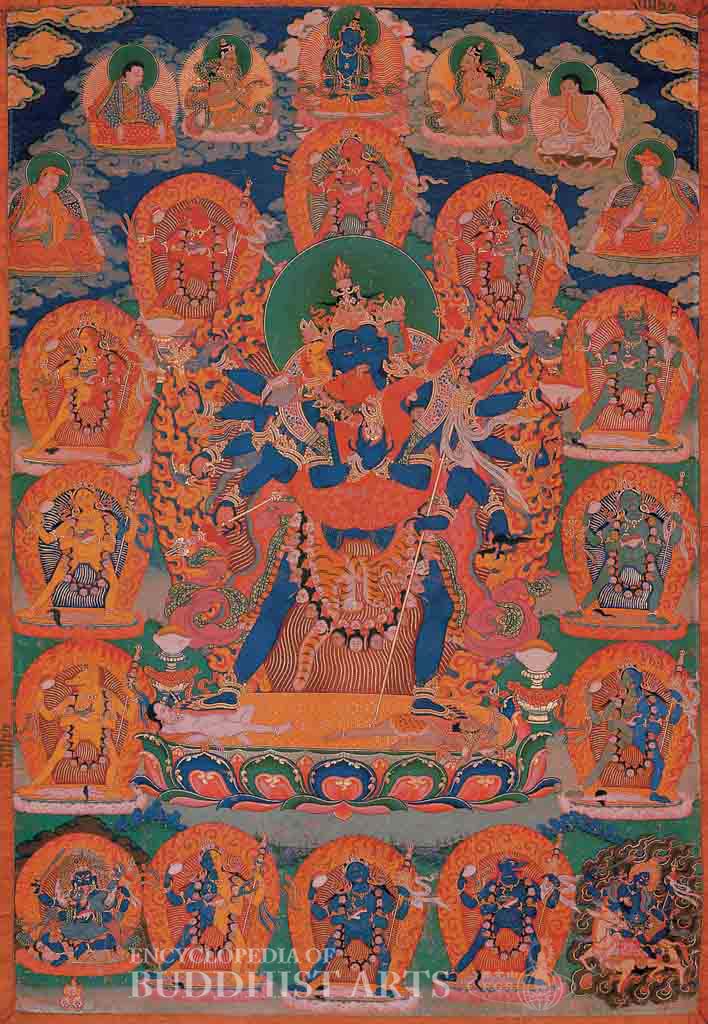
Phajoding Monastery: Cakrasamvara and Consort
Ink and color on cotton
Phajoding Monastery: Cakrasamvara and Consort
BHUTAN, Thimphu
This Bhutanese thangka is currently kept in Phajoding Monastery, Thimphu. The Buddhist art of Bhutan is heavily influenced by art from India, Nepal, and China. It often takes the form of colorful mandala and thangka paintings, drawn on cotton using natural pigments, that are kept in various monasteries. Most of them were completed after the 16th century and feature a rich array of themes.
This painting features Cakrasamvara with five heads and twelve arms. The hands hold several objects including a trident, a vajra axe, a skull cup, and a double-sided drum. Cakrasamvara wears a tiger-skin garment, a necklace made of human heads, and a garland of skulls. Standing on two deities who lie on a colorful lotus throne, he holds his consort, the red Vajravarahi, in an intimate embrace.
Cakrasamvara and Vajravarahi are surrounded by twelve yoginis who wear five-skull crowns and garlands of human heads. The four deities who occupy the four cardinal directions are the blue Dakini, who represents awareness of the body; the yellow Rupini, who represents awareness of the mind; the red Khandaroha, who represents awareness of mental phenomena; and the green Lama, who represents awareness of feelings. The four animal-headed figures are the guardians of the four gates. The blue, crow-headed Kakasya symbolizes right action; the yellow, sow-headed Sukarasya symbolizes right mindfulness; the red, dog-headed Svanasya symbolizes right effort; and the green, owl-headed Ulukasya symbolizes right livelihood. The remaining four two-colored guardian deities are the blue-yellow Yamadahi, the yellow-red Yamaduti, the red-green Yamadamstri, and the green-blue Yamamathani.
In the upper register, the blue Vajradhara is flanked by six lamas of the Kagyu school. Moving from left to right, the lamas are Pema Karpo, Marpa, Tilopa, Naropa, Milarepa, and an unidentified figure. Mahadevi and the four-armed Mahakala are painted in the lower corners.
For more details, go to the Encyclopedia of Buddhist Arts: Painting P-Z, page 739.
Cite this article:
author = Hsingyun and Youheng and Youlu and Wilson, Graham and Manho and Mankuang and Huntington, Susan,
booktitle = {Encyclopedia of Buddhist Arts: Painting P-Z},
pages = 739,
title = {{Phajoding Monastery: Cakrasamvara and Consort}},
volume = 16,
year = {2016}}