
Seula Monastery: Complete Mandala
Ink and color on cotton
Seula Monastery: Complete Mandala
BHUTAN, Punakha
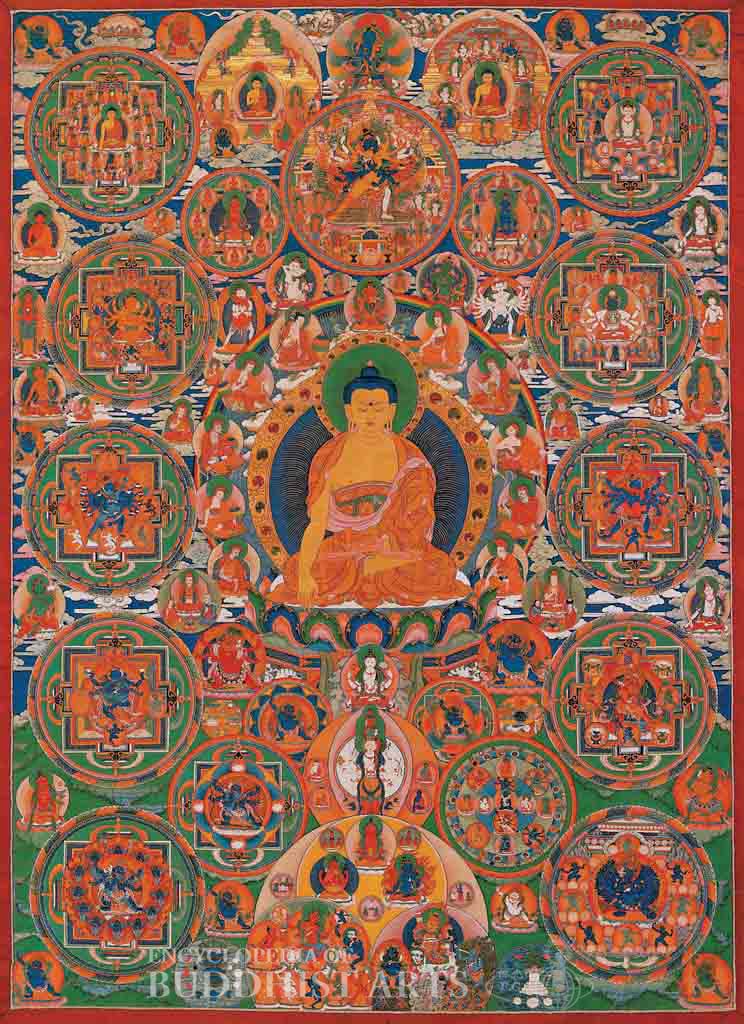
This thangka shows a “complete mandala” composed of several smaller mandalas depicting many deities in the Buddhist pantheon. The central figure, Sakyamuni Buddha, has a tall, round topknot and sits in full lotus position. His right hand forms the bhumisparsa (earth-touching) mudra while the left hand rests on the lap. The rings of the nimbus and aureole are adorned with jewels. The outermost ring of the mandorla is a seven-colored rainbow encircling eleven figures, including Amitayus Buddha at the apex, mahasiddhas, and lamas.
The Kalacakra Mandala sits in the center of the upper register. From top to bottom on the right are the Vairocana Buddha Mandala surrounded by the Five Buddha Families, the Mandala of Guhyasamaja with four Buddhas, the Mandala of Cakrasamvara, the Mandala of Raktayamari, and the Mandala of Vajrabhairava. From top to bottom on the left are the Mandala of Sakyamuni Buddha, the Thirty-Five Buddhas of Confession and the Medicine Buddha, the Mandala of Ratnasambhava Buddha, and the Mandala of Hevajra. The Mandala of Vajrakila is at the bottom.
Four-Armed Avalokitesvara Bodhisattva is depicted beneath the lotus throne of the central figure. Below, there are images of Eleven-Headed Avalokitesvara and the Five Dhyani Buddhas. A yellow circle of light containing Amitayus Buddha, the red Avalokitesvara, and the blue Vajrasattva is painted below Eleven-Headed Avalokitesvara. In the bottom register on the right, there are images of Vaisramana, who carries an umbrella, and Mahakala. On the left are Vajravarahi and Vajrayogini. The remaining small figures include Maitreya Buddha, Vajradhara, Sakyamuni Buddha, Amitayus Buddha, Aksobhya Buddha, and Samantabhadra Bodhisattva.
For more details, go to the Encyclopedia of Buddhist Arts: Painting P-Z, page 806.
Cite this article:
author = Hsingyun and Youheng and Youlu and Wilson, Graham and Manho and Mankuang and Huntington, Susan,
booktitle = {Encyclopedia of Buddhist Arts: Painting P-Z},
pages = 806,
title = {{Seula Monastery: Complete Mandala}},
volume = 16,
year = {2016}}