
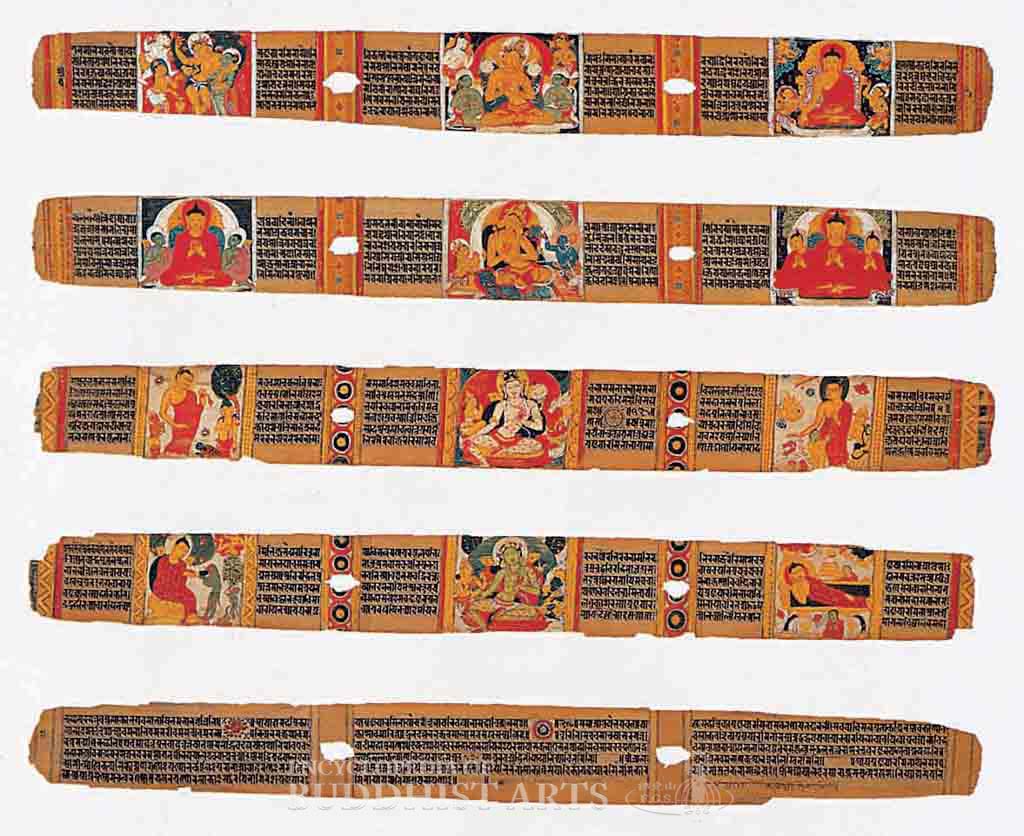
Nalanda: Illustrated Manuscript of the Astasahasrika Prajnaparamita Sutra
Color on palm leaf
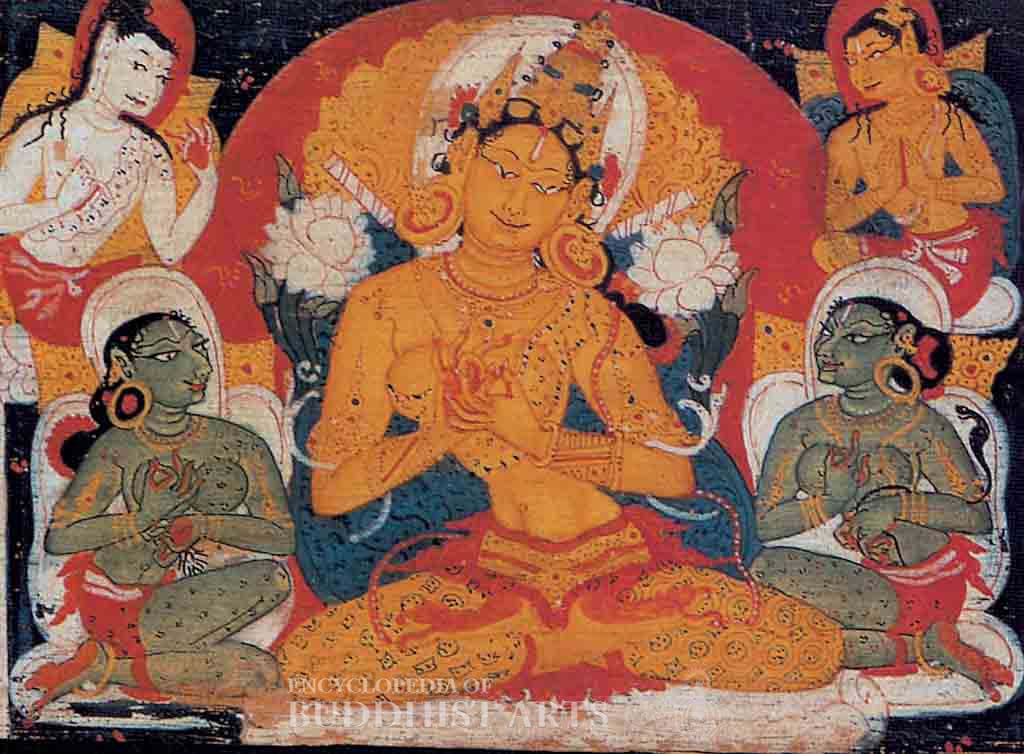
Nalanda: Illustrated Manuscript of the Astasahasrika Prajnaparamita Sutra - Prajnaparamita Bodhisattva and Attendants
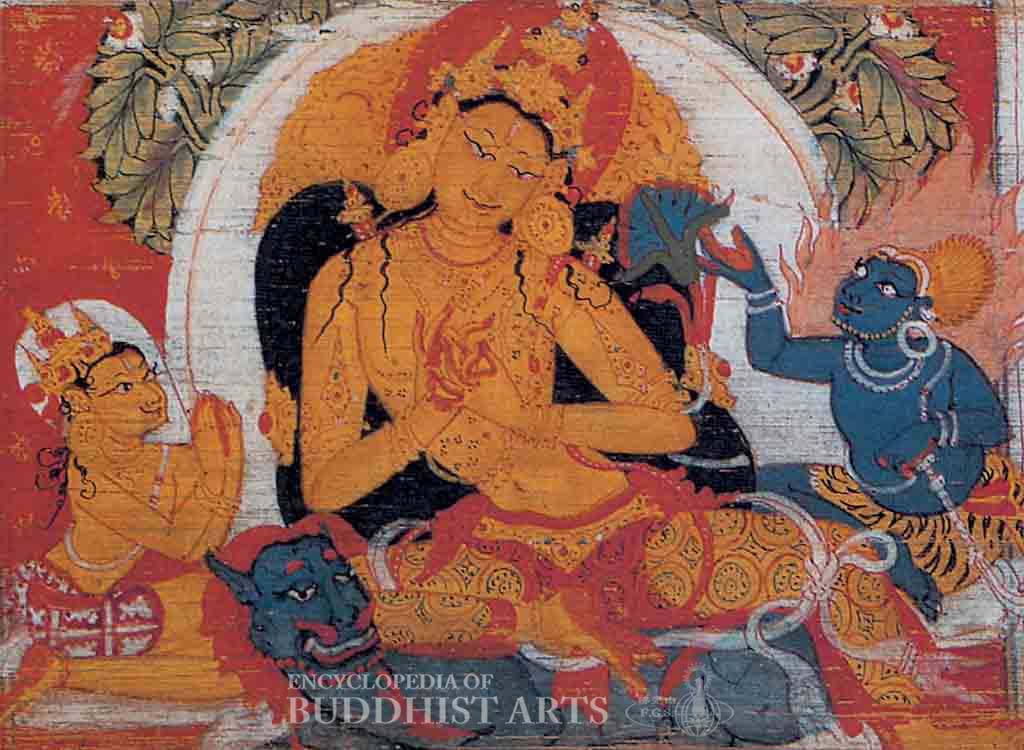
Nalanda: Illustrated Manuscript of the Astasahasrika Prajnaparamita Sutra - Manjusri Bodhisattva and Attendants
Nalanda: Illustrated Manuscript of the Astasahasrika Prajnaparamita Sutra
INDIA, Bihar
This manuscript of the Astasahasrika Prajnaparamita Sutra dated to 1073 was discovered at the site of Nalanda in Bihar. It is written on talipot palm leaves laced together with cord and illustrated with images of Buddhist deities and scenes from the Life of the Buddha, common themes in 11th and 12th century Pala period (circa 8th–12th century) art. A Sanskrit inscription states that the manuscript was commissioned by a devotee named Nae Suta Shoha Sitna, and was copied and illustrated by Ananda of Nalanda. Another inscription indicates that the manuscript was rededicated and possibly repaired in 1151.
The four palm leaves shown here are illustrated with a Bodhisattva and attendants in the middle, and scenes from the Life of the Buddha on the sides. Moving from top to bottom, the central figures are Prajnaparamita Bodhisattva, Manjusri Bodhisattva, Avalokitesvara Bodhisattva, and Tara. The scenes from the Life of the Buddha include the Birth of Prince Siddhartha, Defeat of Mara and Enlightenment, First Turning of the Dharma Wheel, Miracle at Sravasti, Descent from Trayastrimsa Heaven, Calming the Drunken Elephant, Monkey Offering Honey, and Nirvana. The Bodhisattvas have slim figures and bare upper bodies adorned with ornaments. They sit in lotus position, leaning slightly to one side and forming mudras in front of their chests. Their attendants have colorful skin and are arranged in dynamic poses. In the images on the sides, the Buddha is depicted with a red monastic robe, a usnisa, and a nimbus.
For more details, go to the Encyclopedia of Buddhist Arts: Painting I-O, page 709.
Cite this article:
author = Hsingyun and Youheng and Youlu and Wilson, Graham and Manho and Mankuang and Huntington, Susan,
booktitle = {Encyclopedia of Buddhist Arts: Painting I-O},
pages = 709,
title = {{Nalanda: Illustrated Manuscript of the Astasahasrika Prajnaparamita Sutra}},
volume = 15,
year = {2016}}