
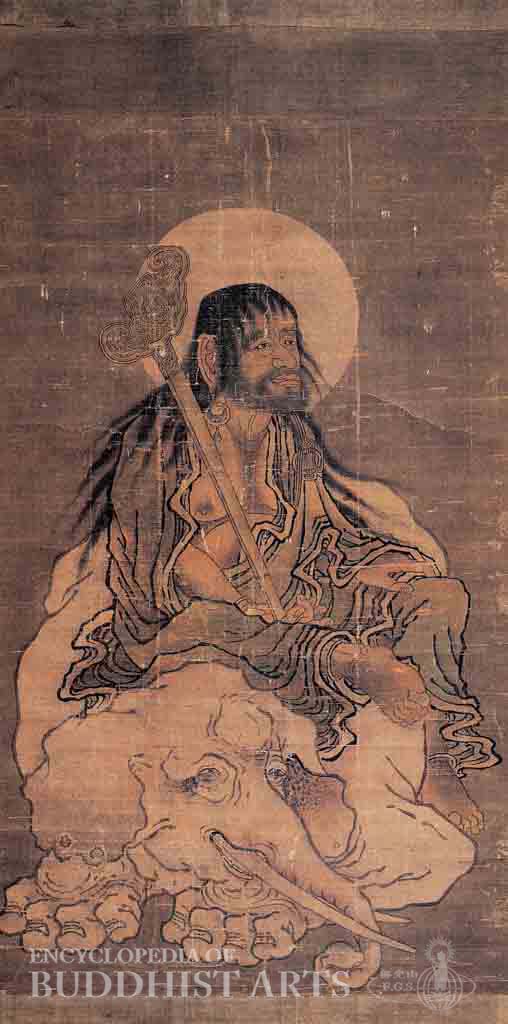
Samantabhadra Bodhisattva
Ink and color on silk
Samantabhadra Bodhisattva
CHINA; Yuan dynasty
Listed as an Important Cultural Property of Japan in 1907, this picture was painted according to descriptions in the “Chapter on the Encouragement of Samantabhadra Bodhisattva” in the Lotus Sutra. It is said that the Bodhisattva will appear, riding on an elephant, in front of one who contemplates the sutra.
Samantabhadra has a beard, a large nose, wrinkled eyes, and long hair that hangs past the shoulders. The Bodhisattva sits in relaxed posture on the back of a crouching elephant, balancing a large ruyi (wish-fulfilling talisman) against the right shoulder. The simple green robe leaves part of the chest bare. Thick lines painted with twisting strokes are used to outline the elephant and the folds in the robe. The picture is similar in style to a painting of Sakyamuni Buddha by Yan Hui currently kept in Rokuoin Temple, Tokyo. It is thought that the two works could have originally been part of a Sakyamuni Buddha Triad.
For more details, go to the Encyclopedia of Buddhist Arts: Painting P-Z, page 789.
Cite this article:
author = Hsingyun and Youheng and Youlu and Wilson, Graham and Manho and Mankuang and Huntington, Susan,
booktitle = {Encyclopedia of Buddhist Arts: Painting P-Z},
pages = 789,
title = {{Samantabhadra Bodhisattva}},
volume = 16,
year = {2016}}