
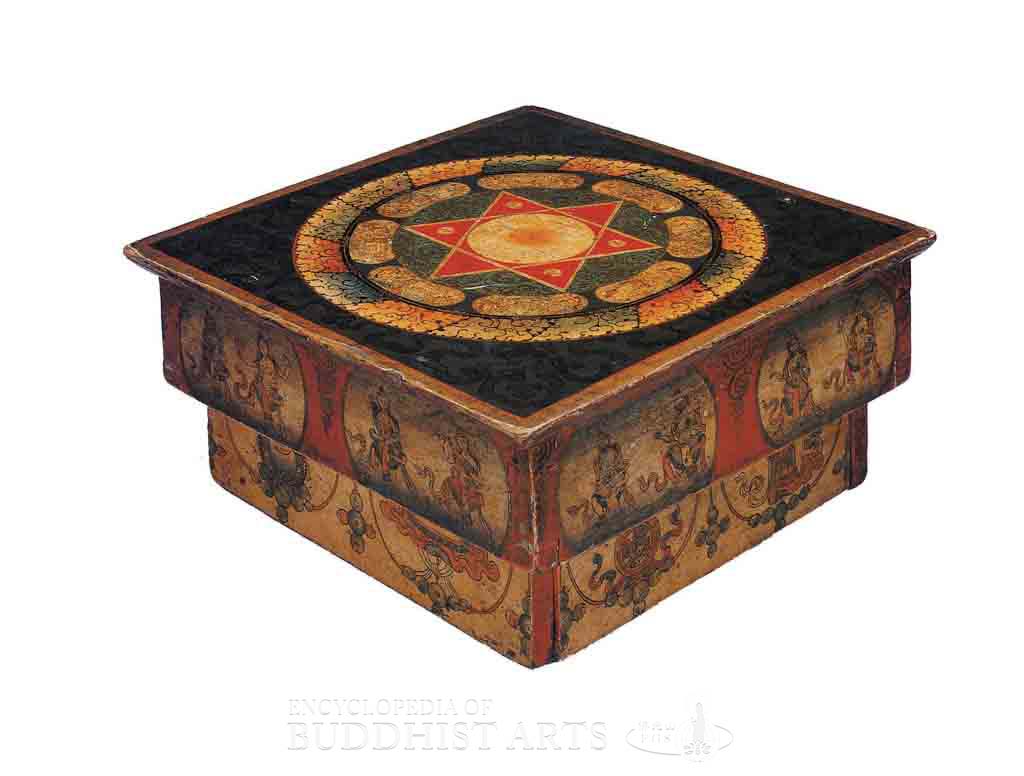
Altar with Mandala
Wood
Altar with Mandala
CHINA; Qing dynasty
This wooden altar is used in Tibetan rituals. On the surface, there is a two-dimensional mandala of Vajrayogini, a meditation deity of Tibetan Buddhism.
The core of the mandala is the Dharmodaya, which symbolizes the arising of all Dharma. It consists of two equilateral triangles overlapping to form a star with six points. The inner red center represents great bliss, while the outer white area symbolizes Bodhi mind and emptiness. The Dharmodaya is visualized as three-dimensional, radiating in brilliant red and white lights. The circle in the center symbolizes the source of one’s wisdom placed in a womblike space for the subduing of defilement in completion of the Buddha’s path. Within the small triangles, there are four white whorls, which are visualized as spinning counter-clockwise and signify the four joys.
The inner core is surrounded by eight charnel grounds, within which there are various carrion-eating animals, yogis and yoginis, snakes, rain clouds, stupas, and other phenomena that one recognizes as the symbol of enlightenment. The outermost ring represents the five-color flames of knowledge, surrounding a thin ring of vajras.
The sides of the altar are divided into two registers. The upper register is painted with 16 deities dancing on all four sides, and the lower register is decorated with the eight auspicious symbols.
For more details, go to the Encyclopedia of Buddhist Arts: Artifacts, page 2.
Cite this article:
author = Hsingyun and Youheng and Youji and Pokorski, Stefanie and Mankuang and Fan, Wen,
booktitle = {Encyclopedia of Buddhist Arts: Artifacts },
pages = 2,
title = {{Altar with Mandala}},
volume = 18,
year = {2016}}