

Illustrated Manuscript Cover of the Astasahasrika Prajnaparamita Sutra
Ink and color on wood
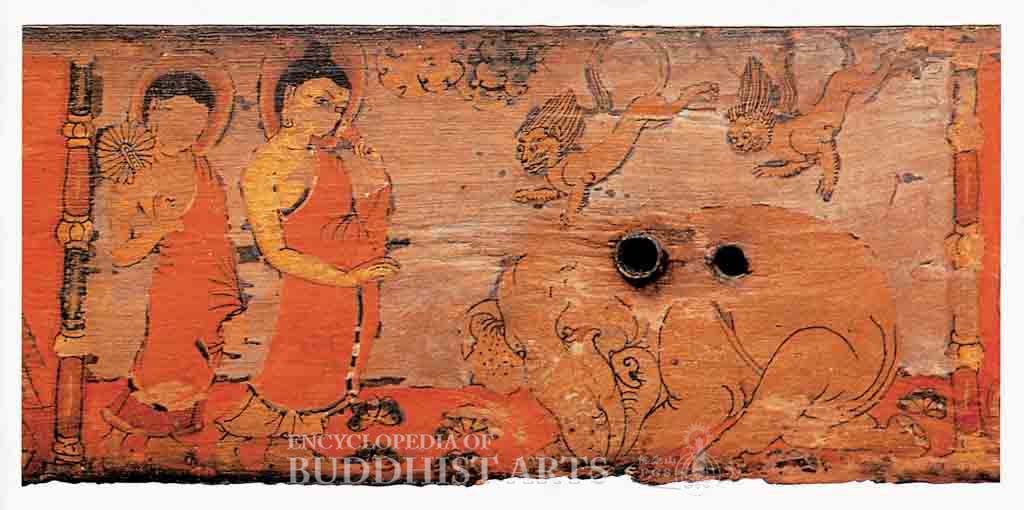
Illustrated Manuscript Cover of the Astasahasrika Prajnaparamita Sutra - Life of the Buddha - Calming the Drunken Elephant
Illustrated Manuscript Cover of the Astasahasrika Prajnaparamita Sutra
NEPAL
The prominence of the seated Prajnaparamita Bodhisattva indicates that this was a cover for the Astasahasrika Prajnaparamita Sutra. The style of the manuscript is characteristic of Nepalese and Indian artworks from the Pala period (circa 8th–12th century).
Prajnaparamita sits in full lotus position in the center of the illustration. Two of the four hands form mudras while the other two hold up prayer beads and a scripture. The orange aureole is decorated with blue dots. Though much of the color on the mandorla has peeled away, a gold background and black lines are still visible. On the right beside Prajnaparamita is a green attendant. The yellow figure on the left holds a lotus, suggesting that it is Padmapani Bodhisattva. To the sides of the central image, there are four scenes from the Life of the Buddha. From left to right, they are the Birth of Prince Siddhartha, Calming the Drunken Elephant, the Buddha Teaching the Dharma, and the Miracle at Sravasti.
For more details, go to the Encyclopedia of Buddhist Arts: Painting I-O, page 356.
Cite this article:
author = Hsingyun and Youheng and Youlu and Wilson, Graham and Manho and Mankuang and Huntington, Susan,
booktitle = {Encyclopedia of Buddhist Arts: Painting I-O},
pages = 356,
title = {{Illustrated Manuscript Cover of the Astasahasrika Prajnaparamita Sutra}},
volume = 15,
year = {2016}}