
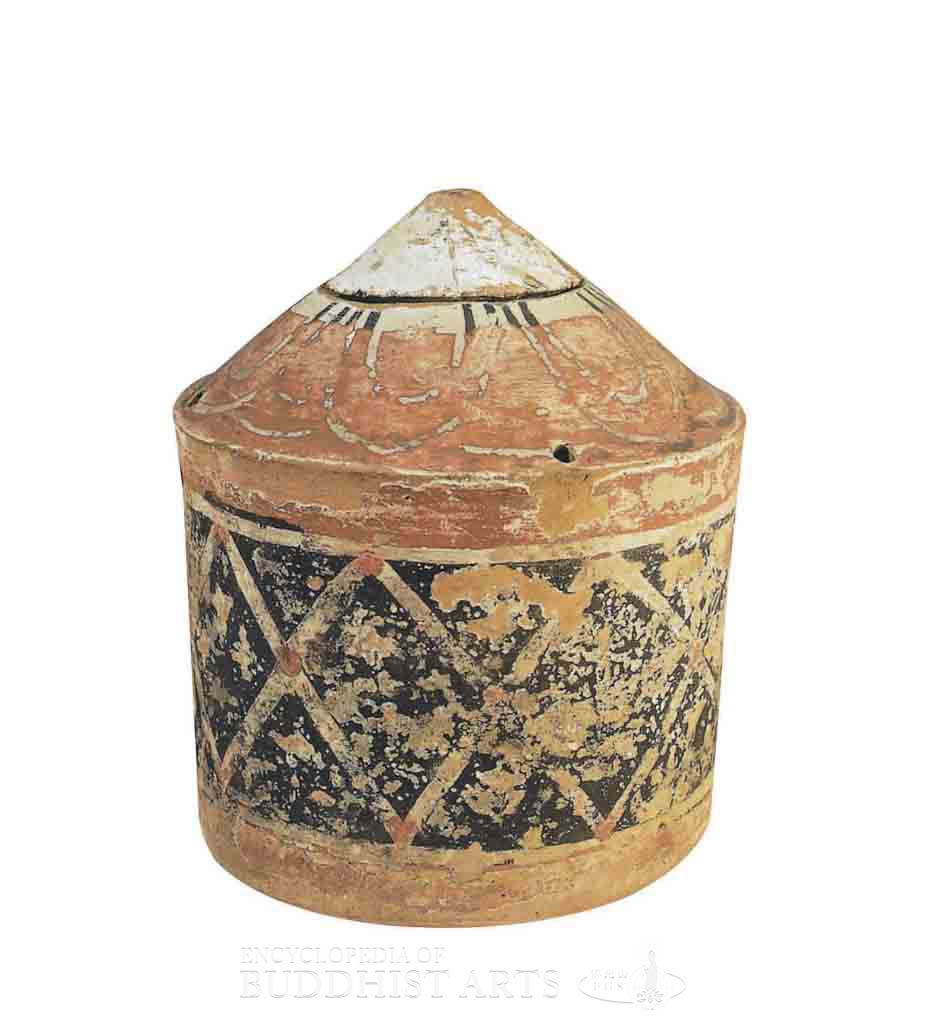
Qiudayitage: Reliquary
Earthenware
Qiudayitage: Reliquary
CHINA, Xinjiang, Kelpin
This 5th century clay reliquary was excavated from the Qiudayitage Castle in Kelpin, Xinjiang. It was originally used to store the ashes of a monk.
The cylindrical reliquary has a tightly sealed conical lid. The base is yellow, while the middle section is black with yellow diamond-shaped patterns marked with red dots where the lines cross; the upper section is a reddish color. The lower part of the lid is decorated with an inverted lotus pattern, while the upper part appears white with a brown ring below. It appears as if the decoration on the lid may have had a different color, but it has deteriorated. There are holes in the lid where it meets the body, so that a cord could be attached in order to carry the reliquary.
For more details, go to the Encyclopedia of Buddhist Arts: Artifacts, page 274.
Cite this article:
author = Hsingyun and Youheng and Youji and Pokorski, Stefanie and Mankuang and Fan, Wen,
booktitle = {Encyclopedia of Buddhist Arts: Artifacts },
pages = 274,
title = {{Qiudayitage: Reliquary}},
volume = 18,
year = {2016}}