
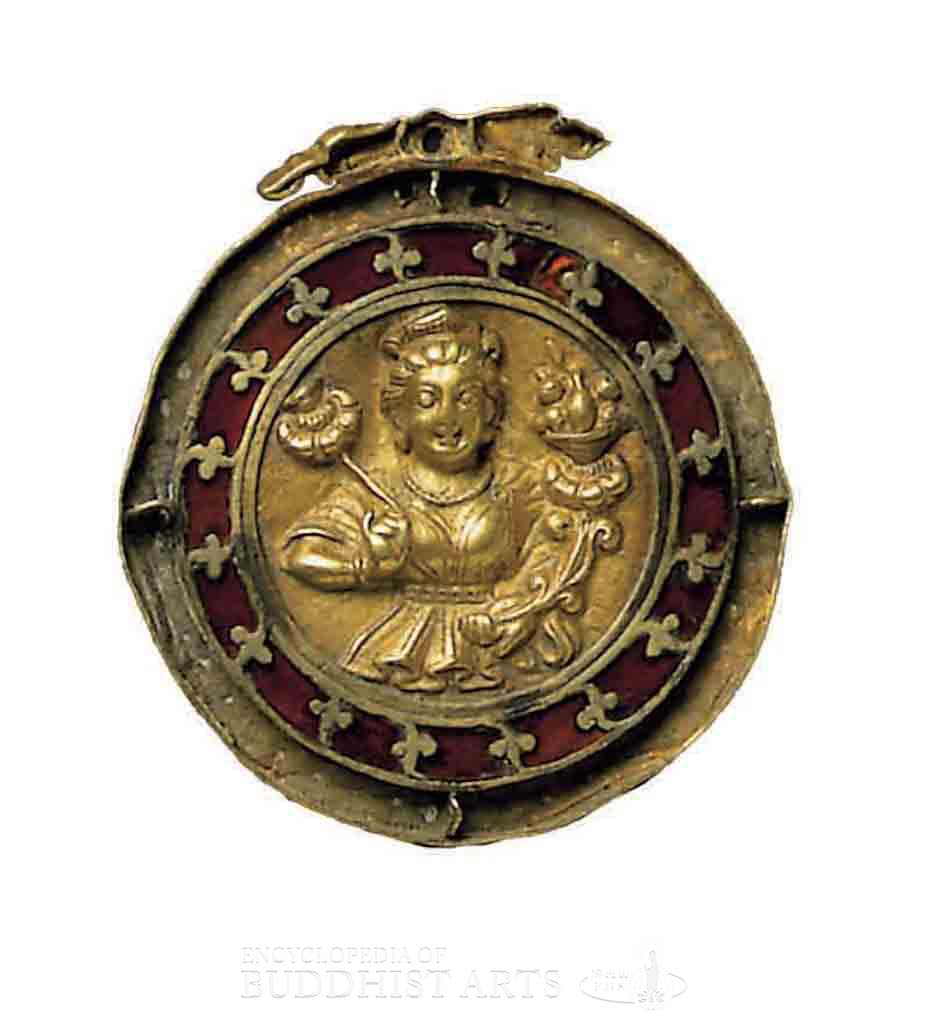
Pendant with Hariti (front)
Gold

Pendant with Hariti (back)
Pendant with Hariti
PAKISTAN; Kushan period
Hariti was originally a Hindu yaksa, who stole and devoured children. After the Buddha converted her to Buddhism, she became a patroness of children, protecting them from danger, disease, and other misfortunes. This Gandharan pendant was made in Pakistan around the 2nd century during the Kushan period. Hariti and her husband, Pancika were popular Buddhist themes in Gandharan art.
The gold pendant is round with an image of Hariti in the center. She is wearing a small diadem and her face is full. Also wearing a tunic with a belt and pleated hem, Hariti holds an open lotus in her right hand, while in her left she carries a cornucopia. The lower part of the cornucopia is a lotus and supports a cup filled with flowers, fruit, rice, and grains, signifying prosperity and wealth. The inner perimeter of the medallion is decorated with a band of thinly sliced cornelian with floral patterns. The outer perimeter has a groove which once held pearls, but they have been lost. At the top of the medallion is a floral bow with a hole for hanging. The reverse of the medallion is engraved with a fully open lotus of 12 petals.
For more details, go to the Encyclopedia of Buddhist Arts: Artifacts, page 218.
Cite this article:
author = Hsingyun and Youheng and Youji and Pokorski, Stefanie and Mankuang and Fan, Wen,
booktitle = {Encyclopedia of Buddhist Arts: Artifacts },
pages = 218,
title = {{Pendant with Hariti}},
volume = 18,
year = {2016}}