
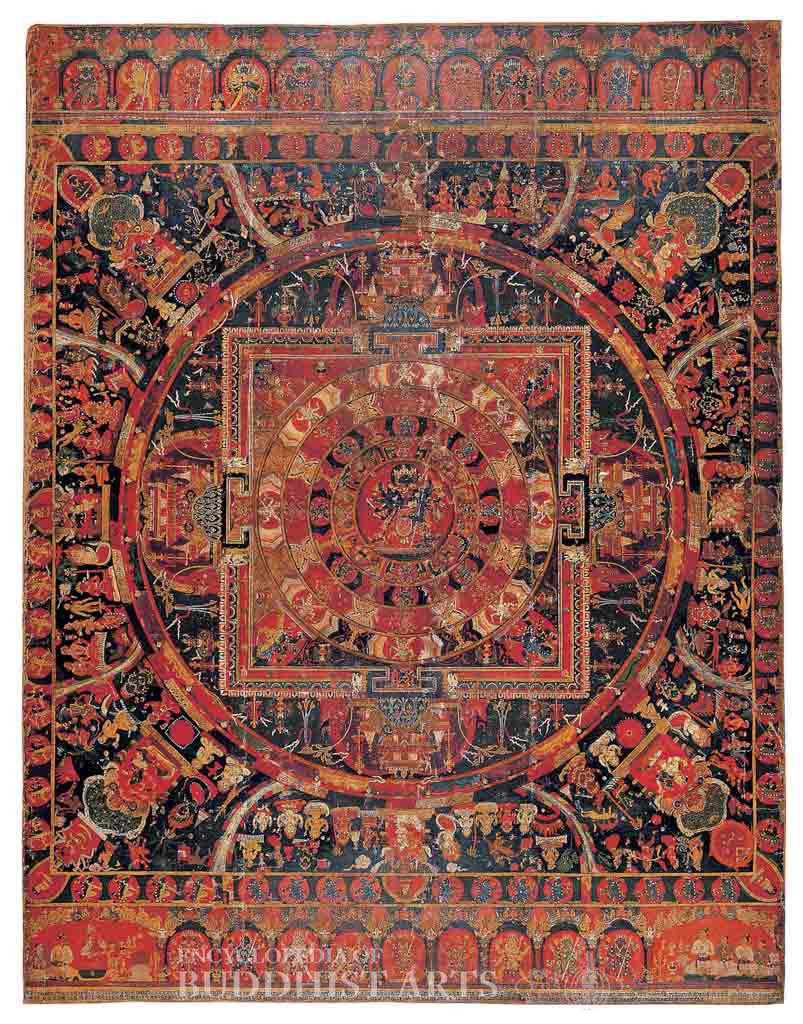
Kathmandu: Cakrasamvara Mandala
Ink and color on cotton
Kathmandu: Cakrasamvara Mandala
NEPAL, Kathmandu
An inscription at the bottom of this mandala dates it to 1648, names the donors led by Suryajoti who collectively commissioned the artwork, and states that it is dedicated to the material and spiritual benefit of all beings in the hope that they will attain final liberation from samsara.
The mandala’s main figure, the four-headed, twelve-armed Cakrasamvara, has blue skin and wears a crown of skulls. Cakrasamvara embraces his consort, the red Vajravarahi, and stands upon the black Bhairava and the red Kalaratri.
The central figures are surrounded by rings filled with small images of deities. In the innermost ring, known as the “circle of joy,” there are eight lotus petals, four of which contain four-armed dakinis. The second ring, the “circle of mind,” contains eight blue couples locked in embraces. In the third ring, the “circle of speech,” there are eight pairs of red deities. The last circle, the “circle of the body,” contains eight white figures. The rings are surrounded by a square representing a palace. In the four inner corners of the square, there are four more deities.
The four gates of the palace are guarded by four animal-headed goddesses. A circle containing images of lotuses and a ring of fire is painted around the palace. The eight Mahasitavatis are enclosed between the circle and the square outermost border, separated from one another by curved bands that represent rivers. The Mahasitavatis, each accompanied by a consort, sit within decorative niches surrounded by small figures. Around the border of the outer square, there are images of eight Buddhas and sixty-four Dharma protectors.
Thirteen deities are depicted along the top of the image, and along the bottom there is a row of nine goddesses. In the bottom corners, a priest is shown performing the homa, a tantric ritual. This exceptionally detailed mandala is well ordered despite its complexity.
For more details, go to the Encyclopedia of Buddhist Arts: Painting I-O, page 412.
Cite this article:
author = Hsingyun and Youheng and Youlu and Wilson, Graham and Manho and Mankuang and Huntington, Susan,
booktitle = {Encyclopedia of Buddhist Arts: Painting I-O},
pages = 412,
title = {{Kathmandu: Cakrasamvara Mandala}},
volume = 15,
year = {2016}}